
 Denmark
The Hulbjerg Passage Grave (Danish: Hulbjerg Jættestue) is a passage grave located at the southern end of the Danish island Langeland, situated on a 15-meter hill south of the ferry harbour Bagenkop [1]. Dating back to 3300–3200 BCE, it is part of the Neolithic Funnelbeaker culture [1]. The grave consists of a chamber and a separate lateral passageway [1]. The rectangular grave chamber is embedded in a round barrow of about 20 m diameter, framed by a ring of stones [1]. The walls of the 6.5 x 1.7 metre chamber consist of 13 large uprights, tightly compacted with a fine wall of hewn stone tiles [1]. On the southern wall of the chamber, vertical stone plates form a separate section [1]. In 1960, the grave was excavated by one of Europe's leading experts in late Stone Age burials, Håkon Berg of the Langeland Museum [1]. In the separate section in the grave chamber, sharpened flint axes and chisels, flint daggers, transverse arrowheads, decorated ceramics, amber beads as well as heaps of bones of 36 adults and 17 children were found [1].
Text: Wikipedia – 'Hulbjerg Passage Grave' (revision of 2026-07-18), CC BY-SA 4.0 · sentences selected and shortened by an AI system · source →Hulbjerg Passage Grave
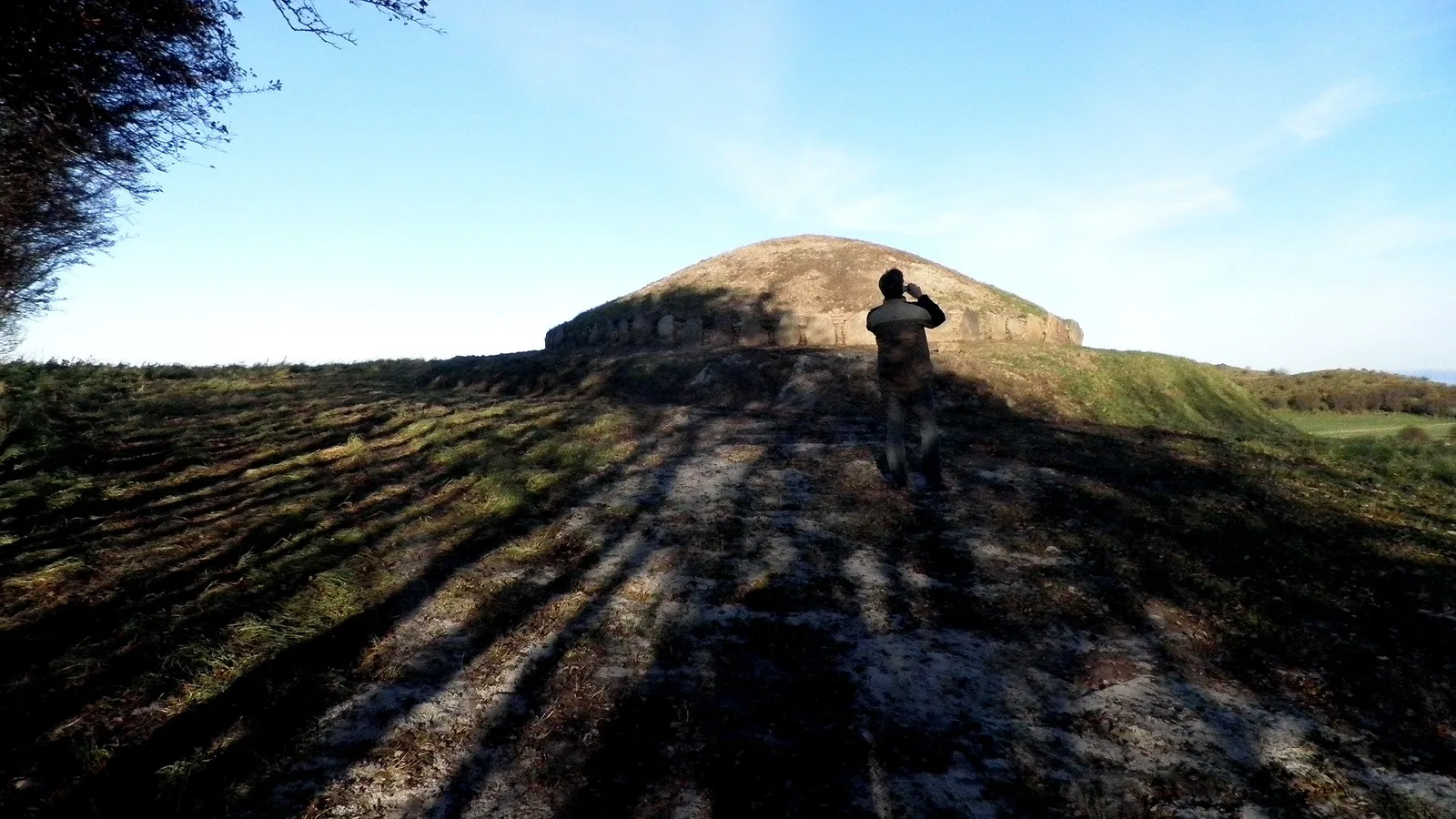
Also known as: Ganggrab von Hulbjerg, Holbjerg, Hügelgrab von Hulbjerg, Hulbjerg Hügelgrab, Hulbjerg Jættestue
| Type | Necropolis/tombs complex |
|---|---|
| Period | 4500 - 3000 BC |
| Country | Denmark |
| Coordinates | 54.7362° N, 10.6847° E |