
 Scotland
The Tomb of the Eagles, or Isbister Chambered Cairn, is a Neolithic chambered tomb located on a cliff edge at Isbister on South Ronaldsay in Orkney, Scotland [1]. The site was discovered by Ronald Simison when digging flagstones in 1958; he conducted a limited excavation and removed some bones and skulls at that time but filled in the site with dirt [1]. A more extensive excavation was started in 1976, and "an enormous amount of material was removed", according to a report published in 2002 [1]. At the site, 16,000 human bones have been found, from at least 324 individuals, but no intact skeletons [1]. Mixed with the human bones were talons and bones from eight to 20 birds [1]. Some believed that the eagle was a totem animal for the individuals entombed here, but subsequent research indicated that the bird artifacts were added at a later time [1]. These were identified as predominantly belonging to the white-tailed sea eagle (Haliaeetus albicilla) [1].
Text: Wikipedia – 'Tomb of the Eagles' (revision of 2026-08-27), CC BY-SA 4.0 · sentences selected and shortened by an AI system · source →Tomb of the Eagles
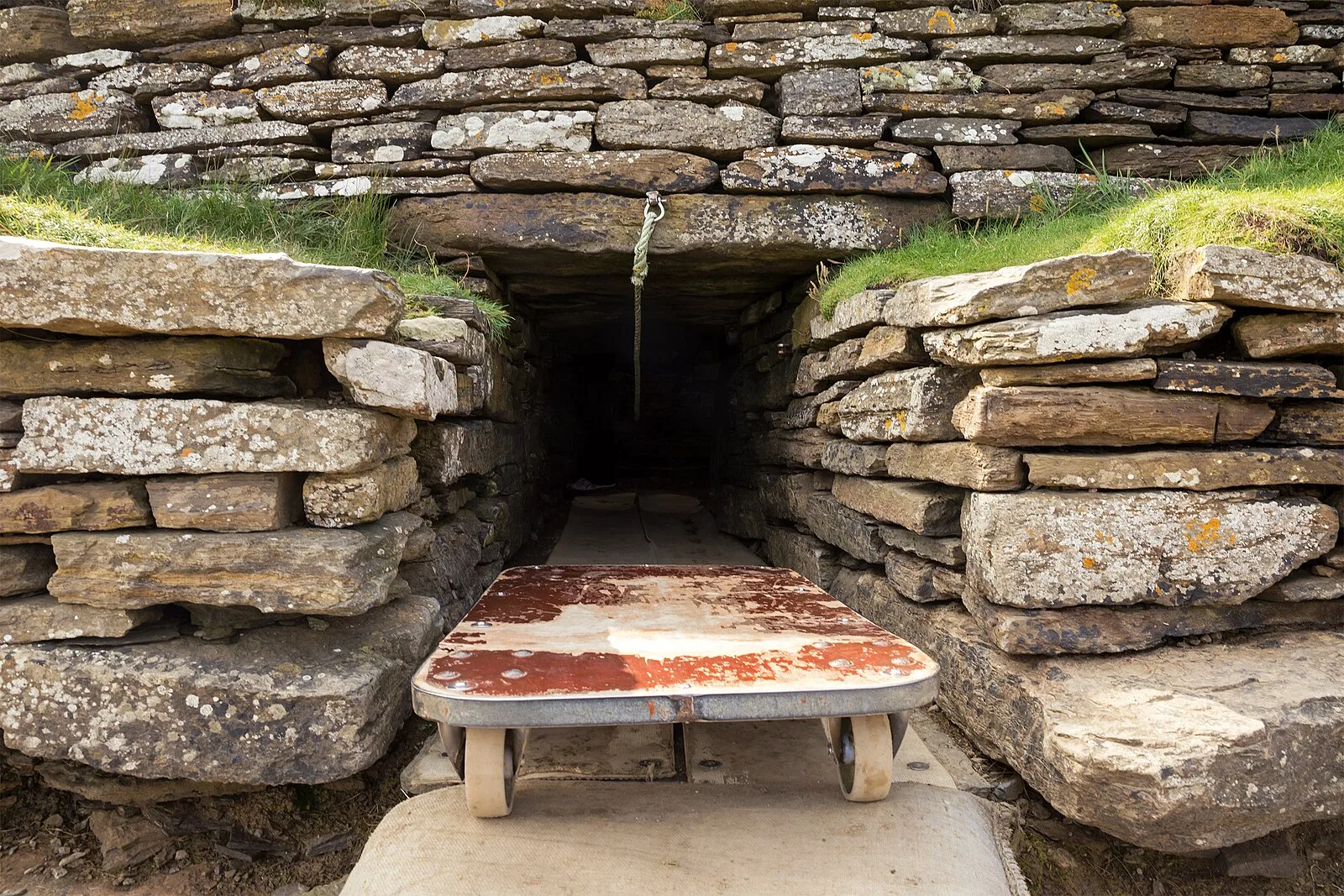
Also known as: Bedd yr Eryrod, Isbister Cairn, Isbister Chambered Cairn, Kairno de Isbister, Tomba de les Àguiles, Tumba das Águias, Tumba de las Águilas, Τάφος των Αετών, Гробница орлов, タカの墓
| Type | Cairn |
|---|---|
| Period | 4500 - 3000 BC |
| Country | Scotland |
| Coordinates | 58.7451° N, 2.9170° W |