
 Jordan
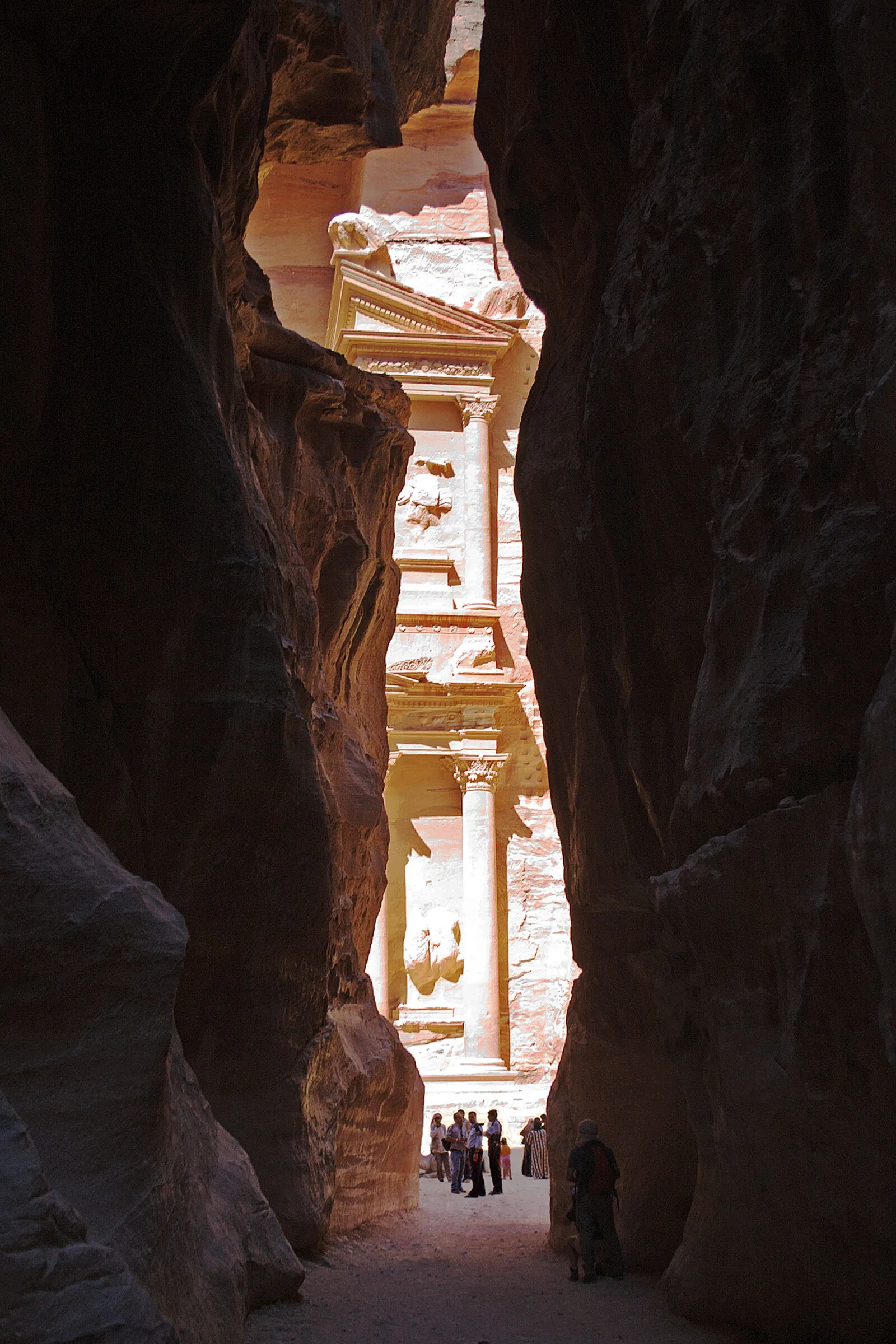
The Siq is the main entrance to the ancient Nabatean city of Petra in southern Jordan [1]. Also known as Siqit, it is a dim, narrow gorge (in some points no more than 3 metres (10 ft) wide) and winds its way approximately 1.2 kilometres and ends at Petra's most elaborate ruin, Al-Khazneh [1]. Unlike slot canyons such as Antelope Canyon in the American Southwest, which are directly shaped by water, the Siq is a natural geological fault split apart by tectonic forces; only later was it worn smooth by water [1]. The walls that enclose the Siq stand between 91–182 metres in height [1]. The entrance to the Siq contains a huge dam designed to bar the mouth of the Siq and reroute the waters of Wadi Musa [1]. The dam is a fairly true reconstruction of what the Nabataeans did to control Wadi Musa between the 1st century BC and the beginning of the 1st century AD [1]. The entrance also contains the remnants of a monumental arch, of which only the two abutments and some hewn stones of the arch itself have survived [1].
Text: Wikipedia – 'Siq' (revision of 2025-12-22), CC BY-SA 4.0 · sentences selected and shortened by an AI system · source →al-Siq
Also known as: As-Sik, As Sīq, As Sīq (lugut sa Hordan), Sik, Siq, Siq (Petra), Siq峽谷, Сик, السيق, السيق as-Siq, سیق, সিক
| Type | Natural feature |
|---|---|
| Period | 500 BC - 1 AD |
| Country | Jordan |
| Coordinates | 30.3233° N, 35.4565° E |