
 Thailand
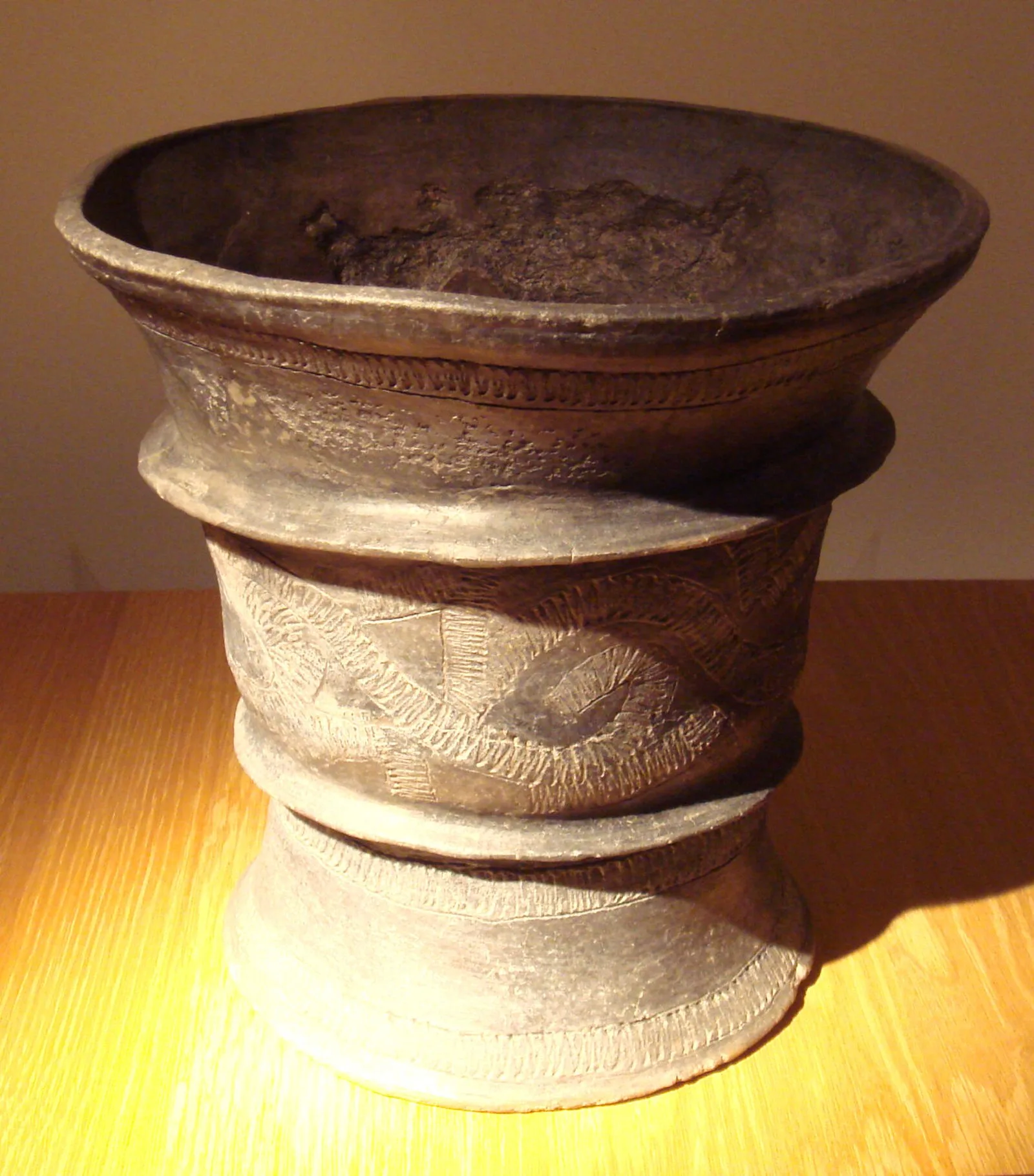
Ban Chiang is an archaeological site in Nong Han district, Udon Thani province, Thailand [1]. It has been a UNESCO World Heritage Site since 1992 [1]. Discovered in 1966, the site first attracted interest due to its ancient red-painted pottery [1]. The site's oldest graves do not include bronze artifacts and are therefore from a Neolithic culture; the most recent graves date to the Iron Age [1]. The first intensive excavation of Ban Chiang was a joint effort by the University of Pennsylvania Museum and the Thai Department of Fine Arts [1]. Recovered bronze objects include bracelets, rings, anklets, wires and rods, spearheads, axes and adzes, hooks, blades, and little bells [1]. At least 142 discrete burials were found in the 1974-1975 excavations [1]. Analysis of the human remains by Michael Pietrusewsky and Michele Toomay Douglas revealed that the people lived a vigorous and active lifestyle with little evidence of interpersonal violence or any form of warfare [1].
Text: Wikipedia – 'Ban Chiang' (revision of 2026-09-20), CC BY-SA 4.0 · sentences selected and shortened by an AI system · source →Ban Chiang
Also known as: 반치앙, 반치앙 문화, 반치앙 유적, 반 치앙, Bānčhīana, Ban Ĉiang, Bančiang, Bancsiang, Sítio Arqueológico de Ban Chiang, Μπαν Τσιάνγκ, Археологический памятник Банчианг, Банчианг
| Type | City/town/settlement |
|---|---|
| Period | 1500 - 500 BC |
| Country | Thailand |
| Coordinates | 17.4072° N, 103.2415° E |