
 France
The Carnac stones are an exceptionally dense collection of megalithic sites near the south coast of Brittany in northwestern France, consisting of stone alignments, dolmens, tumuli, and single menhirs [1]. Most of the stones are within the Breton municipality of Carnac, but some to the east are within neighboring La Trinité-sur-Mer [1]. The standing stones are made of weathered granite from local outcroppings that once extensively covered the area [1]. Three exceptionally large burial mounds are known from the Carnac and Morbihan area, dating from the mid-5th millennium BC and known collectively as 'Carnacéen tumuli': Saint-Michel, Tumiac and Mané-er-Hroëk [1]. Each of these tumuli contained a megalithic burial chamber, containing the burial of only one individual, along with numerous large polished stone axeheads, stone arm-rings, and jewellery made from callaïs [1]. Scientific analyses have shown that many of the axeheads are made of jade from the Italian Alps, whilst the callaïs was imported from south-western Iberia [1].
Text: Wikipedia – 'Carnac stones' (revision of 2026-08-19), CC BY-SA 4.0 · sentences selected and shortened by an AI system · source →Carnac Stones
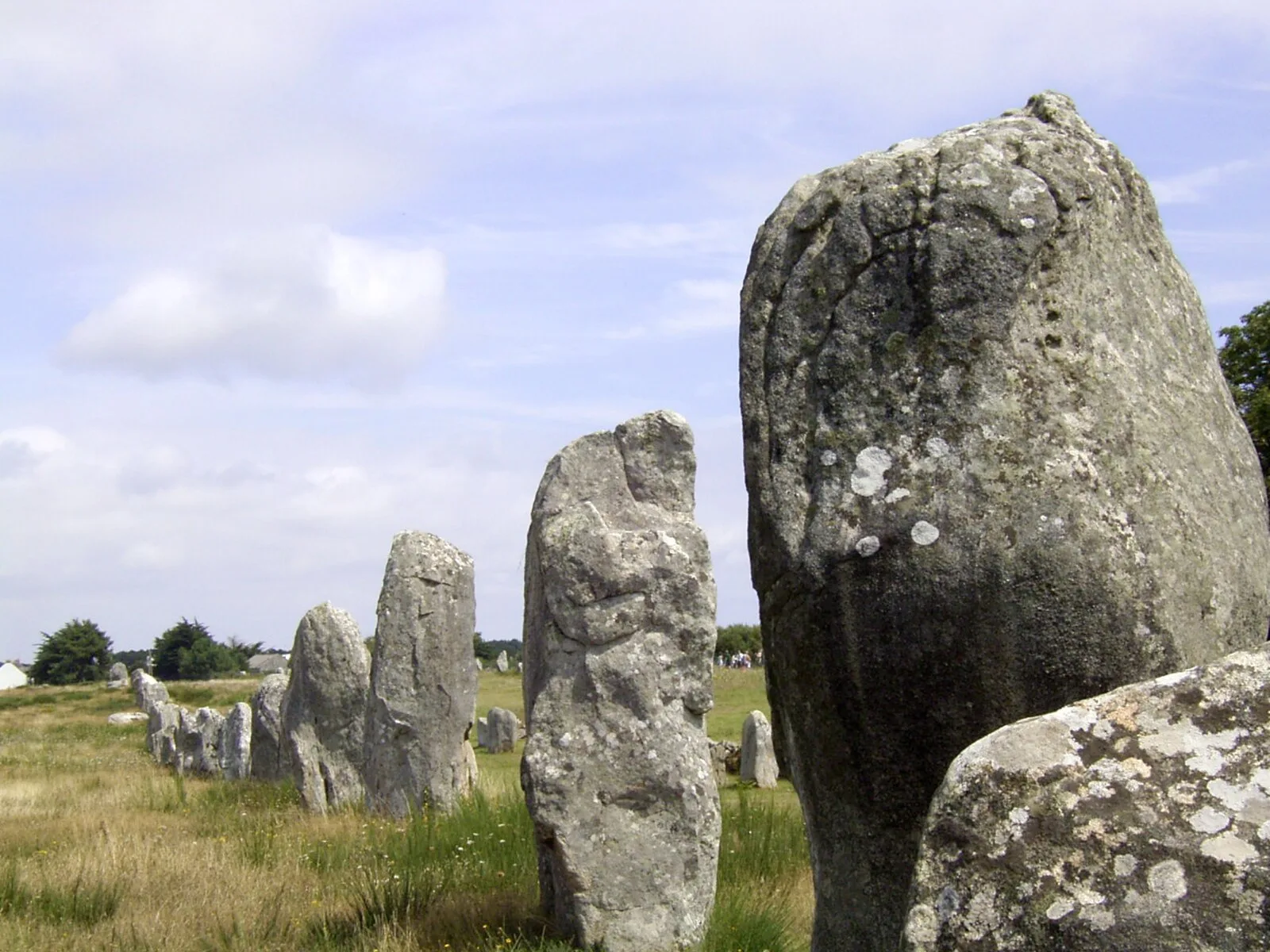
Also known as: 카르나크 열석, alignements de Carnac, Aliñamentos de Carnac, alineaments de Carnac, Alineamientos de Carnac, Allineamenti di Carnac, Alliniamientos de Carnac, Batu Carnac, Carnac, Carnac-eko harri lerroak, carnaci kősorok, Carnacin menhirit
| Type | Megalithic stones |
|---|---|
| Period | 4500 - 3000 BC |
| Country | France |
| Coordinates | 47.5927° N, 3.0820° W |