
 China
ChinaThe earliest history of the creation of Longmen Grottoes is traced to the reign of Emperor Xiaowen of Northern Wei dynasty when he shifted his capital to Luoyang from Datong; Luoyang's symbolic value is borne by the fact that it served as the historic capital for 13 dynasties [1]. The site was subjected to significant vandalism after the fall of the Qing dynasty [1]. The Longmen Grottoes represent a critical period in the evolution of Chinese Buddhist sculpture [1]. Scholarly analysis of the site's Buddhist imagery, particularly from the Northern Dynasties to the Tang dynasty, has revealed a gradual synthesis of imported Central Asian artistic conventions with indigenous Chinese aesthetic traditions [1]. Guyangdong, or Guyang Cave, or Old Sun Cave, is recorded as the oldest Longmen cave with carvings in the Northern Wei style [1]. Also found here are 600 inscriptions in fine calligraphy of writings in the Northern Wei style [1].
Text: Wikipedia – 'Longmen Grottoes' (revision of 2026-07-26), CC BY-SA 4.0 · sentences selected and shortened by an AI system · source →Longmen Grottoes
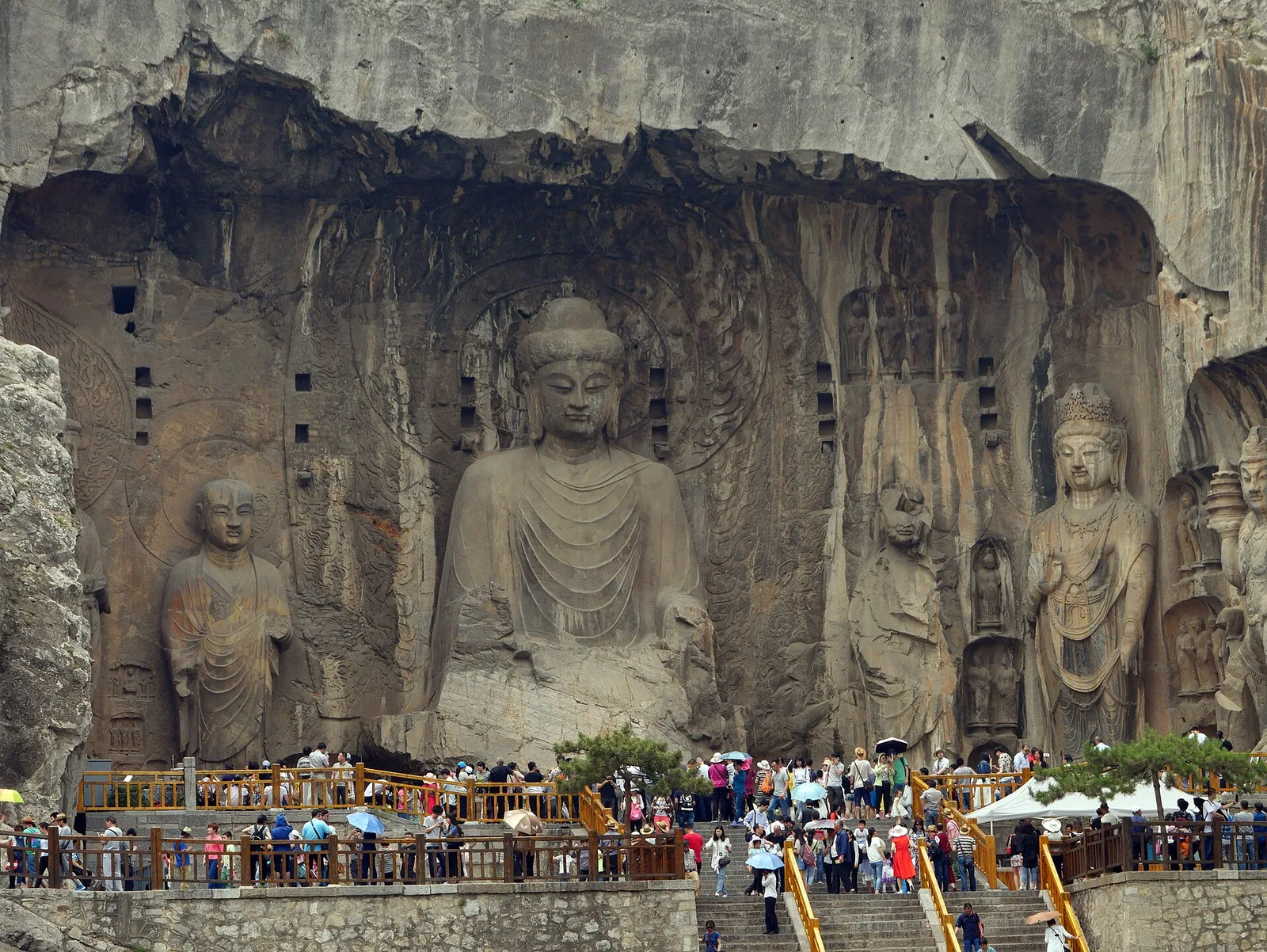
Also known as: 룽먼석굴, 용문석굴, 용문석불, 룽먼 석굴, Covarones de Longmen, Grotele Longmen, Grotte di Longmen, Grotten van Longmen, grottes de Longmen, Grotti ta' Longmen, Groty Dziesięciu Tysięcy Buddów, Grutas de Longmen
| Type | Cave Structures |
|---|---|
| Period | 1 - 500 AD |
| Country | China |
| Coordinates | 34.5597° N, 112.4679° E |