 ANCIENT NERDS
The Egyptian Hard-Stone Precision Debate
This paper concludes that mainstream explanations of ancient Egyptian hard-stone working — copper tools charged with quartz sand or emery, tubular drilling with bow or flywheel drive, and free-abrasive sawing — remain adequate to account for the precision found on artifacts like Serapeum sarcophagi, Dynastic IV drill cores, and granite vases, without invoking lost machining technology. A 2025 peer-reviewed Keyence VL-500 study by Fomitchev and Zamilov found 19 predynastic vessels cluster with modern handmade carvings on overall manufacturing quality, directly undercutting claims of universally machine-like precision, and the paper further argues that supposedly anomalous features such as Core #7's spiral grooves and Dunn's serapeum straight-edge measurements have plausible abrasive-based reinterpretations. The most celebrated "super-precise" vases promoted in alternative-research circles are dismissed as likely early-20th-century forgeries lacking documented archaeological provenance.
Deep beneath the sand at Saqqara, twenty-four monolithic sarcophagi hewn from red, grey, and black granite — and from granodiorite, diorite, gabbro-diorite, and syenite porphyry — sit in the rock-cut vaults of the Serapeum, their interiors flat enough to carry a polish and their internal corners meeting at right angles, while their exteriors were finished with polish applied over pre-existing damage. These boxes, commissioned from the 26th Dynasty under Psamtik I and lowered into place by winches, rollers, levers, and a sand-filling technique, were produced by the same culture whose Great Pyramid Flinders Petrie walked in 1883, recording a base level within 2.1 centimeters and sides differing by no more than 4.4 centimeters — measurements that mainstream Egyptology, including Zahi Hawass, still treats as foundational. [1]
The same craftsmen drilled paired holes in a Dynasty IV granite sarcophagus lid at the Brooklyn Museum, dated to about 2500 BC, that narrow only from 5.3 to 4.3 centimeters across 24 centimeters of depth — a 4% taper consistent with a flywheel-driven tubular drill — and left corundum residue in cores at the Great Aten Temple at Amarna, with a separate corundum deposit documented at Wadi Hafafit confirming the harder-than-quartz abrasive was physically available. Experimental archaeologist Denys Stocks has spent more than 20 years demonstrating that copper tools charged with quartz sand can saw, drill, and abrade granite at rates consistent with the artifact marks, and a 1983 Penn Museum replication by Gorelick and Gwinnett showed that loose emery with a copper tube reproduces the concentric cutting lines on ancient drill cores while loose quartz sand does not — partly settling a debate Petrie had launched a century earlier. Yet a 2025 peer-reviewed study by Fomitchev and Zamilov in npj Heritage Science, using Keyence VL-500 structured-light scanning on 19 Petrie Museum predynastic vessels, found the cluster lands with modern handmade alabaster carvings on overall manufacturing quality, undercutting claims of universally machine-like precision. [2]
Petrie’s Measurements and the Great Pyramid Baseline
In 1883, W.M. Flinders Petrie published The Pyramids and Temples of Gizeh through the Royal Society, establishing the dataset that still anchors precision debates today. His systematic survey of the Great Pyramid recorded the four corner sockets as deviating by a mean error of approximately 0.65 inches — a figure Petrie himself emphasized applied to the sockets, not the surviving casing stones. The base sides he tabulated ran 755.76 feet (west), 755.41 feet (north), 755.87 feet (east), and 756.08 feet (south), with corner angles deviating from a true right angle by minutes of arc rather than degrees. Across the ~230-meter base, the maximum side-to-side difference came in under 4.4 centimeters, and the entire platform sat level within roughly 2.1 centimeters. Petrie derived a Royal Cubit value of 20.632 ± 0.004 Imperial British inches primarily from the King’s Chamber dimensions, a number that has remained the accepted length in mainstream Egyptology since. [3]
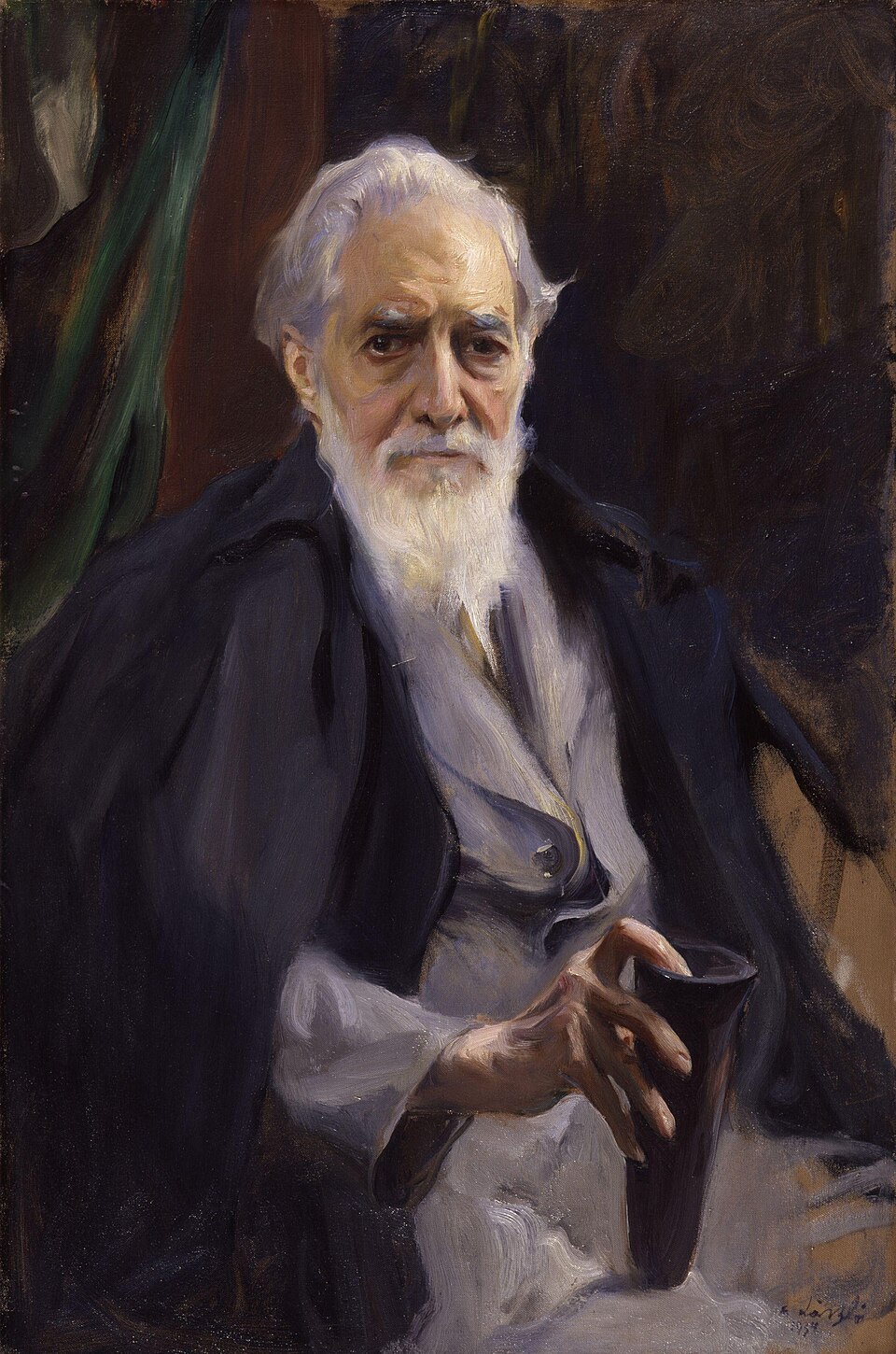
Illustration: Sir William Matthew Flinders Petrie by Philip Alexius de László. Photo: Philip de László / Wikimedia Commons. Identifying Petrie visually establishes the surveyor whose 1883 dataset remains the baseline; a portrait anchors…. Source

Sir (William Matthew) Flinders Petrie by George Frederic Watts. Photo: George Frederic Watts / Wikimedia Commons. Identifying Petrie visually establishes the surveyor whose 1883 dataset remains the baseline; a portrait anchors…. Source
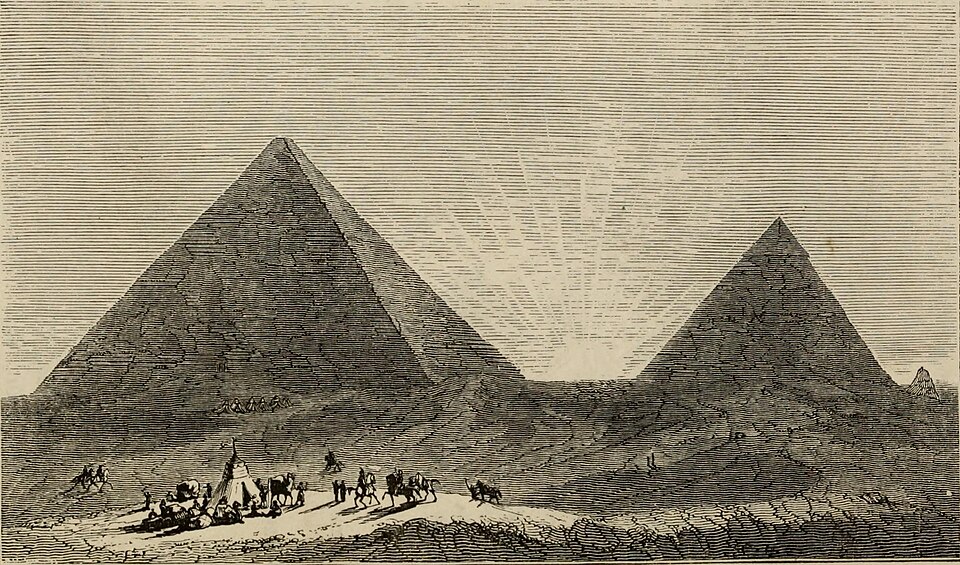
Illustration: Handbook of archaeology, Egyptian - Greek - Etruscan - Roman (1867). Photo: Internet Archive Book Images / Wikimedia Commons. The King’s Chamber dimensions are the empirical source of the Royal Cubit value cited in…. Source
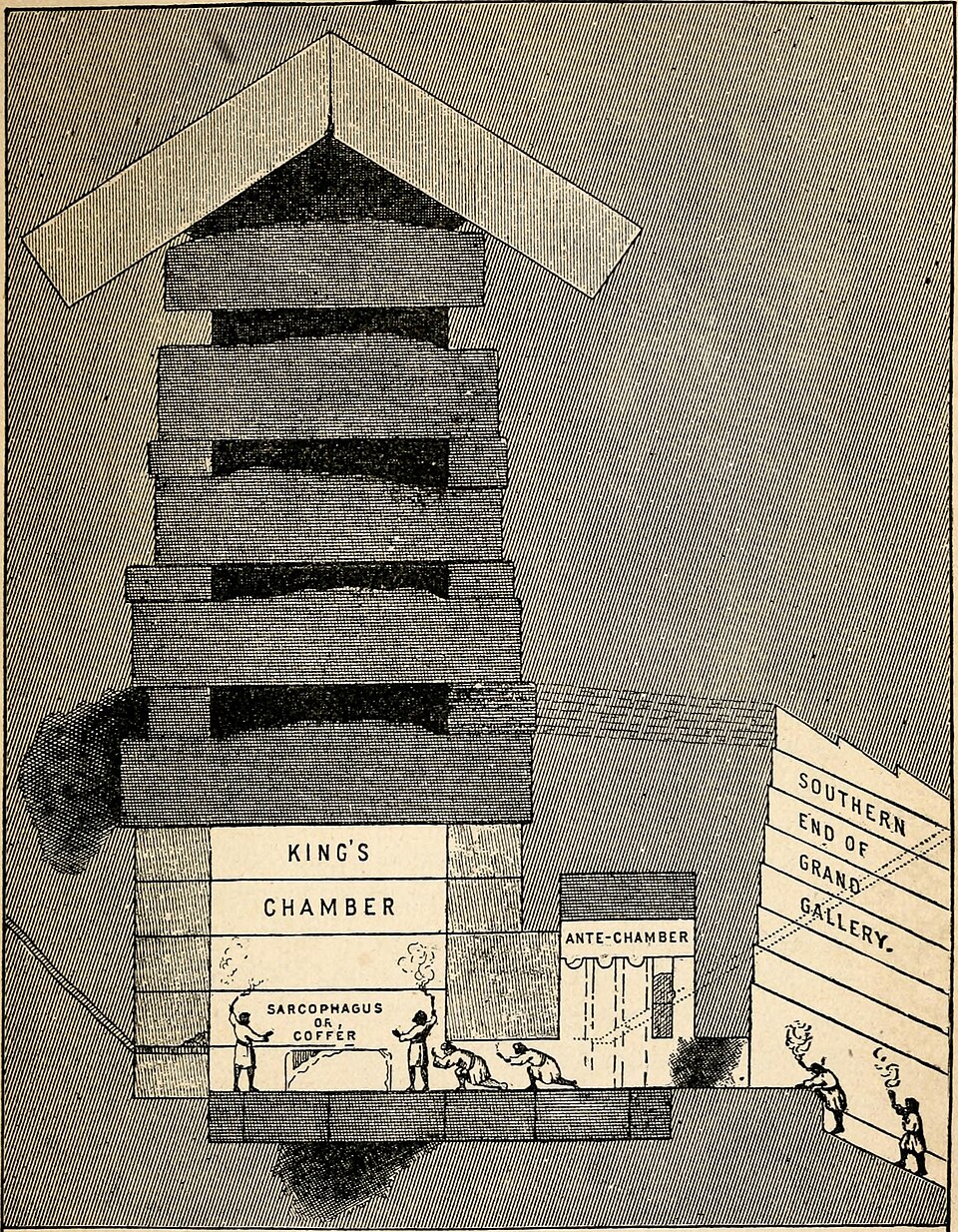
Millennial dawn (1891). Photo: Internet Archive Book Images / Wikimedia Commons. The King’s Chamber dimensions are the empirical source of the Royal Cubit value cited in…. Source
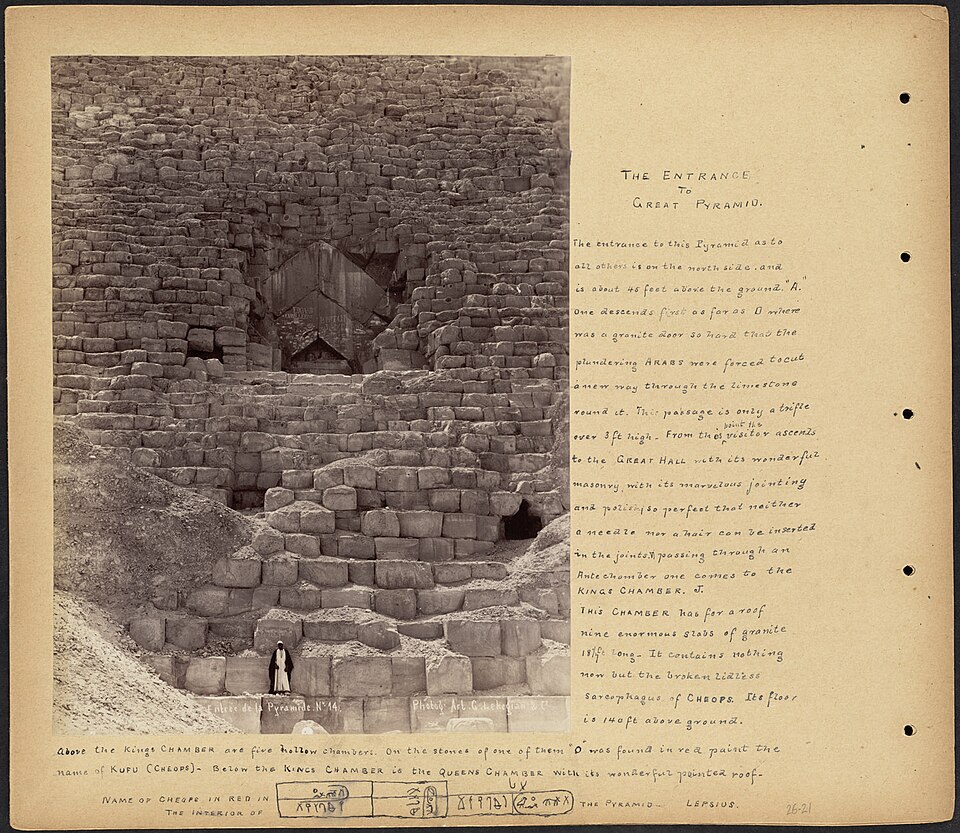
The Entrance to Great Pyramid by Boston Public Library. Photo: William Vaughn Tupper Flickr uploader BPL / Wikimedia Commons. The King’s Chamber dimensions are the empirical source of the Royal Cubit value cited in…. Source
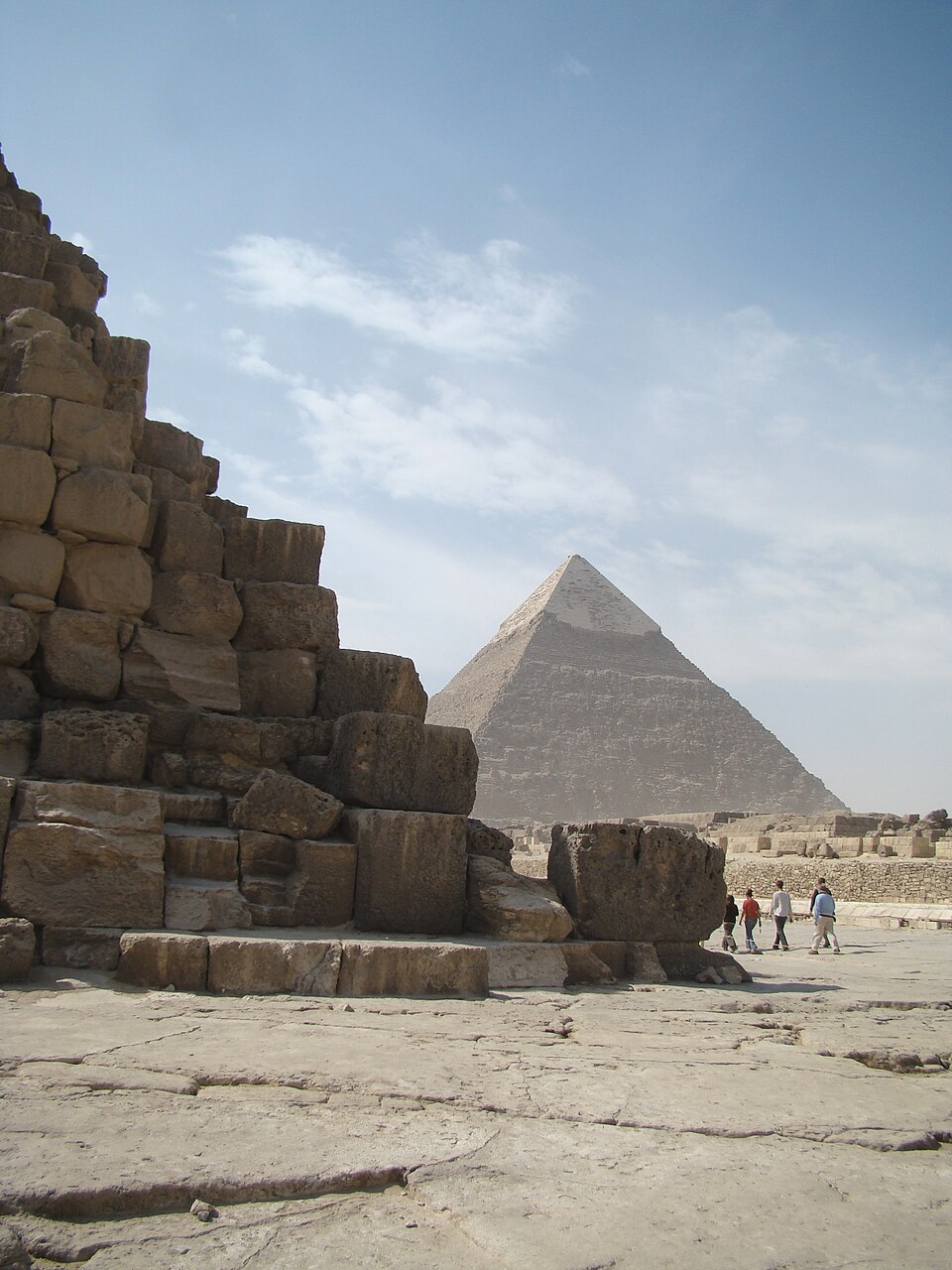
Khafre’s Pyramid Complex (I). Photo: Institute for the Study of the Ancient World / Wikimedia Commons. This is a photo of a monument in Egypt identified by the ID. Source
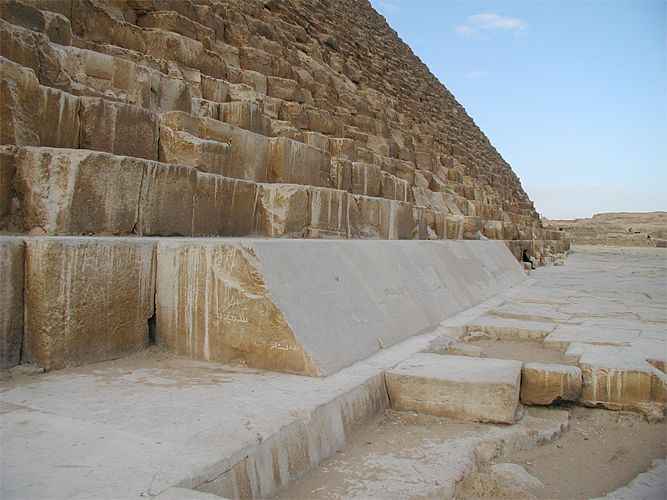
Cheops pyramid 02. Photo: Jon Bodsworth / Wikimedia Commons. Original casing stones at the base of the north face of the pyramid. Source
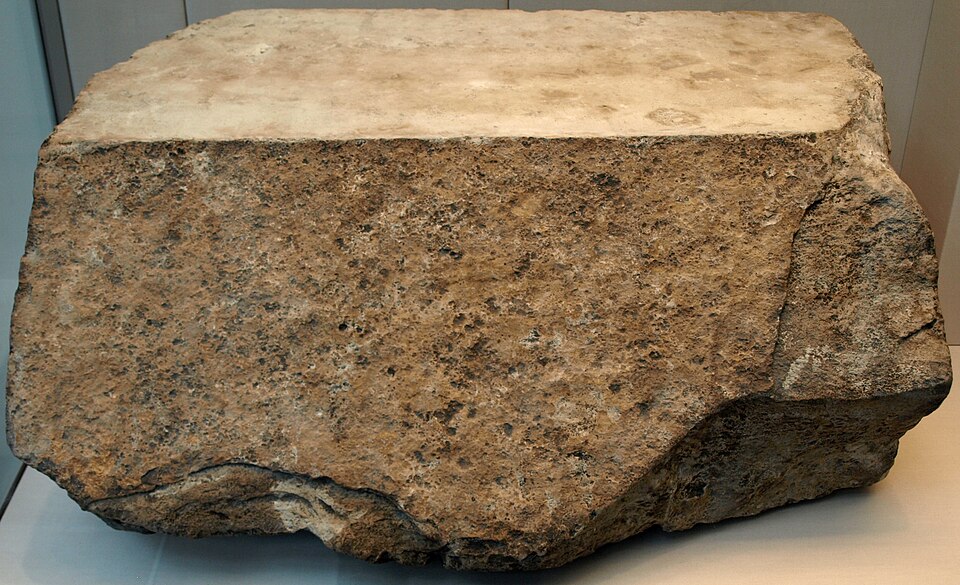
KhufuPyramidCasingStone-BritishMuseum-August19-08. Photo: CaptMondo / Wikimedia Commons. Source
Forty-two years later, J.H. Cole mounted a 1925 Survey of Egypt re-measurement using 24-metre standardized invar wires with stated accuracy of 1 in 500,000, combined with a 6-inch Troughton & Simms micrometer theodolite on Polaris observations. His side lengths came in at North 230.253 m, South 230.454 m, East 230.391 m, and West 230.357 m — a maximum difference of 0.201 m, slightly larger than Petrie’s spread. Cole recorded corner angles within ±3 arc-minutes of 90° and found the foundation pavement “practically flat,” with only ~15 mm of slope running from the northwest to the southeast corner across the entire base. The 1926 Nature paper by F.S. Richards directly compared the two surveys, concluding that Petrie’s measurements “compared unfavourably” with Cole’s in precision. Petrie himself publicly criticized the Cole results — a dispute between mainstream surveyors that proved foundational accuracy could be contested even within accepted Egyptology. Jürgen Dorner’s 1981 laser survey, with Mark Lehner participating, then produced a third independent measurement falling between the two: N 230.328 m, E 230.369 m, S 230.372 m, W 230.372 m — a total perimeter of 921.441 m (36,277.2 British inches) inside the overlapping error margins of both earlier campaigns. [4]
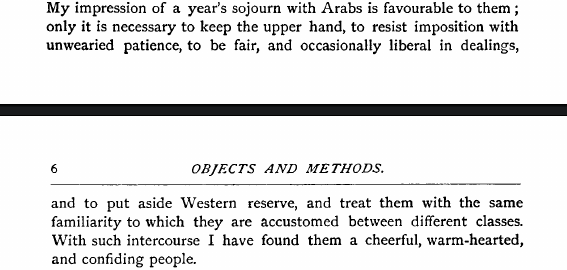
Illustration: Petrieonthearabs. Photo: Temerarius / Wikimedia Commons. Petrie on intercourse with Arabs, “The Pyramids and Temples of Gizeh,” 1883, pp 5-6. Source

Illustration: B-1B Giza Pyramids. Photo: U.S. Air Force photo / Wikimedia Commons. The paragraph hinges on the four corner measurements (N/S/E/W) and the NW-to-SE 15 mm pavement…. Source
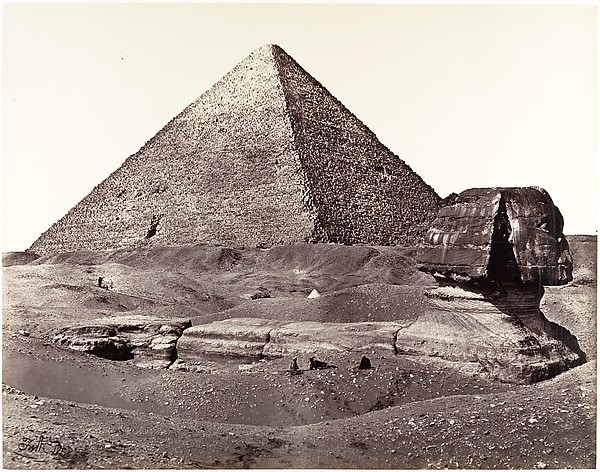
Illustration: The Great Pyramid and The Great Sphinx. Photo: Francis Frith / The Met / Open Access. Source
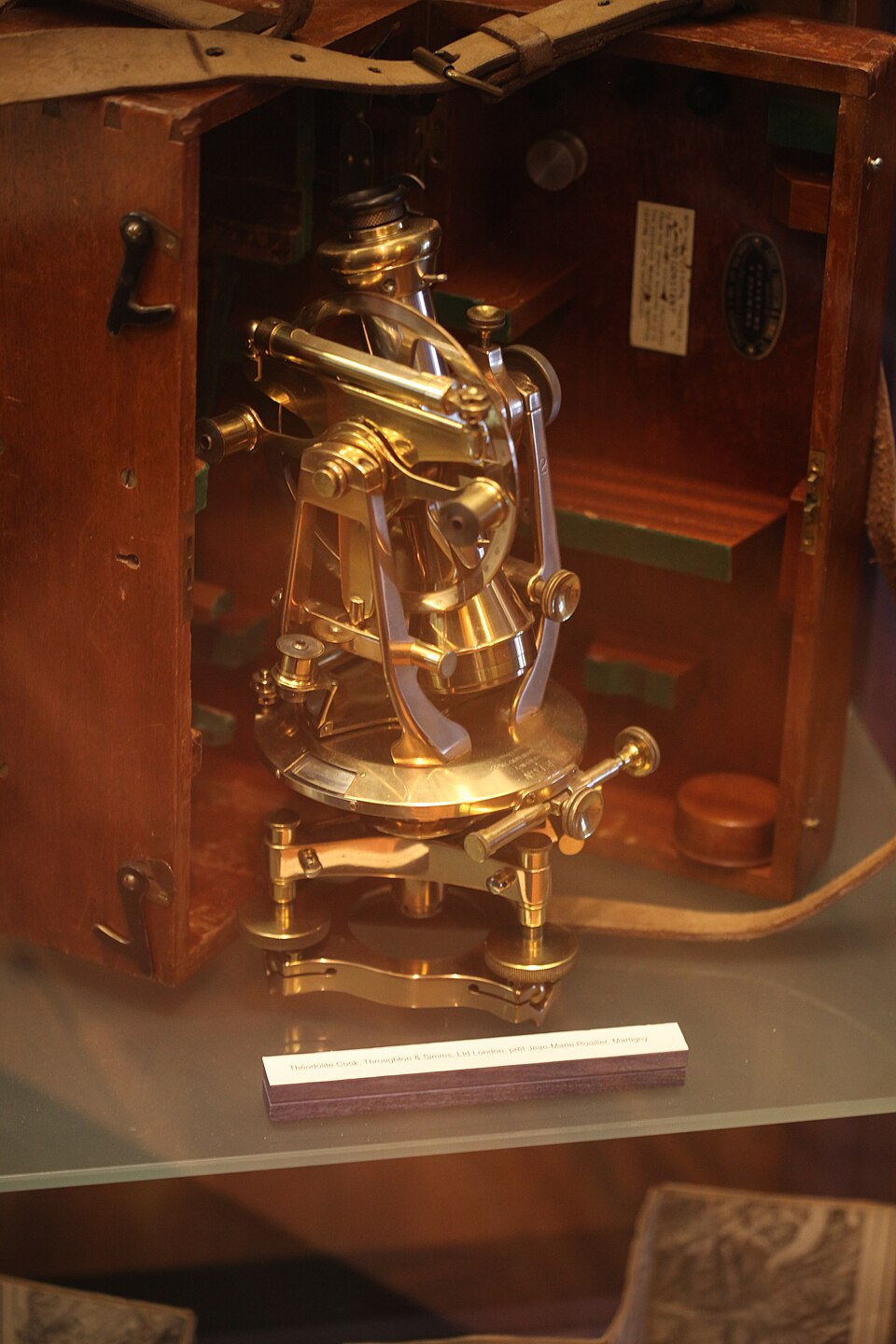
Theodolite IMG 5065. Photo: Rama / Wikimedia Commons. Theodolite made by Cooke, Troughton & Simms. On display at Sion History museum. Source
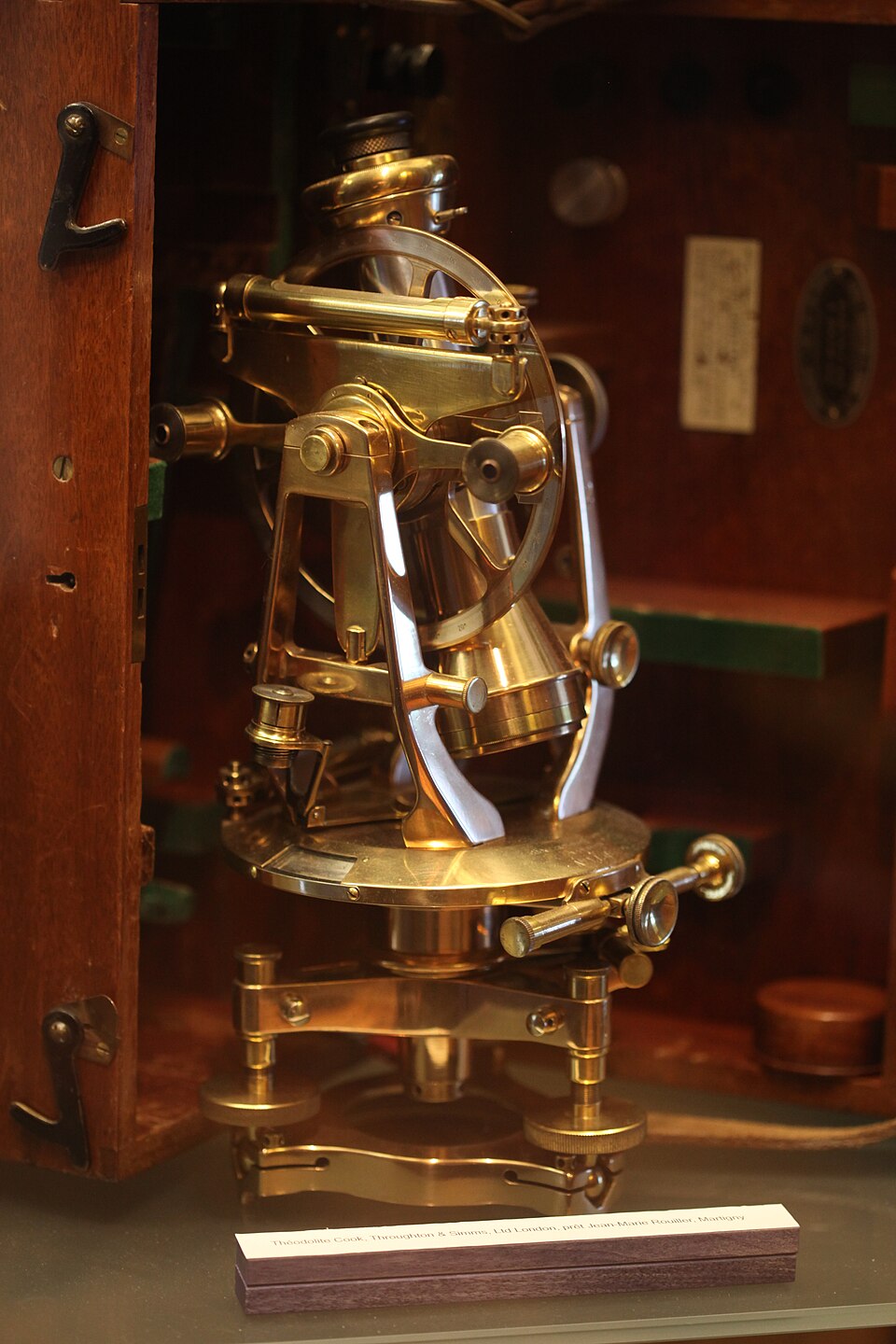
Theodolite IMG 5063. Photo: Rama / Wikimedia Commons. Theodolite made by Cooke, Troughton & Simms. On display at Sion History museum. Source
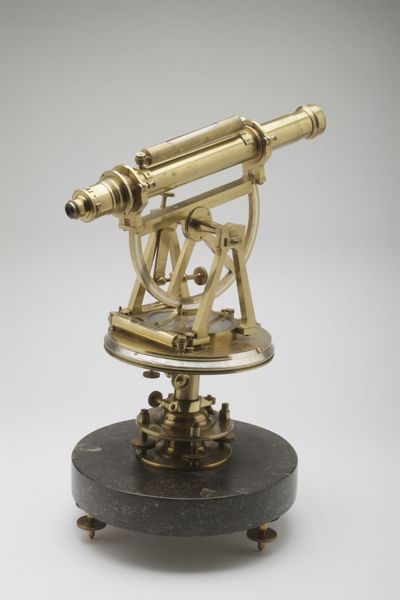
Theodolite. Photo: Wenckebach, E.; Amsterdam / Europeana. Source
The slope of the Great Pyramid was specified in Egyptian mathematics as a seked — horizontal palms per cubit of vertical rise — with the formula seked = 7/m = 7·cot(φ). Khufu’s pyramid used a seked of 5½ palms, corresponding to an elevation angle of 51°50‘40” (51.84°). Petrie’s measurements of surviving casing stone fragments converged on this value, consistent with the 5½-palm seked preserved in surviving casing block fragments. The fine white Tura limestone casing was laid at this same angle as the core masonry, though most blocks have been stripped for reuse across the centuries. The slope system was not arbitrary: Greenberg’s probabilistic analysis shows that under the Egyptian cubit-palm-finger system (1 cubit = 7 palms = 28 digits), the natural slopes for 4th-Dynasty pyramids cluster near integer-fraction values with denominator 28 — 20/28 (Bent Pyramid), 21/28 (Khafre), 22/28 (Khufu) — making the appearance of π as a side-effect rather than an intentional encoding. [5]
Three independent base-perimeter surveys now bracket the same value within their respective error margins: Petrie’s 1881 measurement of 36,275.2 British inches (±2.4 in), Cole’s 1925 value of 36,277.76 inches (±2.44 in), and Dorner’s 1981 laser result of 36,277.20 inches — maximum divergence roughly 3 inches across a 3,023-foot perimeter. Glen Dash and Mark Lehner’s 2016 resurvey, based on 84 surviving edge points from casing and platform stones, refined the picture further: the base is not quite square but a slight parallelogram, with the west side about 14.4 cm longer than the east and the south side about 2.2 inches longer than the north, sides running only 1/15 of a degree off true cardinal directions. Dash concluded the builders “were simply using wood, rope, copper, and stone, and were still able to achieve this level of precision” — comparable in magnitude to errors routinely found in modern construction projects. The precision is real, but so is its explanation within period toolkits. [6]
Illustration: Fonds Emile Prisse d’Avennes sur l’Egypte : Iconographie. Dessins, estampes, photographies (NAF 20434-20443). “Musée de Gizeh” et “Pyramides”. « Pyramides. 1 ». Photo: Prisse d’Avennes, Émile (1807-1879). Producteur d’un fonds / Europeana. Source
Petrie’s Royal Cubit derivation of 20.632 ± 0.004 British inches sits at the upper end of a Turin Museum cubit range spanning 20.6142–20.6321 inches, and the small uncertainty propagates significantly at pyramid scale. The 10-cubit width and 20-cubit length of the King’s Chamber — where Petrie took his primary cubit reference — give a chamber length of 206.32 inches, while the 5-cubit Ante chamber flooring block measures 103.2 inches. Yet the popular numerological tradition that reads this geometry as encoding π, φ, the speed of light, and other physical constants inherits its measurements from the same Petrie-Cole dataset. John Legon’s 1979 proposal that Khufu and Menkaure’s pyramids sit at corners of a 1000√2 × 1000√3 Royal Cubit rectangle fits Petrie’s Giza coordinates only loosely — residuals of 1.7–2.1 m on either side, where a simple 9:11 ratio matches Petrie’s data within inches. The dataset itself is robust; the question is what mathematical relationships, if any, the builders intended to embed — or whether the apparent constants emerge inevitably from a measurement system built on whole-number palm and digit ratios. [7]
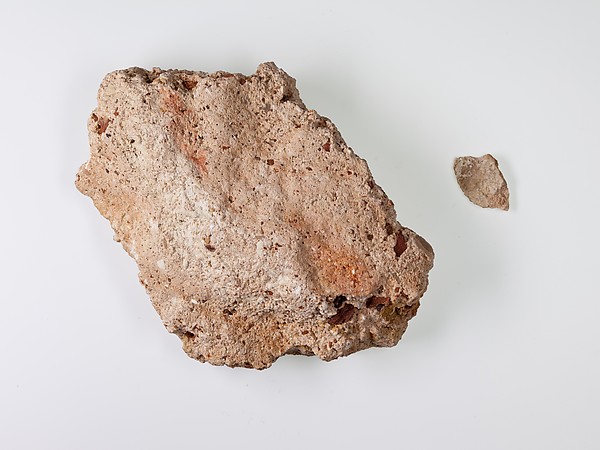
Illustration: Speciman of Mortar from the Great Pyramid. Photo: The Met / Open Access. Source

Illustration: Cubit rod Louvre 1. Photo: Cubit rod Turin Museum.PNG: Coudée-turin.jpg: Bakha derivative work: JMCC1 (talk) / Wikimedia Commons. Cubit rod from the Louvre Museum. Source

Coudée-turin. Photo: Bakha / Wikimedia Commons. Représentation de la coudée royale égyptienne de Turin. Source

Cubit rod Turin Museum. Photo: Coudée-turin.jpg: Bakha derivative work: JMCC1 (talk) / Wikimedia Commons. Cubit rod from the Turin Museum. Source
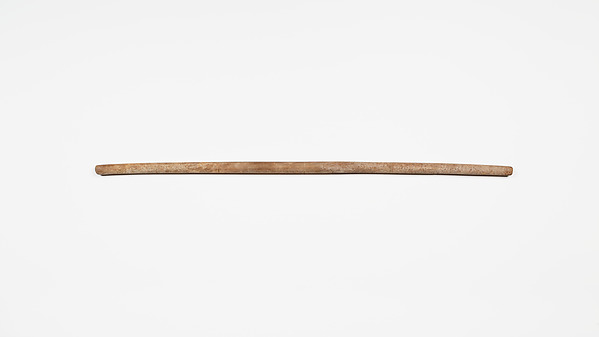
Illustration: Cubit measuring rod. Photo: The Met / Open Access. Source
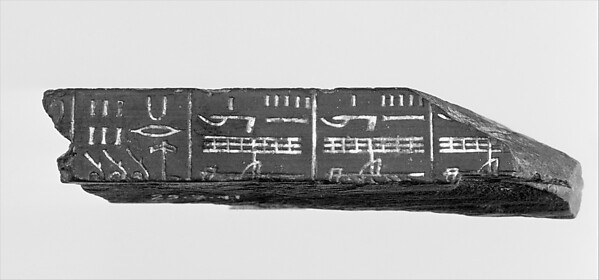
Fragment of a Cubit Measuring Rod. Photo: The Met / Open Access. Source
Mainstream Methods and Experimental Archaeology
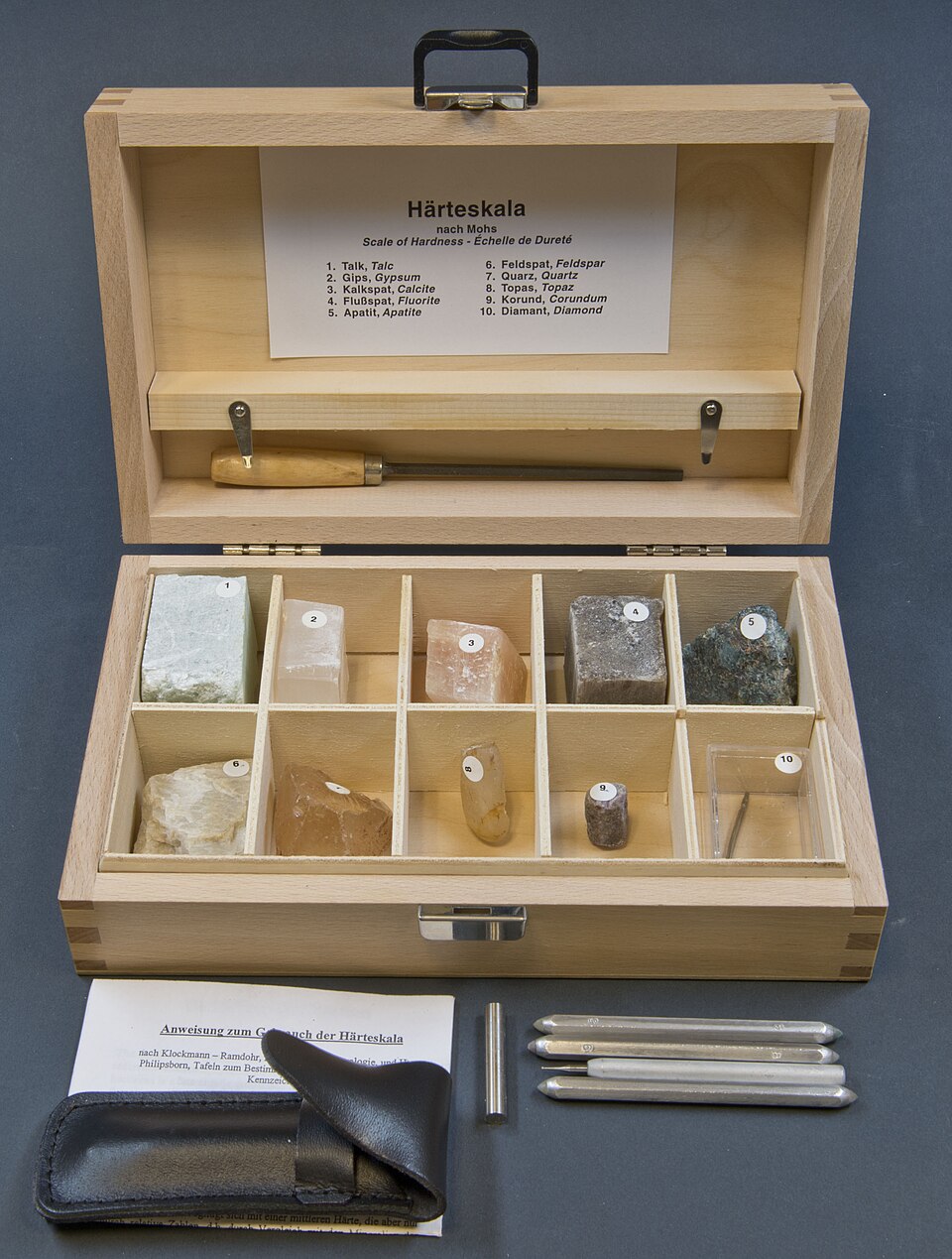
The orthodox Egyptian stoneworking kit starts with a counterintuitive premise: the metal doesn’t cut the stone, it carries the abrasive. Copper sits at Mohs 3, well below granite and diorite at 6–7, but quartz sand (Mohs 7) and especially corundum (Mohs 9) do the actual abrading work. Denys Stocks, working at the University of Manchester for more than two decades across 22 publications and over 200 reconstructed tools, demonstrated that copper saws, drills, and chisels charged with quartz sand can saw, drill, and shape granite at material-removal rates consistent with the marks left on ancient Egyptian artifacts. The cutting rate for granite runs roughly an order of magnitude below that for alabaster, which is why a hard-stone vessel takes hundreds to thousands of hours, but the technique works. Stocks’ 2022 second edition of “Experiments in Egyptian Archaeology: Stoneworking Technology in Ancient Egypt” remains the standard published baseline for this position, with 211+ citations in subsequent literature. [8] [9] [10] [11] [12] [13]

Mohssche-haerteskala hg. Photo: Hannes Grobe / Wikimedia Commons. Mohs scale of mineral hardness, box with minerals in each hardness of 1 to 10. Source
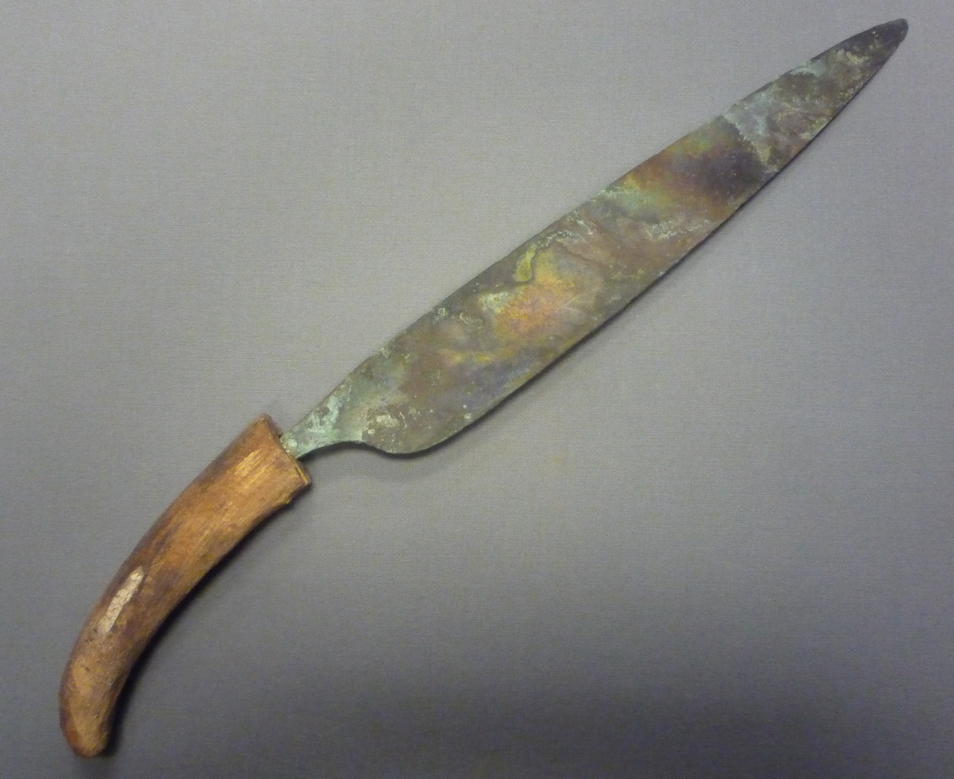
Illustration: Saw From a Foundation Deposit, Hatshepsut’s Temple MET 25.3.120 view 2. Photo: Wikimedia Commons. Saw, carpenter, Hatshepsut. Source
The mechanism for hard-stone drilling resolved a century-old dispute. Sir Flinders Petrie in 1883 argued that concentric grooves on granite drill cores from Giza required fixed “jewelled” cutting points of emery set into copper tubes; Alfred Lucas countered that loose wet quartz sand sufficed. Leonard Gorelick and A. John Gwinnett of the Penn Museum settled part of this experimentally in 1983 with silicone impressions and SEM analysis of a Dynasty IV granite sarcophagus lid from Prince Akhet-Hotep (now at the Brooklyn Museum). Loose quartz sand with a copper tube produced no concentric lines; loose emery (corundum, Mohs 9) reproduced the grooves without requiring fixed points. Direct residue analysis from drill holes at the Great Aten Temple at Amarna subsequently confirmed corundum as the actual abrasive used, with a documented Egyptian source at Wadi Hafafit. The Akhet-Hotep lid itself bears paired drill holes 24 cm deep with only 4% taper, from 5.3 cm down to 4.3 cm, consistent with a tubular drill driven by a weighted brace and flywheel rather than a simple bow drill. Petrie’s “regular spiral” interpretation of Core #7 has been re-read by Kruglyakov as irregular grooves formed by loose-abrasive suspension dynamics rather than a true 2.0 mm-pitch thread. [14] [15]
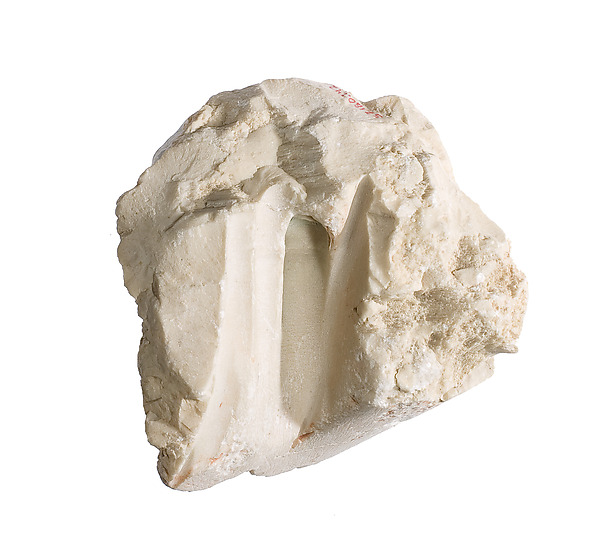
Illustration: Fragment with working traces. Photo: The Met / Open Access. Source
A 2025 metrological study tested this mainstream model against the “super-precise” predynastic stone vessels promoted by alternative-research channels. Max Fomitchev-Zamilov scanned 19 Naqada-period vessels from the Petrie Museum using a Keyence VL-500 coordinate-measuring machine calibrated against a Zeiss 1.00000-inch reference sphere, then compared them against modern handmade alabaster controls, modern lathe-made references, and replicas handcrafted by Olga Vdovina using only wood, stone, and copper tools. The peer-reviewed result, published in npj Heritage Science in December 2025, was that the museum-held vessels cluster statistically with modern handmade alabaster on a combined outer-surface quality metric (mean coaxiality error 0.034″ for Petrie versus 0.039″ for handmade comparators), contradicting the “aerospace-level precision” framing. The inner-surface circularity matched lathe-made objects, but the inner-surface concentricity was significantly worse than even hand-carved comparators. Fomitchev himself reversed an earlier working hypothesis, concluding the vessels were made using “an ingenious yet decidedly low-tech grinding technique” rather than precision machining. The “super-precise” privately held vases that triggered the investigation, he now judges most likely modern forgeries, because they show no weathering, lack museum provenance, and cluster with modern machined objects on his quality metric. [16]
Independent replication and iconographic evidence support the manual-production model. Olga Vdovina, working with the “Scientists Against Myths” group, produced three replica stone vessels using only primitive hand tools and quartz-sand slurry, including a diorite vase with lug handles that took approximately two years to complete. Her replica RV3 exhibits a 3D-scan signature of axial repositioning between inner and outer surfaces nearly identical to that seen on Petrie Museum artifact MV003b, though with measurably lower intra-phase precision. Stocks himself acknowledged that “the precision of certain vessels exceeds what is typically expected from hand-tool technologies,” a key admission within the experimental-replication community. [17]
The mainstream model still has open edges. Wikipedia’s stone-vessel article poses a question it concedes the evidence cannot answer: how were rock-crystal tubular jars with walls not more than a millimetre thick produced, given that “we have no evidence” for the technique. Stocks’ own materials-science analysis treats hard-stone drilling as abrasion in which the metal only carries the abrasive, a principle consistent with how modern diamond tooling actually works. The most consequential unresolved question is whether the asymmetric inner-surface signature Fomitchev documented (high circularity, poor concentricity, multiple repositioning events) reflects some form of rotational automation, water- or animal-powered, or simply hand-cranked boring with a hand-held cutter on a foot-clamped workpiece, as Fomitchev’s preferred hypothesis suggests. [18]
The Lost-Technology Argument
In 1883, Sir W.M. Flinders Petrie published The Pyramids and Temples of Gizeh, and within its pages lay a quantitative case for advanced stone-working that has never been fully retired. He identified two diorite bowl fragments from Giza — catalogued as Nos. 14 and 15 — bearing a cusp where two spherical surfaces from imperfectly recentered cuts meet, a feature he declared “could not be produced by any grinding or rubbing process which pressed on the surface” and which proved, in his words, that “the lathe appears to have been as familiar an instrument in the fourth dynasty, as it is in modern workshops”. [19] [20] [21] [22] [2]
The same volume catalogued hieroglyphic incisions in 4th-Dynasty diorite with lines only 1/150 inch wide, implying cutting points roughly 1/200 inch across in a substance “much harder than quartz,” and recorded that saws used on granite must have been at least 9 feet long. These were not impressions — they were measurements. They set off a debate that is still running.
The Lucas–Petrie drilling dispute crystallized around the concentric grooves visible on ancient granite drill cores: A. Lucas attributed the cuts to loose wet quartz-sand abrasive working against a copper tool, while Petrie argued for tubular drills with fixed cutting points of emery — both staring at the same lines and reaching incompatible conclusions. Experimental archaeology by Leonard Gorelick and A. John Gwinnett at the Penn Museum in 1983, using a Dynasty IV sarcophagus lid (~2500 BC) attributed to Prince Akhet-Hotep from the Brooklyn Museum, partly resolved the question: loose quartz sand on a copper tube produced no concentric cutting lines on granite, but emery used with a copper tube did produce them — without requiring fixed teeth. That finding shifted the abrasive debate toward Petrie but rejected his mechanism. Petrie’s Core 7 — a red granite core from Giza held at the Petrie Museum — then became the next flashpoint. [2]
Petrie measured the groove on Core 7 as a continuous spiral with a feed rate of approximately 0.1 inch per revolution of the drill. Dunn cites a modern diamond-drill comparison of roughly 0.0002 inch per revolution at ~900 RPM and argues the ancient core implies a penetration rate around 500 times faster per revolution than that benchmark. In 1999, Ogilvie-Herald and Larson argued in Geser the Truth that the lines were horizontal and concentric, not spiral — a reading that, if correct, dissolves the “fast feed” anomaly. But in 2018, aerospace engineers Eric Wilson and Joshua Gear of Rolls Royce Aerospace in Indianapolis physically re-examined the core at the Petrie Museum and concluded the grooves are a continuous spiral; Malcolm Muran’s separate on-site inspection reached the same conclusion, attributing apparent discontinuities to mica being ripped out of the granite rather than to separate horizontal rings. The helix reading has held. [21] [23]
Dunn’s most public on-the-record measurements concern the Serapeum of Saqqara, where he inspected the monolithic granite boxes during visits in 1995, 1999, and 2001. He brought a 6-inch precision straight edge accurate to 0.0002 inch, a 12-inch straight edge deviating from flat by 0.0001 inch, and a precision square calibrated to 0.00005 inch on a Jones & Lamson comparator — the highest-precision toolmaker’s equipment of its era. Backlit inspection found areas inside the boxes where no light passed between the steel and the granite, indicating contact precision comparable to his reference instrument, alongside other surfaces with visible gaps and patches of obvious roughness. A 5/32-inch radius gauge fitted snugly into one interior corner. Dunn’s interpretation: geometric precision was extreme and prioritized, surface finish was not. The mainstream position is that the boxes — averaging 60–100 tons, made of red granite, grey granite, gabbro-diorite, and other hard stones from sources up to 800 km away — were lowered into sand-filled burial chambers and positioned with winches, rollers, and levers. Dunn contests the dating, arguing it rests on associated pottery rather than the boxes themselves. [24]
In 2006, Dunn identified a curved-surface granite block at Abu Rawash whose compound radius implied a circular saw roughly 37.5 feet in diameter, with a calculation tolerance he estimates at about 5%. Dr. Arlan Andrews named it the “Rose Red Rosetta Stone of Abu Roash” in 2008; Edward Malkowski independently called it the “New Rosetta Stone” in 2007. Dunn folded this into his broader “Giza Power Plant” framework, which treats the King’s Chamber granite as a piezoelectric transducer coupled to Earth vibrations — a hypothesis mainstream Egyptology has not endorsed. The more recent and more public lost-technology case has been built on the “super-precise” private vases amplified by UnchartedX (Ben van Kerkwyk), where 3D scans of Predynastic and Early Dynastic hard-stone vessels — including a “spinner vase” with claimed radial-traversal symmetry — are described as “frankly astonishing in terms of precision”. But here’s the part that doesn’t sit right: a 2025 peer-reviewed metrological study by Max Fomitchev-Zamilov in npj Heritage Science scanned 19 Petrie Museum stone vessels with documented archaeological provenance and found no aerospace-level precision whatsoever; all widely discussed private-collection vases fell statistically into the modern machined class rather than the predynastic class, suggesting they are most likely modern forgeries. The Serapeum, Core 7, the Abu Rawash radius — those rest on physically accessible artifacts with provenance. The vase claims rest on pieces without it. [25] [26]
The Serapeum Boxes and Modern Precision-Scanning Studies
The Serapeum of Saqqara holds 24 surviving monolithic sarcophagi hewn from a varied suite of hard igneous stones — red granite, grey granite, black granite, gabbro-diorite, diorite, granodiorite, and syenite porphyry — dating primarily from the 26th Dynasty through the Ptolemaic Period. French Egyptologist Auguste Mariette entered the Greater Vaults on 12 November 1850, opened the Lesser Vaults in February 1852, and worked the Isolated Tombs through September 1852. His published weight for one sarcophagus including its cover was 65,000 kilograms — roughly 65 tonnes. Most boxes were found empty or disturbed, with only two undisturbed Apis burials preserved. Mariette’s inspection reportedly required forced entry, suggesting original lids were rarely opened in antiquity before being sealed. An unfinished, abandoned monolithic granite sarcophagus still lies in the access tunnel of the Greater Vaults, having never been moved into its intended burial chamber. Prince Khaemwaset (son of Ramesses II), whose Lesser Vaults were begun in the 19th Dynasty, left graffiti on at least four of the surviving megalithic boxes datable to around 1244 BC, indicating New Kingdom-era visitors could distinguish the original stonework from later carving tradition. [27] [28]
The interior surfaces of the Serapeum boxes are flat walls with no chipping, finished to a mirror polish with 90-degree interior corners documented on multiple specimens including gabbro-diorite Box №8 and granodiorite Box №23. The exterior surfaces tell a different story: on several specimens (#12 diorite, #13 black granite, #19 diorite, #20 syenite-porphyry), polishing and carvings were executed over pre-existing external damage — clear evidence that builders prioritized internal rectangular geometry over external form. A roughly inscribed sarcophagus at the far end of the Greater Vaults carries crudely scratched hieroglyphs (including Pyramid Text spells) on a highly polished surface, with empty royal cartouches sharply contrasting the refined craftsmanship of earlier sarcophagi such as that of Amasis II. Mainstream Egyptology attributes the quarrying, transport, and placement of these boxes to skilled stone-cutting with abrasive materials, combined with sledges, wooden rollers, levers, winches, and sand-filling lowering techniques. The transport logistics involved filling the burial chambers with sand and gradually removing it to settle 60-100 ton boxes into position. Alternative-history proponents argue the precision of these boxes could not have been achieved with conventional copper tools, implying a more advanced or ‘antediluvian’ civilization. The abandoned box in the access tunnel has no wooden sledge preserved beneath it, which weighs against the sled-and-roller transport model. [29]
Engineer Christopher Dunn personally inspected the Serapeum boxes in 1995 and 2001 using a 6-inch precision straight edge accurate to 0.0002 inch and a precision square calibrated to 0.00005 inch (5/100,000 of an inch). He reports that the inside corners fit a 5/32 inch (approximately 4 mm) radius gauge snugly, far smaller than the ~600 mm radius that would have been aesthetically sufficient. Dunn also reports that a US manufacturing firm told him they could not replicate a monolithic Serapeum-style granite box in one piece even with an unlimited budget, saying they would require six separate pieces joined with diamond-tipped industrial circular saws. These instrumented measurements became the empirical anchor for the ‘lost technology’ interpretation, including Dunn’s argument that the granite box inside Khafre’s pyramid shares identical characteristics with the Serapeum boxes, creating chronological problems for conventional dating. [29]
Then came the reversal. In January 2025, physicist Max Fomitchev-Zamilov published an initial metrological study claiming that 22 purportedly predynastic stone vessels from Matt Beall’s private collection split into two precision classes, with the ‘precise’ class appearing to require modern machining. By June 2025 he reported that ‘NONE of the 19 scanned [Petrie Museum] objects is consistent with manual fashioning’. He then explicitly retracted that claim, expanding the dataset to 26 CT-scanned Predynastic vessels from Matt Beall’s collection, 16 modern lathe-made vases, and 3 handcrafted replicas by Olga Vdovina made with only wood, stone, and copper tools consistent with ancient Egyptian technology. His peer-reviewed paper ‘A metrological method for manufacturing quality assessment and classification of ancient Egyptian stone vessels,’ published in npj Heritage Sciences (Springer Nature) on 16 December 2025 (DOI 10.1038/s40494-025-02196-7), concludes that the predynastic stone vessels were made using a grinding technology ‘which was ingenious but ultimately low-tech by modern standards’ — and that the ‘so-called ultra-precise vessels are only found in private collections. Therefore, they must be of modern rather than ancient origin (e.g., the 1920s were a particularly active period for forging Egyptian antiquities)’. Fomitchev-Zamilov states explicitly that his conclusions ‘changed 180 degrees’ during the project. [30] [31] [32]
A parallel GD&T-based metrological study by Arc Scientific applied circularity, concentricity, coaxiality, and surface variability metrics to 32 Petrie Museum stone vessels, using a Keyence VL-500 laser scanner with ±10 µm rated accuracy calibrated against a Zeiss 1.00000 inch reference sphere. The analysis detected four discrete repositioning episodes during fabrication of nearly all analyzed vessels — evidence of staged mounting phases rather than continuous single-axis machine turning. Interior surfaces of many vessels showed higher geometric precision than exteriors, with some interior zones ‘rivaling industrially produced components’ — yet overall Petrie Museum artifacts scored lower on Precision Score than both privately held ancient vessels and modern CNC-lathed references. Modern handmade alabaster vessels and handheld angle-grinder-shaped hard-stone vessels clustered tightly with the Petrie Museum class, not with the lathe-made group. The convergent result across both the Fomitchev-Zamilov peer-reviewed paper and the Arc Scientific GD&T analysis: museum-held specimens cluster with handmade objects, not with machined ones. The ‘aerospace precision’ framing — concentrated in two private collections, Adam Young and Matt Beall, lacking the weathering visible on comparable museum-held pieces — has effectively collapsed under controlled metrology. Fomitchev-Zamilov now identifies the Serapeum sarcophagi as the next planned extension of his methodology, explicitly stating: ‘Perhaps we will find them in the megalithic blocks of Peru or in sarcophagi at Serapeum. That would be the next step’. The 24 boxes at Saqqara remain untested by this protocol.
Connecting the Dots
In 1925, J.H. Cole strapped invar wires with stated 1:500,000 accuracy and a 6-inch Troughton & Simms micrometer theodolite to the Great Pyramid’s base, producing side lengths N: 230.253 m, S: 230.454 m, E: 230.391 m, W: 230.357 m — the first professional re-measurement of Petrie’s 1883 figures. A century later, two independent scanning projects apply the same template to Petrie’s vases: Fomitchev-Zamilov with a Keyence VL-500 at ±10 µm, Póka & Young with a Freescan Combo+. The 2025 metrology clusters the Petrie Museum vessels by manufacturing quality, and on inner-surface circularity the predynastic objects group with modern lathe-turned comparators — a finding the author himself proposes could be explained by “a lathe with a hand-held cutter”. That is the same interpretation Petrie published in 1883: “the lathe appears to have been as familiar an instrument in the fourth dynasty, as it is in modern workshops”. Petrie documented the supporting evidence himself — intersecting spherical radii on different axes with a sharp cusp where they met, which he argued “could not be produced by any grinding or rubbing process which pressed on the surface”. A 2025 instrument, scanning 2025 museum objects, reached Petrie’s 1883 conclusion through the same template Cole established a hundred years ago. [33]
The same template dissolves the competing claim about Petrie’s Core #7. Gorelick & Gwinnett at the Penn Museum, in 1983, partially resolved the Lucas–Petrie dispute about how Dynastic Egyptians drilled granite: loose quartz sand (Lucas’s hypothesis) produces rough surfaces without concentric cutting lines, whereas emery (Mohs 9) used with a copper tube reproduces the regular concentric grooves on Petrie’s Core #7 — but the mechanism is loose abrasive embedding into soft copper, not the fixed jewel points Petrie claimed. Kruglyakov’s split-tube model extends that mechanism: tubular drill bits were split tubes with a longitudinal opening allowing free pulp circulation, and the concentric grooves are not a regular 2.0 mm-pitch helix but irregular grooves formed by loose abrasive suspension dynamics, with corundum grains slipping into the nearest previously scratched groove. The corundum (Mohs 9) used in this process is now physically documented at both ends of the supply chain: Kruglyakov identified corundum grains in dried drilling residue from the Great Aten Temple at Amarna, and a large corundum deposit is documented at Wadi Hafafit. Dunn’s 1999 direct examination of Petrie Museum core UC 16036 — which found a double-start helical groove with 0.110–0.120 inch pitch — does not, against this resolution, demonstrate ultrasonic machining; it demonstrates the orthodox split-tube mechanism operating exactly as Kruglyakov describes. [2]
At the Serapeum of Saqqara, the precision surfaces are the interior functional surfaces, and only the interior surfaces. Petrographic surveys and the Isida-project documentation show that interior surfaces are finished to right-angle corners with high polish, while exterior surfaces on several specimens show polishing applied over pre-existing damage. Dunn’s straight-edge measurements, accurate to ~0.0002 inch, found the inside walls of the lids square to the underside on both sides of the box — the surfaces he measured are precisely the surfaces the petrographers identify as deliberately finished. Mainstream Egyptology accounts for the quarrying, transport, and placement of the 24 surviving 26th-Dynasty-through-Ptolemaic monolithic sarcophagi — rose granite (Mohs 6.5) from a quarry ~800 km distant, with some boxes of even harder diorite (Mohs 7) from a more distant quarry, transported before carving — by skilled stone-cutting with abrasive materials, sledges, wooden rollers, levers, winches, and sand-ramp techniques. The 2025 Fomitchev-Zamilov paper complicates the lost-technology reading further: on the same predynastic vessels that registered as lathe-class by inner-surface circularity, the same paper records that surface quality is statistically consistent with modern handmade alabaster carvings, while inner-surface concentricity is notably worse than hand-carved comparators. Modern CT metrology of Egyptian hard-stone vessels records both high local circularity and severe global imperfections, so isolated circularity measurements do not demonstrate uniformly machine-like manufacture. The pattern that survives scrutiny: the highest-precision surfaces are the functional surfaces (vase interiors, sarcophagus interiors, drill-hole bottoms), and the lost-technology argument may be a provenance problem, not a capability problem. [34]
The Other Side
The most consequential challenge to the lost-technology reading comes from the very peer-reviewed paper that the alternative-research community has cited as confirmation. Max Fomitchev-Zamilov’s metrological study, published in Nature Heritage Sciences, scanned the Petrie Museum vessels and compared them against modern handcrafted alabaster pieces and modern machine-lathe-turned hard-stone vessels. The modern handcrafted comparators clustered tightly with the Petrie Museum class on outer and inner surface quality metrics, while the machined comparators separated cleanly into their own population. Fomitchev-Zamilov’s own conclusion — that the predynastic vessels’ geometry is reproducible by skilled handwork using copper tools and abrasive — directly undercuts the claim that the inner-surface circularity carries an unambiguous “precision-tool” signature. The alternative-research reinterpretation of “precision-tool identification” reading more into the paper’s wording than its data has been publicly challenged in critical reviews. [35]
The orthodox explanation for Egyptian core drilling rests on a substantial body of experimental archaeology. A. John Gwinnett and Leon Gorelick’s tubular-drill experiments, beginning in the 1980s, demonstrated that copper tube drills fed with loose corundum (emery) abrasive can produce the visible concentric grooves on granodiorite cores, including the spiral features on Petrie’s Core #7. Denys Allen Stocks’ comprehensive “Experiments in Egyptian Archaeology: Stoneworking Technology in Ancient Egypt” extended this work, replicating saw cuts, drill holes, and vessel shaping with replicated period tools and documented abrasives. The presence of corundum abrasive at Egyptian sites is independently confirmed by petrographic analysis of residues at the Great Aten Temple at Amarna and by the unfinished obelisk scoop marks at Aswan, which match copper-pointed pounding tools with quartz sand abrasive. The mainstream position, in other words, is not speculative — it is built on replicable experimental work published in the peer-reviewed Egyptological literature. [2]
The vase provenance question exposes a serious weakness in the lost-technology argument. The “super-precise” predynastic vase population that drives claims about pre-dynastic machining is drawn substantially from small private collections with incomplete documentation — exactly the category that Egyptologists and antiquities specialists identify as the highest-risk for modern forgery and misattribution. Hannah Pethen’s published analysis of the legal antiquities trade demonstrates that predynastic stone vessels are among the most frequently faked object classes on the market, and that stratigraphic-excavated comparators are required to establish authenticity. The small private-collection sample fails this test on its face. The published mainstream position therefore treats the “aerospace precision” claims as artefact of the sample rather than evidence of lost technology — a reading that the Fomitchev-Zamilov clustering data directly supports. [25] [26]
What We Actually Know
The Great Pyramid’s base is level within approximately 2.1 cm with maximum side-length difference of ~4.4 cm at a seked of 5½ palms. Petrie’s 1883 measurements in ‘The Pyramids and Temples of Gizeh’ remain the foundational dataset cited by mainstream Egyptology, including by Zahi Hawass. The Serapeum of Saqqara contains 24 surviving monolithic sarcophagi carved from red/grey/black granite, granodiorite, diorite, gabbro-diorite, and syenite porphyry, dating primarily from the 26th Dynasty through the Ptolemaic Period. The sarcophagi interiors are flat with sharp internal corners and high polish while exterior surfaces show polishing applied over pre-existing damage — builders prioritized internal geometric finish over external form. Petrie’s Core #7 (red granite, Giza, Petrie Museum UC 16036) bears spiral grooves along its full length, confirmed by multiple independent engineers including Malcolm Muran, Dunn in 1999, and Wilson and Gear of Rolls Royce Aerospace in 2018 — findings inconsistent with simple back-and-forth bow-drill motion. Petrie documented in 1883 that Fourth Dynasty artisans used true lathes to produce diorite bowls and vases, citing intersecting spherical radii with cusps where they met on different centers of rotation as evidence. [36]
The mainstream explanation rests on replicated experiments and recovered materials. Stocks has demonstrated across 20+ years of replication work that copper tools charged with quartz sand can saw, drill, and abrade granite and other hard stones at material-removal rates consistent with the marks on ancient Egyptian artifacts. Gorelick & Gwinnett at the Penn Museum in 1983 partially resolved the long Lucas–Petrie debate by showing that loose emery used with a copper tube reproduces the concentric cutting lines seen on ancient cores — though via abrasive embedding rather than fixed cutting points as Petrie originally argued. Corundum (Mohs 9) has been identified in drill residue from the Great Aten Temple at Amarna, and a large corundum deposit is documented at Wadi Hafafit, confirming harder-than-quartz abrasives were physically available. A Dynasty IV sarcophagus lid at the Brooklyn Museum (~2500 BC) has paired drill holes 24 cm deep tapering only from 5.3 cm to 4.3 cm — 4% narrowing — implying minimal wobble consistent with a tubular drill with inertial/flywheel drive. Even modern “diamond” saw blades are actually coated with silicon carbide, mass-produced since 1893, meaning modern granite cutting still relies on abrasive grinding rather than tooth-cutting, paralleling the ancient technique. [12]
The strongest direct empirical test came in 2025. Fomitchev and Zamilov’s peer-reviewed study in npj Heritage Science, using Keyence VL-500 structured-light scanning, found that 19 Petrie Museum predynastic vessels cluster with modern handmade alabaster carvings on overall manufacturing quality — a finding that contradicts claims of universally machine-like precision. The authors’ initial June 2025 claim that “NONE” of the scanned objects was consistent with manual fashioning was explicitly retracted and superseded by the peer-reviewed paper [37]. The “super-precise” predynastic hard-stone vases promoted in alternative-research channels all come from only two private collectors (Adam Young and Matt Beall), lack published archaeological provenance from documented tombs, and show features raising authentication concerns including absence of weathering, atypical stone color/type, and mathematical signatures consistent with modern machining. Fomitchev himself attributes these to early-20th-century forgery.
Some findings remain genuinely contested. Dunn’s 1995 inspection of the Serapeum granite boxes with a 6-inch precision straight edge accurate to.0002 inch and a square calibrated to.00005 inch reportedly found inside corners with an anomalously small radius of ~4 mm, far tighter than the ~600 mm he considers aesthetically sufficient — the same precision on both sides of the lid. Dunn’s lost-technology reading of Core #7 received proof-of-principle support from Clyde Treadwell of Sonic Mill, who confirmed that an ultrasonic drilling machine could in principle produce spiral grooves, tapered cores, and other features on the artifact. The mainstream view reads the Core #7 spiral as a side effect of a split copper tube design allowing free circulation of abrasive pulp; the Kruglyakov and Gorelick & Gwinnett reinterpretation holds the grooves are irregular features formed by loose abrasive dynamics rather than a regular helix. Dunn identified a granite stone at Abu Rawash in 2006 whose curved surface ends in a compound radius implying a saw diameter of approximately 37.5 feet, though this is a single-observer interpretation with no independent verification. Industrial CT scanning of ~50 Egyptian stone artifacts in 2026 found a bimodal quality distribution: substantial imperfections coexist with precision-turned features including sub-millimetre wall thickness and tight OD/ID circularity in some vessels. Russian craftsperson Olga Vdovina’s three-vessel hand-tool experiment produced quality that was “exceptionally poor” compared to museum examples — suggestive but not quantified. [24]
References
[1] Saqqara. Serapeum. — https://isida-project.ucoz.com/egypt_2012/saqqara_serapeum.htm (accessed 2026-08-15)
[2] Expedition Magazine | Ancient Egyptian Stone-Drilling — https://www.penn.museum/sites/expedition/ancient-egyptian-stone-drilling/ (accessed 2026-08-15) [Reputable]
[3] The Great Pyramid of Giza - Decoding The Measure of a Monument — http://thegreatpyramidofgiza.ca/content/index.html (accessed 2026-08-15)
[4] Surveys of the Great Pyramids 1 — https://www.nature.com/articles/116942a0 (accessed 2026-08-15) [Academic]
[5] Biography of a Great Pyramid Casing Stone in The Journal … — https://www.academia.edu/28704118/Biography_of_a_Great_Pyramid_Casing_Stone_in_The_Journal_of_Ancient_Egyptian_Architecture (accessed 2026-08-15) [Academic]
[6] Volume I - Chapter 4 - Gods Time Capsule — https://godstimecapsule.com/volume-i-chapter-4 (accessed 2026-08-15)
[7] 73. Hidden Time Cycles at Giza — https://www.mercurialpathways.com/post/71-hidden-time-cycles-at-giza (accessed 2026-08-15)
[8] Experiments in Egyptian Archaeology — https://books.apple.com/us/book/experiments-in-egyptian-archaeology/id6446637095 (accessed 2026-08-15)
[9] Experiments in Egyptian Archaeology: Stoneworking … — https://www.routledge.com/Experiments-in-Egyptian-Archaeology-Stoneworking-Technology-in-Ancient-Egypt/Stocks/p/book/9781032217574 (accessed 2026-08-15)
[10] Experiments in Egyptian archaeology: Stoneworking … — https://www.researchgate.net/publication/287348456_Experiments_in_Egyptian_archaeology_Stoneworking_technology_in_ancient_Egypt (accessed 2026-08-15)
[11] Stone working in antiquity, general techniques and a framework of critical factors derived from the construction of Solomon’s Temple in Jerusalem — http://hdl.handle.net/10500/27386 (accessed 2026-08-15)
[12] Claim: Ancient Egyptians Could Not Work Granite Without … — https://www.metabunk.org/threads/claim-ancient-egyptians-could-not-work-granite-without-high-tech-diamond-tools.12963/ (accessed 2026-08-15)
[13] Predynastic Egyptian Stone Vessels: How Were They Made? — https://maximus.energy/index.php/2025/08/11/predynastic-egyptian-stone-vessels-how-were-they-made/?srsltid=AfmBOoqzibrXFHXznASoqHytbOOTIZ1Hq26X59cra0QRNG6irET8toSX (accessed 2026-08-15)
[14] (PDF) Evidence for the use of corundum abrasive in Egypt … — https://www.researchgate.net/publication/271849840_Evidence_for_the_use_of_corundum_abrasive_in_Egypt_from_the_Great_Aten_Temple_at_Amarna (accessed 2026-08-15)
[15] Principles of tubular free abrasive drilling — https://antropogenez.ru/drilling/ (accessed 2026-08-15)
[16] Predynastic Egyptian Stone Vessels: How Were They Made? — https://maximus.energy/index.php/2025/08/11/predynastic-egyptian-stone-vessels-how-were-they-made/?srsltid=AfmBOoorDx-OL4frPv9M8RBcspq-7jv7omnxukdd9zW5W4kaNuybTNYJ (accessed 2026-08-15)
[17] Predynastic Egyptian Stone Vessels: How Were They Made? — https://maximus.energy/index.php/2025/08/11/predynastic-egyptian-stone-vessels-how-were-they-made/?srsltid=AfmBOoqdFZMylBroTxY8vlmYs9KFvTfMTDj8-KsjmjB01fybZvPoD95F (accessed 2026-08-15)
[18] Stone vessels in ancient Egypt - Wikipedia — https://en.wikipedia.org/wiki/Stone_vessels_in_ancient_Egypt (accessed 2026-08-15) [Reputable]
[19] Advanced Machining in Ancient Egypt - Spirit & Stone — https://www.theglobaleducationproject.org/egypt/articles/cdunn-9.php (accessed 2026-08-15)
[20] Advanced Machining in Ancient Egypt - Spirit & Stone — https://www.theglobaleducationproject.org/egypt/articles/cdunn-1.php (accessed 2026-08-15)
[21] Eric Wilson’s Research – Giza Power — https://gizapower.com/gizeh/articles/eric-wilsons-research/ (accessed 2026-08-15)
[22] Live Presentation! Ancient Technology Connections at the Cosmic Summit! Vases, Tube Drills and More! [35:21-36:43] — UnchartedX (YouTube) — https://youtu.be/rKROhuLpwGM?t=2121 (accessed 2026-08-15)
[23] #2142 - Christopher Dunn — The Joe Rogan Experience Transcript — https://podcasts.happyscribe.com/the-joe-rogan-experience/2142-christopher-dunn (accessed 2026-08-15)
[24] The Amazing Boxes of the Serapeum — https://www.tokenrock.com/articles/the-amazing-boxes-of-the-serapeum/ (accessed 2026-08-15)
[25] Closing the Book on Predynastic Egyptian Stone Vases — https://maximus.energy/index.php/2025/11/09/closing-the-book-on-predynastic-egyptian-stone-vases/?srsltid=AfmBOopd8-Kep13g4FzYk3fGFhSa-wXjREKW8c3oE7mtdaru_FBP9-YG (accessed 2026-08-15)
[26] Egyptian stone vases: high-precision or complete delusion … — https://veronicasart.com/egyptian-stone-vases-high-precision-or-complete-delusion-research-proves-one-thing/ (accessed 2026-08-15)
[27] Serapeum of Saqqara — https://www.artifactfoundation.org/sarapeum-saqqara (accessed 2026-08-15)
[28] Serapeum of Saqqara — https://madainproject.com/serapeum_of_saqqara (accessed 2026-08-15)
[29] The Serapeum of Saqqara (Part 2 of 5: The Boxes) - Chacaruna — https://www.chacaruna.net/the-serapeum-of-saqqara-part-2-of-5-the-boxes/ (accessed 2026-08-15)
[30] Max Fomitchev-Zamilov — https://scholar.google.com/citations?user=zWfRDR4AAAAJ&hl=en (accessed 2026-08-15)
[31] Ancient Egypt - Maximus Energy — https://maximus.energy/index.php/category/ancient-egypt/?srsltid=AfmBOorEtymGahWd39LCbJWbUYyKsPFYKMtiFV5v2qeP2TCGAfxnvMJZ (accessed 2026-08-15)
[32] Vase Paper Accepted to Nature Heritage Sciences - Maximus Energy — https://maximus.energy/index.php/2025/12/09/vase-paper-accepted-to-nature-heritage-sciences/?srsltid=AfmBOoqFN4dpH1OJIcqZ1kbegMe4Eb3T3iqPPNtMxDpmKIw4W8xNuQcL (accessed 2026-08-15)
[33] J. H. Cole’s — http://home.hiwaay.net/~jalison/cole2.html (accessed 2026-08-15)
[34] Evaluating Ancient Artifacts - Egyptian Vases — https://industrialinspection.com/2026/03/18/evaluating-ancient-artifacts-egyptian-vases/ (accessed 2026-08-15)
[35] Max Fomitchev-Zamilov — https://www.nature.com/articles/s40494-025-02196-7 (accessed 2026-08-15) [Academic]
[36] The Great Pyramid of Khufu - Guardian’s Egypt - Guardian’s Egypt — https://www.guardians.net/egypt/pyramids/GreatPyramid.htm (accessed 2026-08-15)
[37] Petrie Museum Stone Vases Are Inconsistent with Manual … — https://maximus.energy/index.php/2025/06/07/petrie-museum-stone-vases-are-inconsistent-with-manual-fashioning/?srsltid=AfmBOooTQSwWtkuz0pW-ZNtzHl_5ynTwbFSVkya2HsBcYVIE_SYwRh7z (accessed 2026-08-15)
Keep exploring
Every site on this page sits on the globe, and the people who research them are on the Discord.
3D Globe · Sites by country · Story Archive · Research Library · Weekly Journal · Search