

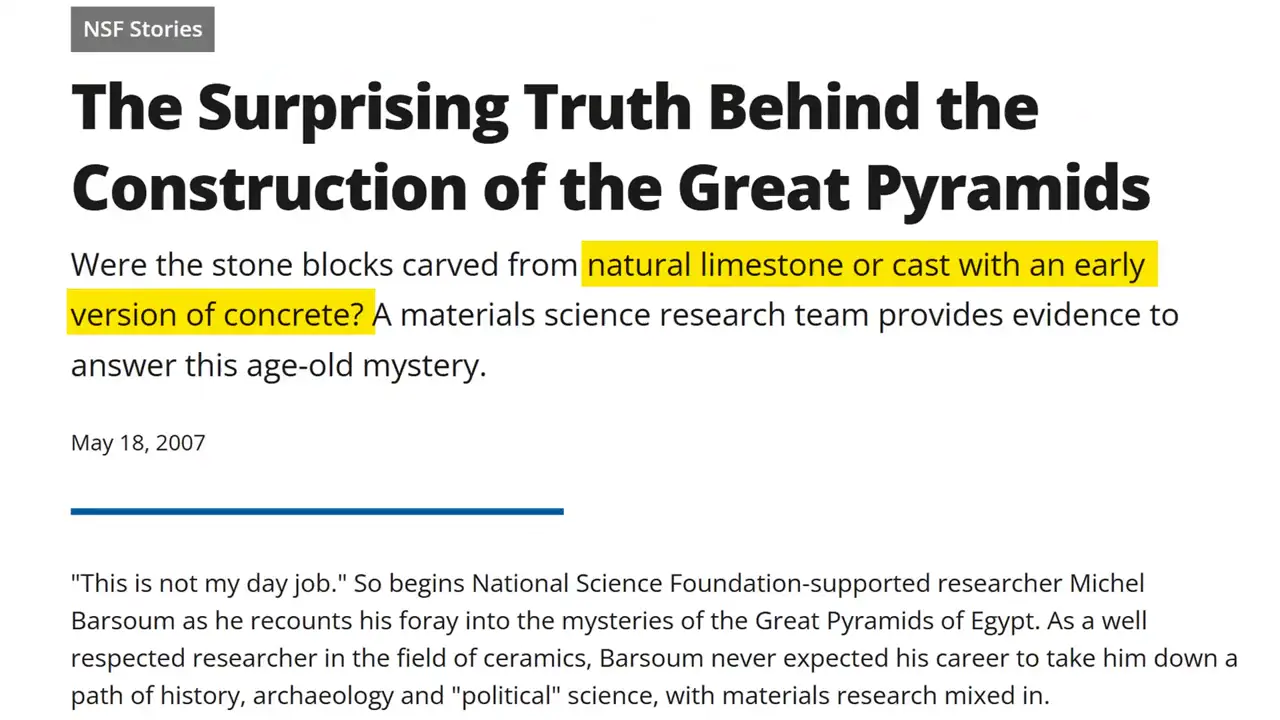
Joseph Davidovits advanced his cast-limestone/geopolymer hypothesis in the 1980s. MIT materials scientist Michel Barsoum and colleagues used X-ray diffraction, electron microscopy and NMR to detect cementitious material in some pyramid samples, consistent with lime-based mortar but not proof that the blocks were cast. Petrographic work, including R. L. Folk’s 1992 study, identifies the tested stones as natural limestone; geopolymer.org presents Davidovits’s case, not independent confirmation. Modern pumps can move bulk concrete over substantial distances, but that does not show ancient builders used casting. The video’s claims about separate-block casting and monitoring passages in a containment structure remain theories, not established findings. 🧱🧪
Evidence of ancient mortar does not prove pyramid blocks were cast
 EgyptTheory
Key facts
- Joseph Davidovits, a French materials chemist and founder of the Geopolymer Institute, advanced his cast-limestone/geopolymer hypothesis in the 1980s, notably in his 1986 book.
- Michel W. Barsoum is an MIT professor of materials science and engineering. His group's X-ray diffraction, electron-microscopy and NMR analyses detected cementitious material consistent with lime-based mortar in some pyramid samples, not proof that the blocks were cast in place.
- R. L. Folk's 1992 petrographic study found natural limestone and did not support poured-geopolymer blocks. The geopolymer.org pyramid pages present Davidovits's own case, not independent confirmation.
- Silica or aluminosilicate nanoparticles do not by themselves demonstrate high-temperature manufacture or cast-block production.
- Modern pumps can move bulk concrete over substantial distances, but their capacity does not establish ancient construction methods. Casting blocks separately could reduce lift-related stresses but would not necessarily eliminate thermal stress or cold joints.
- The Great Pyramid is overwhelmingly solid masonry with chambers and shafts. The video interprets narrow passages as monitoring access in a containment structure, but that interpretation is not established and approximate solidity does not validate it.
Sources
How the ancient Egyptians built the pyramids matters to climate ...usgbc.org
Davidovits suggested that the blocks were formed by pouring an ancient concrete—he called it geopolymer—into wooden molds. A fraction of the ...
The Surprising Truth Behind the Construction of the Great Pyramidsnsf.gov
Davidovits claimed that the stones of the pyramids were actually made of a very early form of concrete created using a mixture of limestone, ...
Cutting-Edge analysis proves Davidovits' Pyramid theorygeopolymer.org
In the mid-1980s, Joseph Davidovits proposed that the pyramids were cast in situ using granular limestone aggregate and an alkali alumino ...
Davidovits pyramid theory worldwidedavidovits.info
Most Egyptologists reject the idea, put forth in the mid-1980s by French chemist Joseph Davidovits, that the pyramids contain concrete.
In Search of Concrete Evidence - C&EN - American Chemical Societycen.acs.org
He said the French geochemist Joseph Davidovits had postulated decades ago that the pyramids had not, as Egyptologists thought, been made of ...
Gathering 'concrete' evidencenews.mit.edu
French materials chemist Joseph Davidovits, who invented (or perhaps reinvented) the geopolymer formula.
Joseph Davidovitsen.wikipedia.org
He posited that the blocks of the Great Pyramid are not carved stone but mostly a form of limestone concrete or man-made stone. Known for Geopolymer Scientific ...
concrete in the Pyramids - CIVL 1101ce.memphis.edu
Mr Davidovits and his team at the Geopolymer Institute at Saint-Quentin tested the method recently, producing a large block of concrete limestone in ten days.
Was this story useful?
Keep exploring
Every site on this page sits on the globe, and the people who research them are on the Discord.
3D Globe · Sites by country · Story Archive · Research Library · Weekly Journal · Search
AI-generated text · images from the original sources · always verify with the sources.