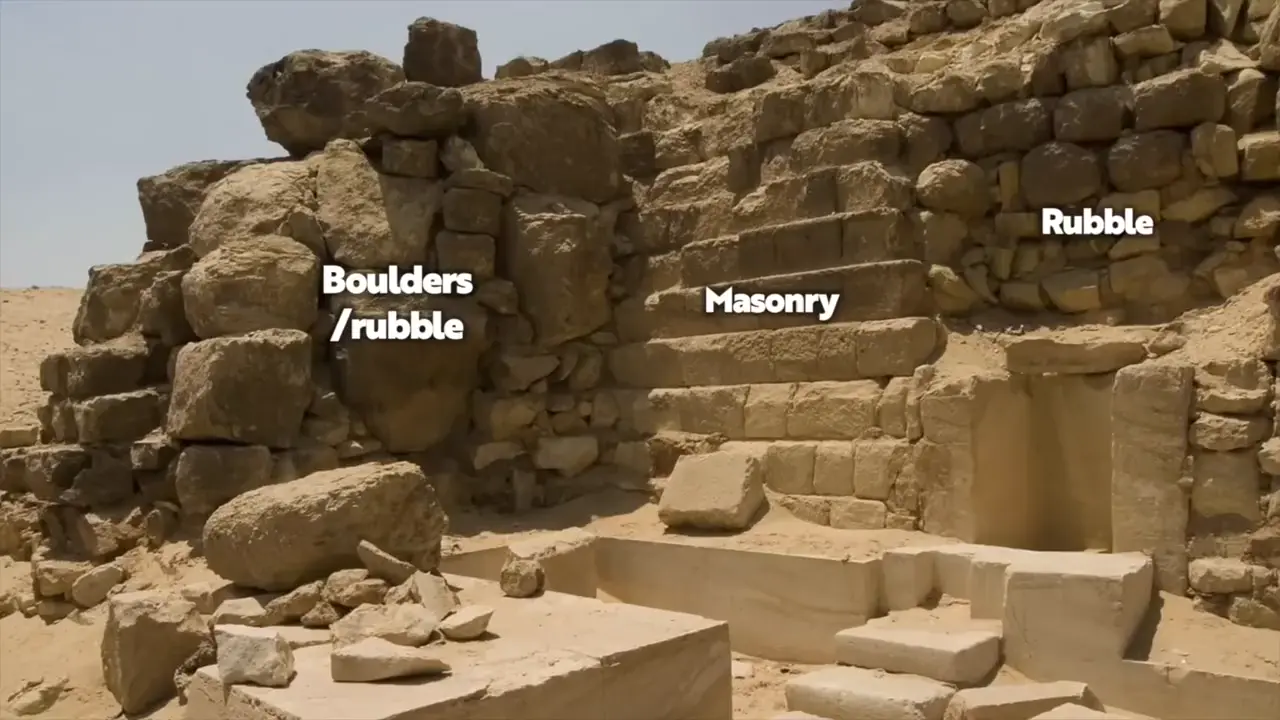
New research challenges the classic view of the Great Pyramid. The traditional assumption: 2.3 million cut limestone blocks, each weighing around 2.5 tons. But evidence suggests much of the core may be rubble bound with mortar.
Key facts:
- Traditional assumption: Great Pyramid contains 2.3 million blocks of cut limestone, averaging 2.5 tons each
- Alternative theory: Large proportion of pyramid core is rubble (undressed stone of varying sizes) bound with gypsum mortar
- Evidence from Hemiunu's mastaba (G4000) at Giza shows outer casing of fine limestone with inner core of irregular limestone blocks and rubble
- Almoon's Tunnel analysis reveals alternating pattern of rubble and dressed masonry blocks
- Estimate: approximately 25% of Great Pyramid's core may be rubble rather than precision-cut blocks
Sources
Construction of the Great Pyramid with pulley-like systems ... - Naturenature.comThe average block weighs ~2.5 tons, and an estimated ~2.3 million blocks were used to build the pyramid. The total construction time can be ...
The Surprising Truth Behind the Construction of the Great Pyramidsnsf.govThe stones of the pyramids were actually made of a very early form of concrete created using a mixture of limestone, clay, lime and water.
Scientists propose bold new theory on how Egypt's Great Pyramid ...nypost.comScientists have proposed a groundbreaking new theory on how Egypt's Great Pyramid was built, positing that they used a pulley and counterweight ...
The Surprisingly Plausible Theory that the Pyramids were Poured ...todayifoundout.comIn 1974 a French geochemist named Joseph Davidovits forwarded a radical new theory- that the pyramid blocks were not cut, but poured.
AI-generated text · images from the original sources · always verify with the sources.