

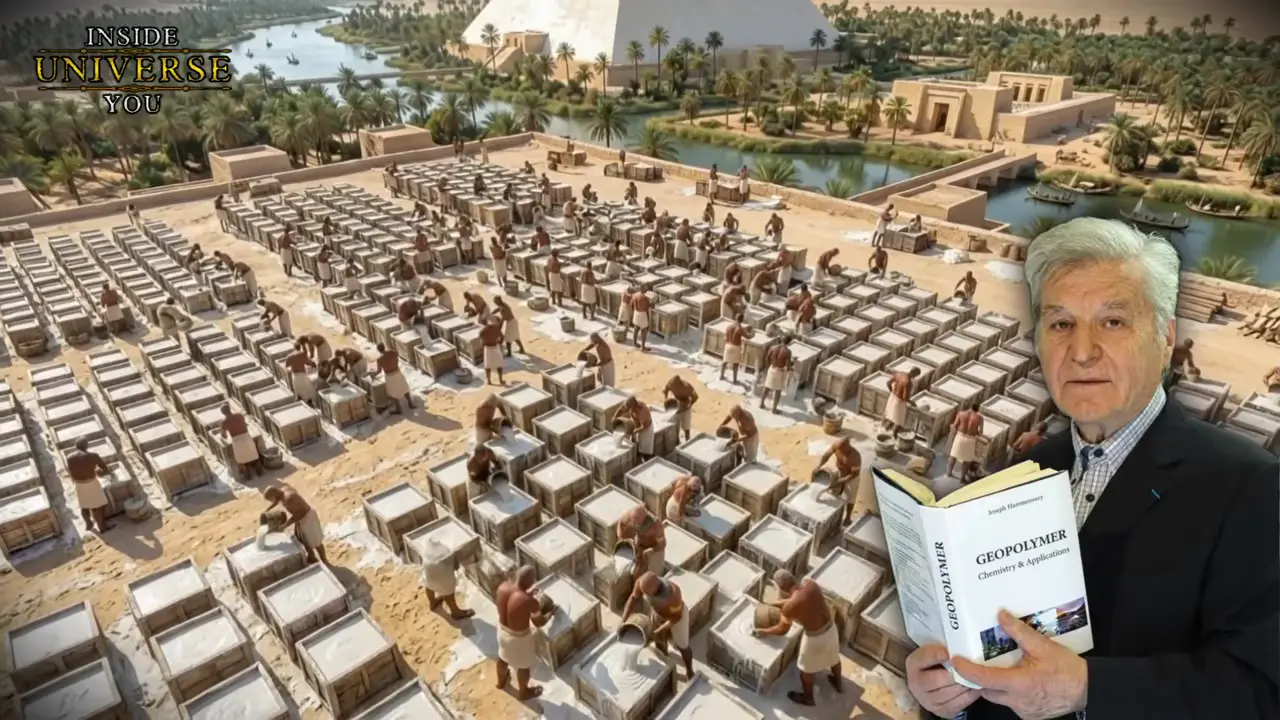
French materials scientist Joseph Davidovits proposed that many core blocks of the Great Pyramid were cast in situ from crushed limestone and an alkali aluminosilicate binder. His team reported voids, human hairs and amorphous phases in samples attributed to the pyramid, but the disputed findings do not establish that the blocks were made from concrete. Natron, quicklime, Nile clay and faience-making were available in ancient Egypt, though that does not validate the recipe. The proposal does not explain the transport of the King's Chamber's huge granite beams.
Davidovits' controversial geopolymer claim for Giza's pyramid blocks
 EgyptTheory
Key facts
- French materials scientist Joseph Davidovits proposed that many core blocks of the Great Pyramid were cast in situ from granular limestone aggregate and an alkali aluminosilicate binder.
- Davidovits and his collaborators report air-bubble-like voids, human hairs and amorphous phases in samples attributed to the pyramid. These disputed findings are not accepted proof that the blocks were cast: natural limestone can contain pores, and embedded hair alone does not establish when a block was placed.
- Natron, quicklime and Nile floodplain clays were available in ancient Egypt, and Old Kingdom Egyptians produced self-glazing faience. Their availability does not demonstrate knowledge of Davidovits's proposed recipe.
- Most of the Great Pyramid's core is local nummulitic limestone; its original casing was fine Tura limestone, while granite was used in the King's Chamber. Davidovits's arguments about jumbled fossils and scarce tools are interpretations, not established archaeological findings.
- Davidovits's proposal chiefly concerns limestone core blocks and does not by itself explain the transport of the enormous granite beams used in the King's Chamber from southern Egypt.
Sources
They Built the Pyramids - Joseph Davidovitsbooks.google.com
Joseph Davidovits explains the intriguing theory that made him famous. He shows how the Pyramids were built by using re-agglomerated stone ...
Joseph Davidovitsen.wikipedia.org
He posited that the blocks of the Great Pyramid are not carved stone but mostly a form of limestone concrete or man-made stone.
Gathering 'concrete' evidencenews.mit.edu
MIT class explores controversial pyramid theory with scale model. ... Davidovits, who invented (or perhaps reinvented) the geopolymer formula.
Joseph DAVIDOVITS | Professor Emeritusresearchgate.net
In this book, Professor Joseph Davidovits explains the intriguing theory that made him famous. He shows how the Pyramids were built by using re-agglomerated ...
Cutting-Edge analysis proves Davidovits' Pyramid theorygeopolymer.org
Joseph Davidovits proposed that the pyramids were cast in situ using granular limestone aggregate and an alkali alumino-silicate-based binder.
Was this story useful?
Keep exploring
Every site on this page sits on the globe, and the people who research them are on the Discord.
3D Globe · Sites by country · Story Archive · Research Library · Weekly Journal · Search
AI-generated text · images from the original sources · always verify with the sources.