

New theory suggests the Great Pyramid's Grand Gallery functioned as a sliding ramp with a 26.5-degree slope! Researchers propose heavy counterweight slabs on wooden sledges descended through interior passages, generating lifting force for ascending blocks. The anti-chamber may have been a pulley-lifting unit, with floor inlays guiding sledges. Repeated lifting cycles using descending mass to pull rising stones could explain how massive blocks were moved. 🏛️
New Great Pyramid theory proposes interior counterweight pulley system for lifting blocks
 EgyptTheory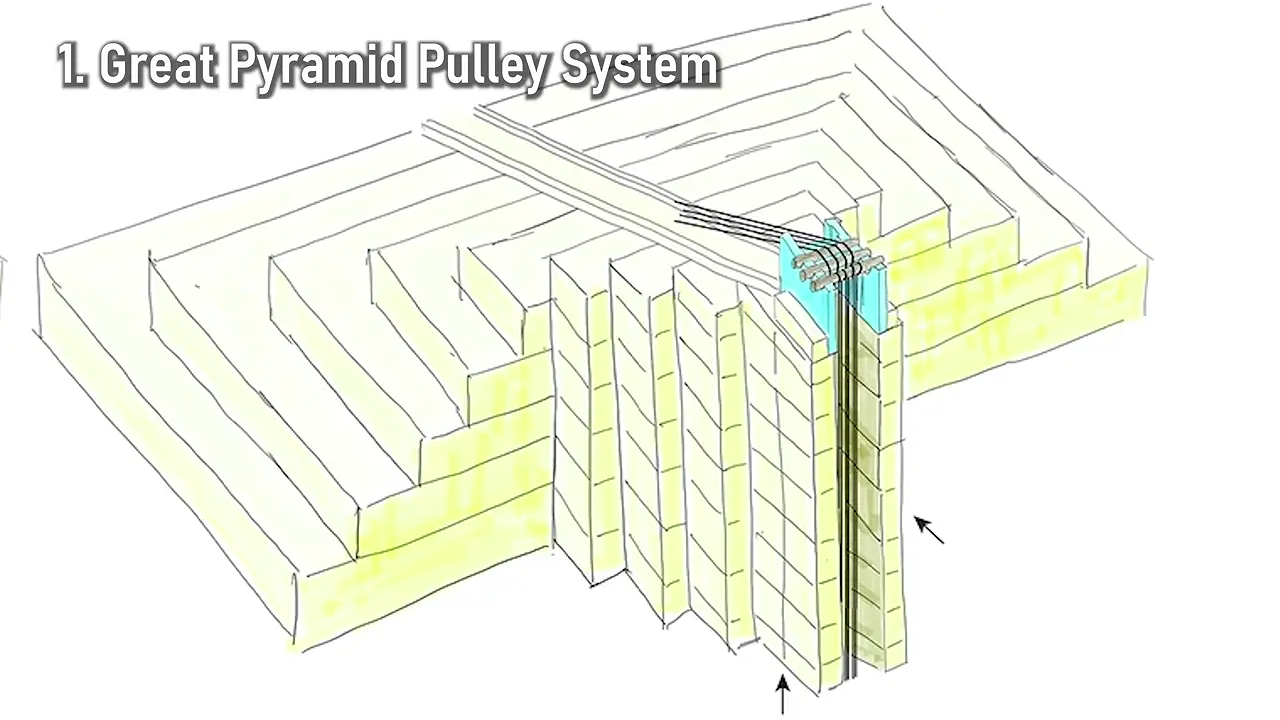
Site mentioned
Key facts
- Paper proposes the Grand Gallery and ascending passage functioned as one long sliding ramp with 26.5 degree slope
- Heavy counterweights on wooden sledges slid downward through passages to generate lifting force
- Anti-chamber interpreted as pulley-lifting unit rather than portcullis for blocking intruders
- Floor slabs identified as inlays rather than continuous original floor
- Ropes would have passed over wooden elements above an open shaft for vertical lifting
- System involved repeated lifting cycles with dedicated counterweight slabs and exchange systems
- Descending mass helped pull rising stones with minimal extra force beyond friction and resetting
Sources
The Grand Gallery | Prof's Ancient Egypt | Derek Hitchinsegypt.hitchins.net
On the far side of the entrance passage, a ramp has been started, built in limestone, sloping upwards at 26.5 degrees. The clip shows the ramps being extended, ...
Grand Gallery (Pyramid of Khufu) - Madain Project (en)madainproject.com
A more pragmatic view argues that the gallery functioned as a mechanical ramp or channel through which large objects — possibly the granite sarcophagus or ...
Great Pyramid Was a Gigantic Machine Building Itself from the ...architexturez.net
Note, Grand Gallery and Ascending Passage form a continuous sliding-ramp. Inset: Schematic of forces related to a hanging block and a block on ...
How the Great Pyramid of Giza Was Built Finally Revealedlabrujulaverde.com
... Grand Gallery could be another upper sliding ramp used in the final stages of construction. The corridor on the north face, also recently ...
The Mystery of the Grand Gallery - The Pharaoh Codethepharaohcode.substack.com
The sudden high ceiling is a mystery only until you look at the 27 indentations (the notches mentioned earlier) along the ramp which are as ...
Was this story useful?
Keep exploring
Every site on this page sits on the globe, and the people who research them are on the Discord.
3D Globe · Sites by country · Story Archive · Research Library · Weekly Journal · Search
AI-generated text · images from the original sources · always verify with the sources.