

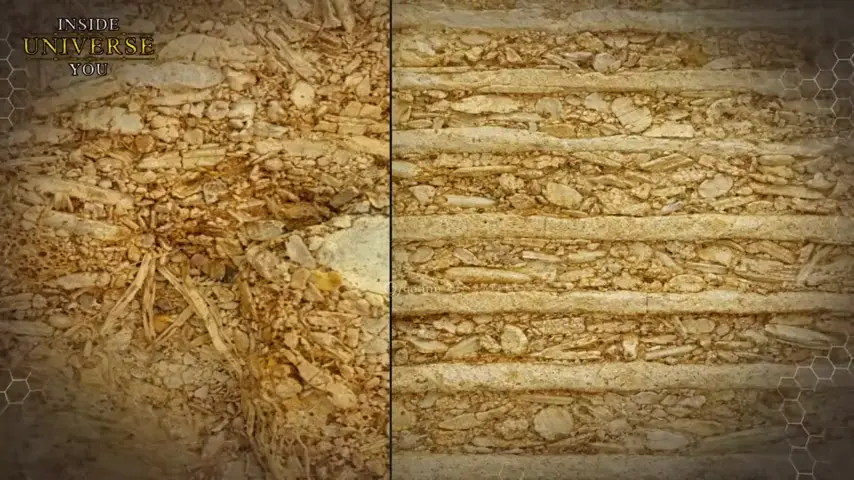
The video argues that randomly oriented fossils, exceptionally tight joints and the limited recovery of copper tools point to crushed limestone cast in molds. It says Old Kingdom Egypt had limestone, clay, natron and lime, and that Joseph Davidovits's group made tightly fitting prototype blocks. The cast-block theory is not established: fossil orientation and joint fit are not diagnostic, Giza excavations have yielded copper tools and stone pounders, and the surviving Great Pyramid casing stones came from Tura quarries.
Video Presents Davidovits's Case for Cast Limestone Blocks
 EgyptGeneral
Key facts
- The video argues that randomly oriented shell fossils in some pyramid blocks indicate crushed limestone aggregate cast in molds. Natural limestone can contain fossils in varied orientations, so this is not diagnostic of casting.
- Limestone powder, clay, natron and lime were available in Old Kingdom Egypt, but their availability does not show that they were used to cast pyramid blocks.
- The Great Pyramid's tight joints are compatible with cast blocks but also with accurately quarried, dressed and laid stone. Joint tightness alone does not establish casting.
- Giza excavations have yielded copper tools and stone pounders. Established quarrying methods included stone pounding, wooden wedges swollen with water, and copper tools, rather than extensive carving of every block.
- Joseph Davidovits's group made prototype cast blocks with tight joints using the proposed materials. This demonstrates that the method is feasible, not that the Great Pyramid's blocks were made that way.
- Surviving Great Pyramid casing stones came from limestone quarries at Tura; Davidovits's casting proposal chiefly concerns core blocks.
- The Great Pyramid dates to about 2600 BCE, so the approximately 4,500-year-old timeframe is accurate.
Sources
Unveiling the Mystery: Were the Pyramids Built with Ancient Concrete?shawnrb.medium.com
Disorganized Fossil Shells: In natural limestone, fossils are typically found in layered arrangements due to sedimentation over time. However, ...
How Did Egyptians Build the Pyramids? Ancient Ramp ... - History.comhistory.com
Researchers in Egypt discovered a 4,500-year-old ramp system used to haul alabaster stones out of a quarry, and reports have suggested that ...
Pyramids (2) The evidences - Geopolymer Institutegeopolymer.org
Jumbled fossil shells in a limestone block of the Great Pyramid. Natural sedimentation at sea bottom normally leaves them in horizontal layers.
Pyramids packed with fossil shells - ABC Newsabc.net.au
"Egyptian pyramid blocks of limestone tend to contain fossil shells and nummulites, often huge quantities of them, many of them intact, and many ...
The Surprising Truth Behind the Construction of the Great Pyramidsnsf.gov
The stones of the pyramids were actually made of a very early form of concrete created using a mixture of limestone, clay, lime and water.
concrete in the Pyramids - CIVL 1101ce.memphis.edu
The Ancient Egyptians built their great Pyramids by pouring concrete into blocks high on the site rather than hauling up giant stones, according to a new Franco ...
Gathering 'concrete' evidencenews.mit.edu
The materials and know-how needed to cast the pyramids' giant 2-1/2 ton blocks in place, rather than quarrying and moving blocks of solid ...
Casing stone from the Great Pyramid of Gizanms.ac.uk
The limestone casing blocks came from quarries at Tura 15km upriver from Giza. A large light coloured rock on a black background. The Great Pyramid casing stone ...
Was this story useful?
Keep exploring
Every site on this page sits on the globe, and the people who research them are on the Discord.
3D Globe · Sites by country · Story Archive · Research Library · Weekly Journal · Search
AI-generated text · images from the original sources · always verify with the sources.