

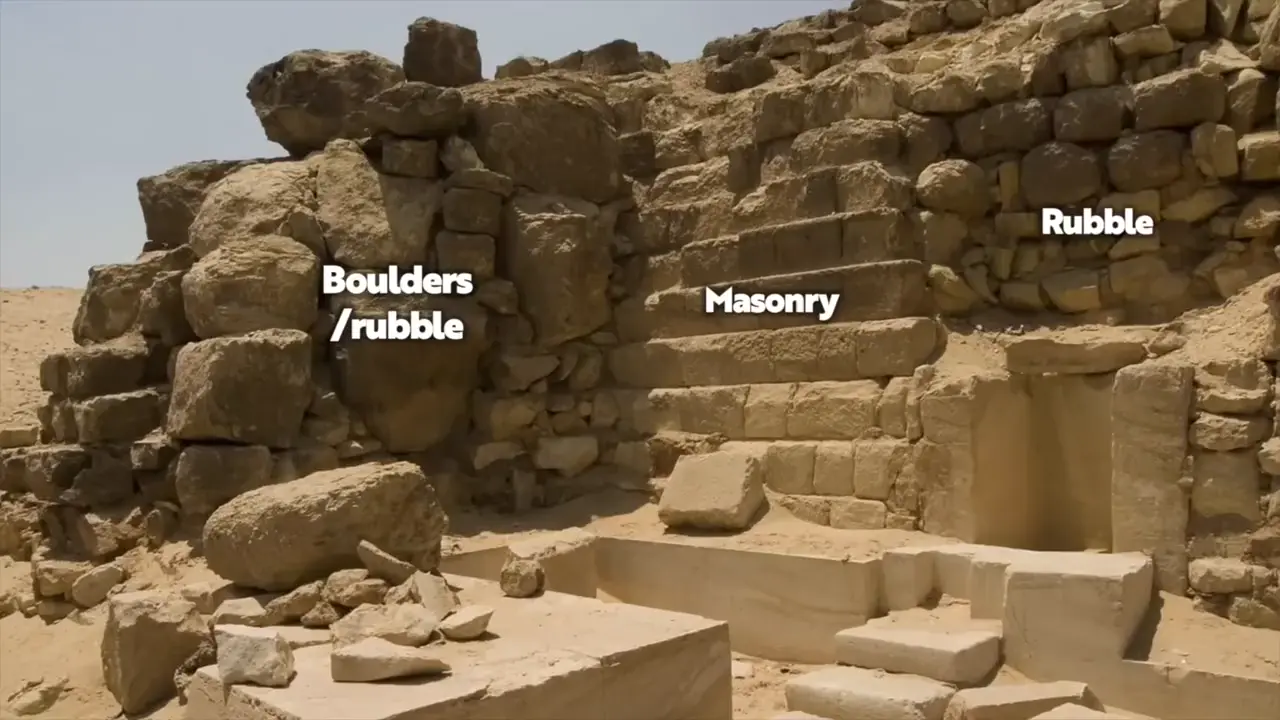
The Great Pyramid is commonly estimated to contain about 2.3 million limestone blocks averaging roughly 2.5 tonnes each. Its core used roughly shaped blocks, with rubble inserted into gaps and mortar used to bind outer layers and fill the voids. The video argues that rubble made up about 25% of the core and reduced construction work, but that proportion and its engineering benefits are not established by the cited evidence.
Great Pyramid: 2.3 million blocks averaging 2.5 tonnes, with rubble-filled core gaps
 EgyptTheory
Key facts
- The commonly cited estimate is about 2.3 million limestone blocks averaging roughly 2.5 tonnes, not 3 tonnes; many core blocks were only roughly shaped.
- The core was built from roughly shaped blocks with rubble inserted in larger gaps and mortar used to bind outer layers and fill gaps, not chiefly from loose rubble.
- The roughly 25% rubble share and the claimed savings in quarrying, processing and placement time are the video's argument, not an established result in the cited evidence.
- Hemiunu was Sneferu's grandson, Khufu's nephew, vizier and chief justice; calling him the pyramid's architect is a conventional attribution for his oversight of royal works.
Sources
Construction of the Great Pyramid with pulley-like systems ... - Naturenature.com
The average block weighs ~2.5 tons, and an estimated ~2.3 million blocks were used to build the pyramid. The total construction time can be ...
The Surprising Truth Behind the Construction of the Great Pyramidsnsf.gov
The stones of the pyramids were actually made of a very early form of concrete created using a mixture of limestone, clay, lime and water.
Scientists propose bold new theory on how Egypt's Great Pyramid ...nypost.com
Scientists have proposed a groundbreaking new theory on how Egypt's Great Pyramid was built, positing that they used a pulley and counterweight ...
The Surprisingly Plausible Theory that the Pyramids were Poured ...todayifoundout.com
In 1974 a French geochemist named Joseph Davidovits forwarded a radical new theory- that the pyramid blocks were not cut, but poured.
Casing stone from the Great Pyramid of Gizanms.ac.uk
This block is one of the few surviving casing stones from the Great Pyramid of Giza, built for King Khufu. It is the only pyramid casing stone on display ...
Is the Great Pyramid filled with rubble?egypttravelblog.com
Nope, the Great Pyramid is not just filled with rubble. solid stone, not rubble, as you can see when you enter this “newer” entrance.
Great Pyramid Corestouregypt.net
... core is made up of loose, irregular fill. There are seams and gaps in the stepped core blocks, and through these we can see limestone chips and rubble.
The Great Pyramid Quarry|AERAaeraweb.org
the core of the Great Pyramid. Massive amounts of limestone, sand, tafla (desert clay), and gypsum debris now fill the center of the quarry.
Was this story useful?
Keep exploring
Every site on this page sits on the globe, and the people who research them are on the Discord.
3D Globe · Sites by country · Story Archive · Research Library · Weekly Journal · Search
AI-generated text · images from the original sources · always verify with the sources.