

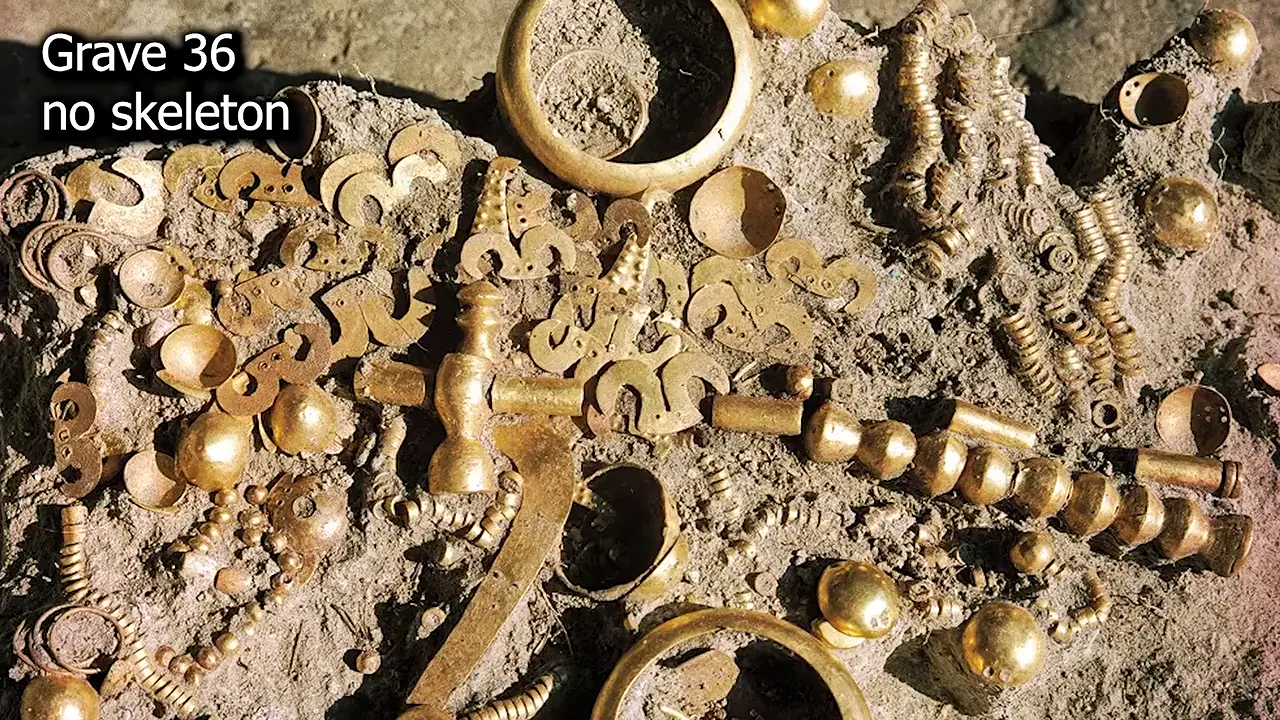
Grave 36 at Varna held outstanding gold but no human skeleton: two gold bulls, bracelets, gold implements, a composite gold scepter, and a miniature diadem about 4.3 cm across, plus thousands of shell beads and 30 gold appliqués shaped as horned animal heads. Bull symbolism like this is also documented in Mesopotamia and Egypt. There was also a tiny gold astragalus (animal knucklebone, 1.9 cm long) — gaming and divination pieces in later cultures. 🐂
Varna's richest graves without skeletons: gold diadem, bull figures, clay heads
 BulgariaGeneral
Key facts
- Grave 36 held an exceptional set of valuables but no human skeleton: two golden animals usually identified as bulls, bracelets, gold implements, a composite gold scepter, and a miniature diadem about 4.3 cm (1.7 in) in diameter.
- Grave 36 also contained thousands of shell beads and 30 gold appliques representing stylized horned animal heads; bull symbolism of this kind is also documented from Mesopotamia and Egypt.
- The deposit included a gold astragalus, a model of an animal knuckle bone, catalogued at only 1.9 cm (0.79 in) long; knucklebones served as gaming and divination pieces in later cultures.
- Excavator Ivan Ivanov proposed the deposit could be a symbolic burial for a child, another researcher argued for a ceremonial retirement of a ruler, and a third suggested a symbolic grave for the community's final ruler, his wife and a child as the community prepared to leave - all interpretive proposals, not established facts.
- Other symbolic graves contained modelled clay heads decorated with gold appliques positioned on the eyes, mouth, ears and forehead; these are pure clay, not plastered skulls as at Catalhoyuk, and recent research suggests the face-shaped plates may be compressed remains of larger modelled heads.
- Maria Gimbuts interpreted the earlier Varna deposits through a goddess-religion framework, arguing gold was placed on clay figures rather than on living individuals, suggesting a later shift toward individuals covered in gold.
- The 1991 dataset of 301 graves comprised 93 male, 67 female, 47 symbolic and 94 other/disturbed burials; 61 contained gold (10 male, 13 female, 34 symbolic, 4 disturbed).
- Of the six richest gold graves only Grave 43 held a male skeleton, and there are as many female as male symbolic graves, which the presenter says weakens the claim that male rulers replaced a female goddess-worshipping order.
- A study cited in the 2010 work 'The Lost World of Old Europe' reports that 26.47% of extended burials were female and 46.15% of contracted burials were male, contrary to the usual male-extended, female-contracted pattern.
Was this story useful?
Keep exploring
Every site on this page sits on the globe, and the people who research them are on the Discord.
3D Globe · Sites by country · Story Archive · Research Library · Weekly Journal · Search
AI-generated text · images from the original sources · always verify with the sources.