

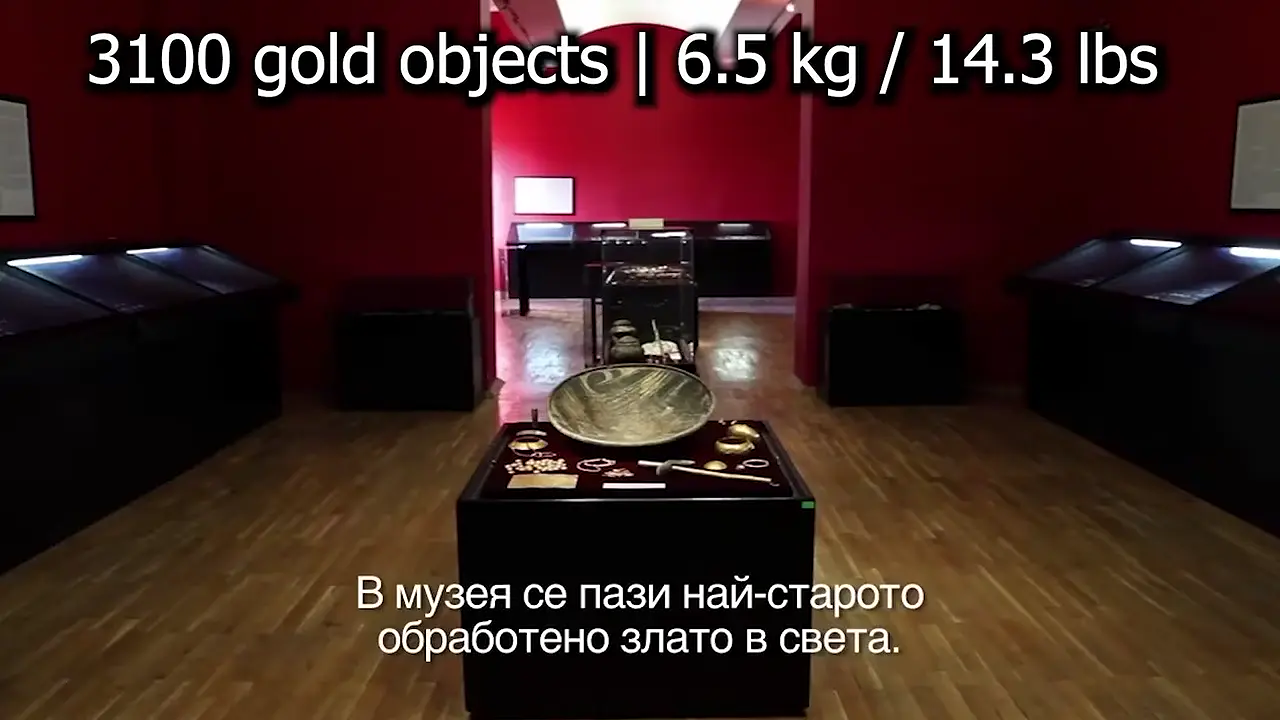
The Varna I cemetery in Bulgaria was in use for roughly 250 years, around 4600-4300 BC. About 3,100 gold objects (some 6.5 kg) plus ~160 copper implements came from it, yet only around 60-70 of 327 burials contained gold. Six graves (1, 4, 36, 41, 43, 63a) held about two-thirds of the gold — and Grave 43 alone roughly a quarter of it. Colin Renfrew called Varna crucial because farming communities that look egalitarian in their houses show radical inequality in their burials. 🏺
Varna I necropolis: 3,100 gold objects, two-thirds of them in six graves
 BulgariaGeneral
Key facts
- The Varna I cemetery near Varna in present-day Bulgaria dates to about 4600-4300 BC and was used for roughly 250 years.
- Roughly 3,100 gold objects weighing around 6.5 kg (over 14 lb) plus about 160 copper implements were recovered.
- The most recent accounting lists 327 burials, of which only about 60-70 contained gold.
- Grave 43 alone held around 990 gold objects weighing about 1.5 kg (3.3 lb), roughly a quarter of the cemetery's total gold.
- Six graves - 1, 4, 36, 41, 43 and 63a - together held about two-thirds of the cemetery's gold objects.
- Colin Renfrew treated Varna as an important discovery because farming communities that look egalitarian in their houses and everyday equipment show extreme inequality in their burials.
- Varna belongs to the grouping termed 'Old Europe' (a term introduced by Maria Gimbuts), covering southeastern European farming communities linked by technology, genetics and trade, not an empire.
- The video notes Varna's farmers arrived with farming already established in Anatolia, roughly a thousand years earlier, and that Catalhoyuk and Gobekli Tepe predate the Varna period by about 2,000 and 4,000 years respectively.
Was this story useful?
Keep exploring
Every site on this page sits on the globe, and the people who research them are on the Discord.
3D Globe · Sites by country · Story Archive · Research Library · Weekly Journal · Search
AI-generated text · images from the original sources · always verify with the sources.