

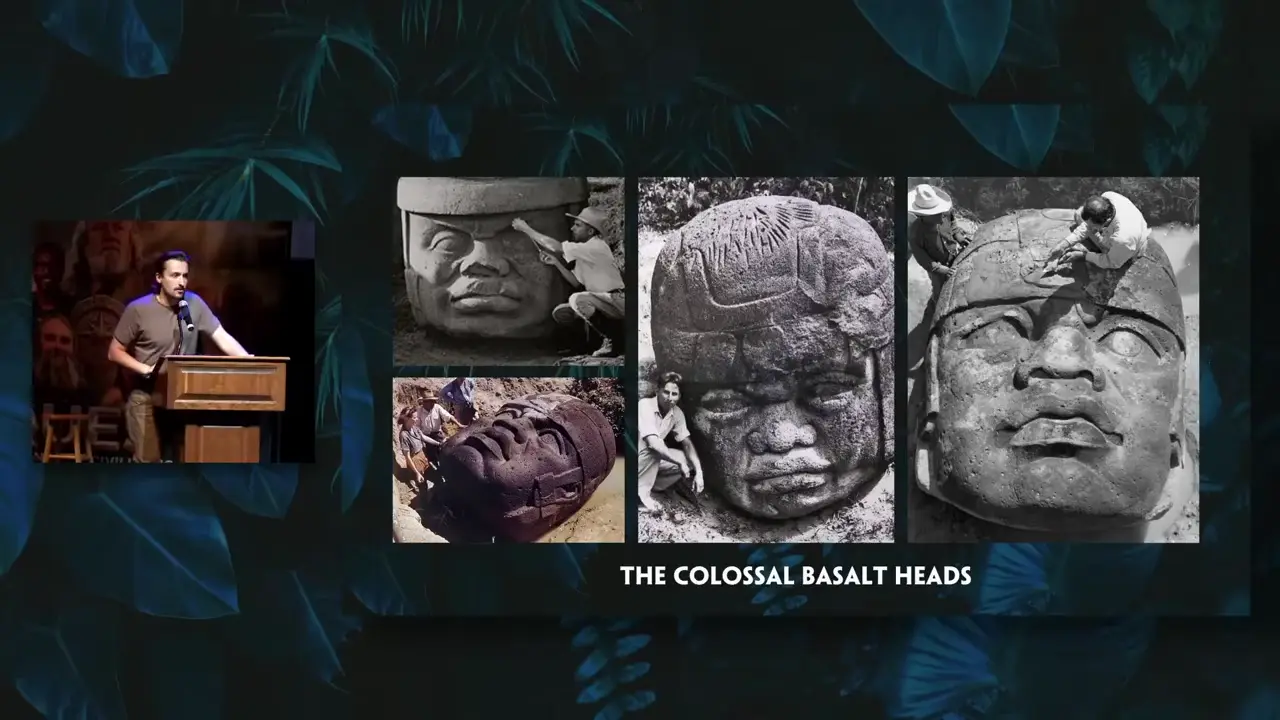
Sixteen securely attributed colossal Olmec heads are known, with a possible 17th in Costa Rica; they were carved from grey basalt in the Sierra de los Tuxtlas. Quarry and workshop debris shows the heads were worked in stages. Published estimates put El Rey—the largest found at San Lorenzo—at about 28 metric tonnes. The video’s 50+ tonne and 44-ton figures are its own estimates, not established weights. 🗿
Olmec colossal heads: 16–17 known; El Rey about 28 metric tonnes
 MexicoGeneral
Key facts
- The video begins at the San Lorenzo Tenochtitlán museum with El Rey, the largest head found at San Lorenzo. The museum labels the Middle Preclassic from about 1800 BC; the video separately claims occupation reached about 3000 BC, which is not the established date.
- Sixteen colossal heads are securely attributed to the Olmec; a possible seventeenth from Costa Rica is disputed. Published estimates put the largest San Lorenzo head, El Rey, at about 28 metric tonnes.
- The heads were carved from grey basalt from the Sierra de los Tuxtlas, called the Sierra de Latusha in the video. The approximately 90 km transport distance is the video’s estimate. Quarry and workshop debris supports rough shaping and working in stages.
- The roughly 44-ton weight for Altar 4 is the presenter’s calculation, not a standard published weight.
- The lecture presents the claims about thousands of columns being moved for column tombs, no human remains being found, and acidic soil dissolving bone. Acid dissolution is offered as an explanation, not a demonstrated cause.
- The column sizes and weights—2–7 tons on average, a 12-foot example at 13–15 tons, and a fallen 20-foot example at roughly 20 tons—are the presenter’s own measurements.
- Pre-Columbian America had no domesticated draft animals, so the Olmec relied on human labor for monument transport. The claim that their transport effort exceeded the Egyptian comparison is the presenter’s interpretation.
Sources
(PDF) San Lorenzo - Mesoamerican Archaeologyacademia.edu
The great plateau at San Lorenzo, a monumental site of the Olmec civilization, is key to understanding their early grandeur and socio-political structure.
Cabeza Colosal Número 1 (El Rey), San Lorenzo, Veracruzarqueologiamexicana.mx
Ésta fue la primera localizada en San Lorenzo Tenochtitlán y por sus dimensiones y su calidad plástica se le llamó el Rey. Fue descubierta por Matthew Stirling, ...
San Lorenzo (Mexico) - Olmec Civilization in Veracruzthoughtco.com
San Lorenzo is the name of the central place in the larger San Lorenzo Tenochtitlan archaeological region. It is located on a steep plateau ...
San Lorenzo Tenochtitlánen.wikipedia.org
San Lorenzo Tenochtitlán is best known today for the colossal stone heads unearthed there, the greatest of which weigh 28 metric tons (28 long tons; 31 short ...
San Lorenzo Tenochtitlan, Veracruz, Mexicolatinamericanstudies.org
Olmec Colossal Head No. 10. San Lorenzo Tenochtitlan Veracruz, Mexico. Click on the pictures.
Was this story useful?
Keep exploring
Every site on this page sits on the globe, and the people who research them are on the Discord.
3D Globe · Sites by country · Story Archive · Research Library · Weekly Journal · Search
AI-generated text · images from the original sources · always verify with the sources.