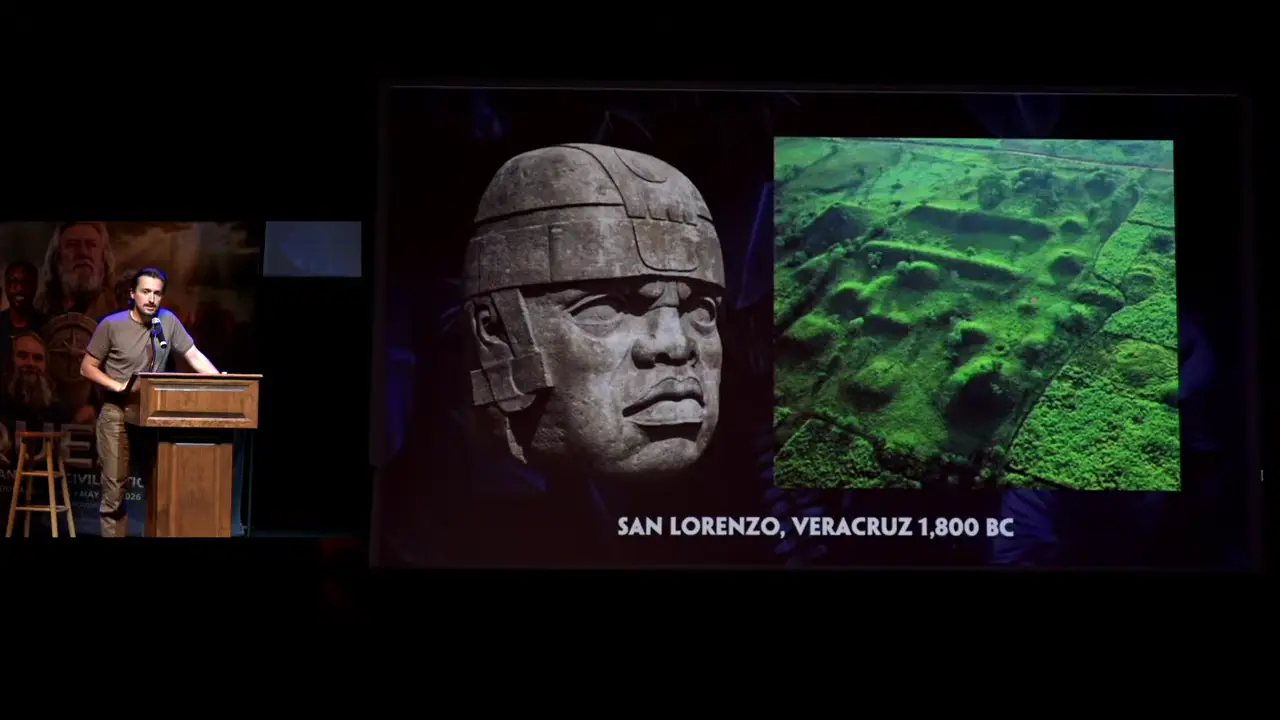
The San Lorenzo site reveals one of archaeology's greatest mysteries: the Olmec civilization appears to 'spring into existence' with no precursor era. Dating to approximately 1200-1100 BC with its main period around 1400-900 BC, the site features roughly 10 colossal basalt heads. The largest, Head 2, demonstrates a fully-formed civilization appearing seemingly out of nowhere in the ancient record.
Key facts:
- San Lorenzo dates to approximately 1200 BC with its main period around 1400-900 BC
- The site features approximately 10 colossal basalt heads, including a massive example weighing around 50 tons
- Basalt was transported approximately 90 kilometers from the Sierra de Los Tuxtlas volcanic belt
- The largest La Venta head weighs approximately 50 tons
- The Olmec civilization 'springs into existence' with no precursor era in the archaeological record
Sources
San Lorenzo Tenochtitlán - Wikipediaen.wikipedia.orgAlong with La Venta and Tres Zapotes, it was one of the three major cities of the Olmec, and the major center of Olmec culture from 1400 BCE to 900 BCE. San ...
The Historic Olmec City of San Lorenzo - ThoughtCothoughtco.comConsidered by some archaeologists to be the first true Mesoamerican city, San Lorenzo was a very important center of Olmec commerce, religion, and political ...
San Lorenzo | Ancient City, Facts, Olmec, & Colossal Headsbritannica.comThe oldest known center of Olmec civilization, San Lorenzo dates to about the 12th century BCE. The site is most noted for its extraordinary stone monuments ...
Monumental Mexico - the art and culture of the Olmecsminervamagazine.comAround 1000 BC, we can see that San Lorenzo encountered difficulties and ceased to be the centre of power in the Olmec world. The exact causes of its ...
Olmec History Tour in Mexico - Far Horizonsfarhorizons.comBy no later than 1200 BC, San Lorenzo Tenochtitlán had emerged as the most prominent Olmec center and largest settlement in Mesoamerica. Without city walls for ...
AI-generated text · images from the original sources · always verify with the sources.