

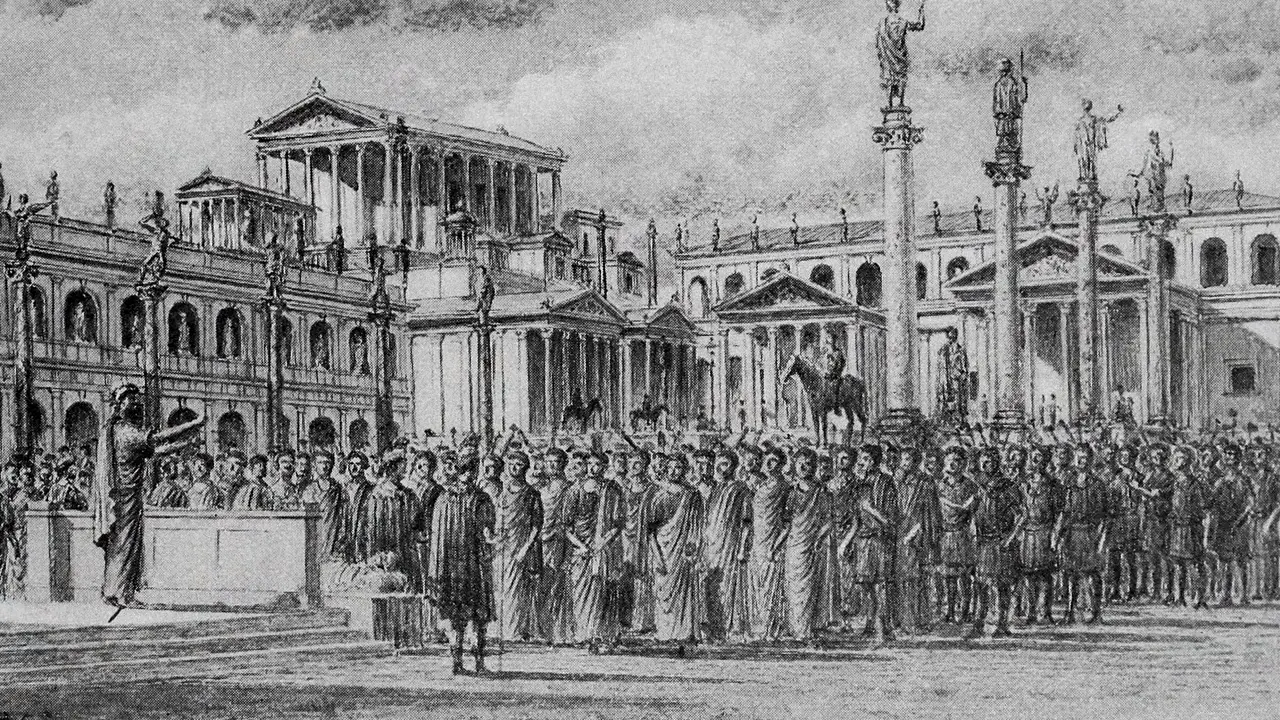
Caesar was cremated at the Forum's east end before the Regia, and a temple built over his pyre displayed a gilded comet said to carry his soul to the gods. The Rostra's outline is still traced into that podium, and an altar set into the Rostra platform marks the exact spot of the fire. His new Forum also gave the square its present orientation. 🔥
Caesar's pyre altar and late-antique rebuilds remade the Roman Forum
 ItalyGeneral
Site mentioned
Key facts
- Julius Caesar built a new Forum next to the original square, the first in a series of expansions that culminated in Trajan's Forum a century and a half later.
- In the same project Caesar gave the Forum its present orientation, shifting the Rostra and Curia to their present positions.
- Caesar was cremated at the east end of the Forum Square in front of the Regia, and a temple was constructed on the site to celebrate his apotheosis.
- The outline of the Rostra built into the temple podium is still visible, and an altar embedded in the Rostra platform marks the exact spot of Caesar's pyre.
- The pediment of the temple displayed a gilded image of the comet said to have carried Caesar's soul to the gods.
- Augustus rebuilt the Temple of Castor, the basilicas on both sides of the Forum Square and the Curia, turning the Forum into an increasingly monumental, ceremonial space for celebrating imperial glory as economic activity moved elsewhere.
- Later emperors filled in Augustus's monumental scheme, with much new construction on the west side: Tiberius completed the Temple of Concordia Augusta and the Flavians added the Temples of Vespasian and Titus.
- The Arch of Septimius Severus spanned the Via Sacra, the ancient triumphal route crossing the Forum on its way up the Capitoline to the Temple of Jupiter Optimus Maximus; it celebrates Severus's victories over the Parthians in what is now northern Iraq, and its heavily damaged high-relief panels depicted the capture of Mesopotamian cities.
- The Temple of Saturn, established in the first days of the Roman Republic, was last reconstructed in the late 4th century AD; its porch columns of gray and red granite were recycled from older buildings, with one column upside down and several spliced together, and reused architrave blocks identifiable from the inward-facing frieze.
- The Curia Julia, begun by Caesar and completed under Augustus, was destroyed by a fire that swept the Forum about three centuries later and rebuilt in brick-faced concrete with a stuccoed exterior and marble-plated interior; the late antique floor and three tiers of marble benches seating about 300 senators survive.
- The base of the altar of victory opposite the Curia entrance was removed in the late 4th century AD during the controversy between Christian emperors and traditionalists in the Senate.
- Alaric's sack of Rome is believed to have destroyed most of the Basilica Aemilia, while the other Forum buildings were maintained through and beyond the fall of the Western Roman Empire.
- The Column of Phocas, erected at the beginning of the 7th century AD when Rome was a Byzantine frontier possession, was the final monument built in the Forum and reused both column and base.
- The Roman people were still called to assemble in the Forum in the 8th century, and most buildings appear to have remained intact until the great earthquakes of the 9th century; the Forum Square stayed visible amid ruins until it was buried after the Norman sack of 1084 and later became the Campo Vaccino cattle pasture.
Sources
Forum of Caesarturismoroma.it
Forum Iulium: a Pleiades place resourcepleiades.stoa.org
Forum Iuliumdigitalaugustanrome.org
Forum of Caesaren.wikipedia.org
THE FORUM OF CAESAR EXPLAINEDatouchofrome.com
Was this story useful?
Keep exploring
Every site on this page sits on the globe, and the people who research them are on the Discord.
3D Globe · Sites by country · Story Archive · Research Library · Weekly Journal · Search
AI-generated text · images from the original sources · always verify with the sources.