

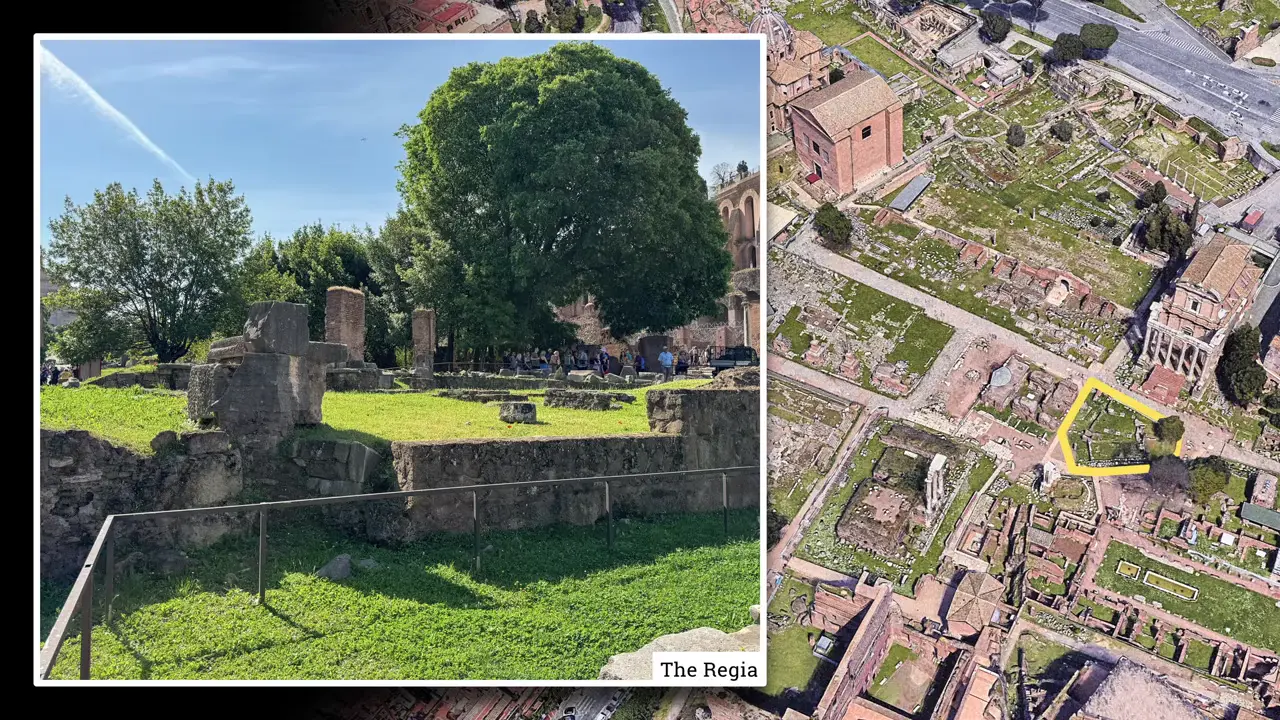
Only the Regia's foundations survive in the Roman Forum — its marble walls were quarried for St. Peter's Basilica in the Renaissance. Beneath it lies an earlier royal structure, and despite its palace-like look it always functioned as a sanctuary where Rome's kings served as high priests, supervising the Vestal Virgins who tended Vesta's sacred fire. Next door, the round Temple of Vesta may echo the earliest Romans' mud-brick huts. 🏛️
Regia, Temple of Vesta and the Rostra anchor the Forum's regal and republican core
 ItalyGeneral
Site mentioned
Key facts
- The Regia is one of the few visible legacies of the Forum's regal period; its marble walls were dismantled during the Renaissance to provide stone for St. Peter's Basilica, while its foundations survive.
- Beneath the Regia are the remains of an earlier structure built by the kings of Rome soon after the Forum was drained and paved.
- Although it resembled a palace, the Regia appears to have functioned always as a sanctuary where the kings acted as high priests.
- Roman kings also oversaw the Vestal Virgins, six aristocratic maidens who tended the sacred fire of Vesta, goddess of the hearth and home.
- The Temple of Vesta, next to the Regia, was among the Forum's oldest structures, was rebuilt several times over the centuries, and always retained a circular plan; the video suggests the shape may echo the round mud-brick huts of the earliest Romans.
- The Comitium, the open-air space where the popular assemblies of the Roman Republic convened, stood at the northwest corner of the Forum Square and is no longer visible.
- Beside the Comitium were the original Curia (Senate House) and the Rostra; the Rostra survives on the west side of the Forum Square and was moved to its present position by Julius Caesar.
- Mark Antony delivered his funeral oration for Julius Caesar from the Rostra, and the severed head of Cicero was displayed there.
- The Temple of Castor and Pollux on the south side of the Forum was built to commemorate the Battle of Lake Regillus; the ruins now visible belong to a later rebuilding.
- Rows of shops flanked the Forum Square, with houses of the Roman elite behind them on the Palatine side, as the political and economic center of Rome.
- As the Republic expanded with general booty and Greek urban planning ideas, the shop-lined square was replaced by porticoes and basilicas such as the Basilica Julia and Basilica Aemilia, which once stood about 100 Roman feet tall with colored marble facades before being gutted in the Renaissance; little survives above foundation height.
Sources
Regia » Rome self-guided audio tour app »voicemap.me
Regia - Photo Archive - René Seindalsights.seindal.dk
The Roman Regia Revisitedsites.lsa.umich.edu
Roman Forumen.wikipedia.org
Was this story useful?
Keep exploring
Every site on this page sits on the globe, and the people who research them are on the Discord.
3D Globe · Sites by country · Story Archive · Research Library · Weekly Journal · Search
AI-generated text · images from the original sources · always verify with the sources.