

AI-assisted CT scans and 3D reconstructions of a plaster cast from Pompeii's 1961-1962 Garden of the Fugitives excavation revealed a hidden wooden case containing bronze and silver coins, medical instruments and a slate slab. The case had a toothed-wheel locking mechanism. Its Roman medical instruments support identifying one of the site's 13 victims as a doctor.
CT scans reveal Roman medical kit in Pompeii plaster cast
 ItalyArtifact
Site mentioned
Key facts
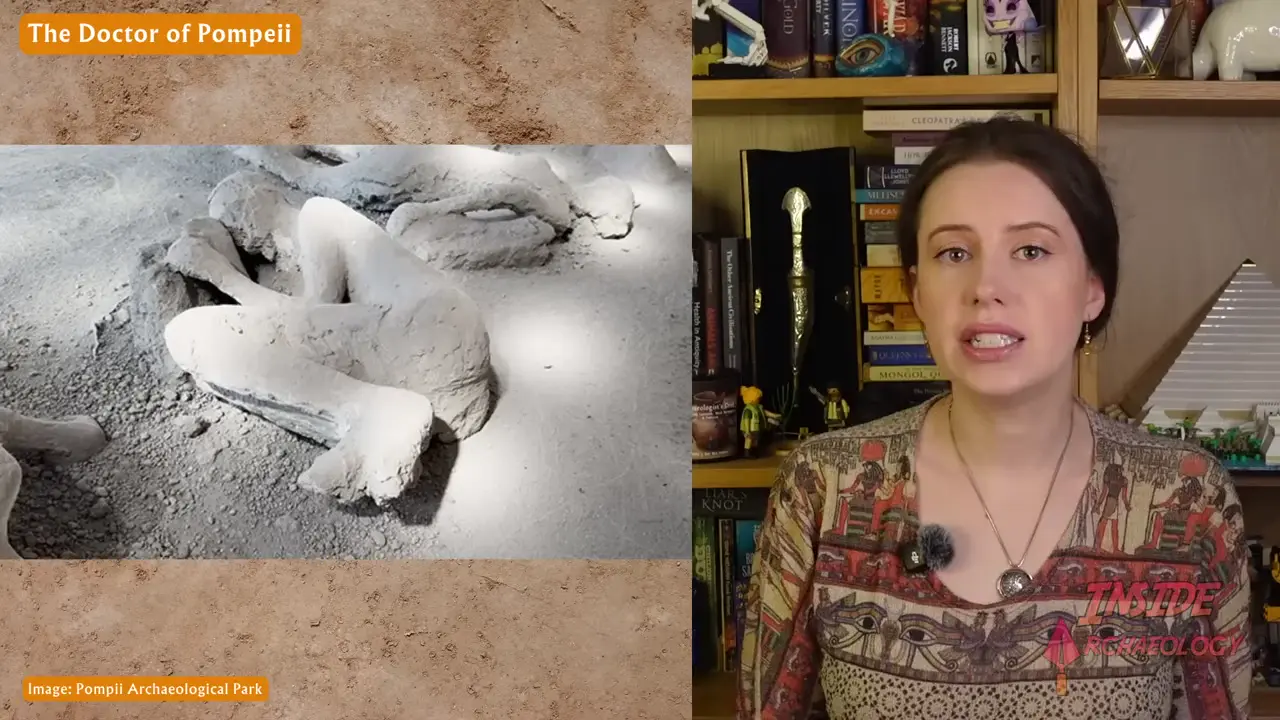
- The Garden of the Fugitives, discovered at Pompeii in 1961-1962 near the Nucerian Gate, contains 13 casts of people killed by Vesuvius nearly 2,000 years ago.
- Plaster casts were created by filling cavities left after the victims' soft tissues decomposed.
- AI-assisted CT scans and 3D reconstructions of one cast revealed a small wooden case, a fabric pouch of bronze and silver coins, metal medical instruments and a slate slab.
- The wooden case had a sophisticated locking system with a toothed wheel.
- The instruments resemble those used by Roman doctors, supporting the victim's identification as a medicus, or Roman doctor.
- The slate may have been used to mix medicine or cosmetics.
Sources
Pompeii. Porta di Nocera or Nuceria Gate. Excavated c.1803, 1814 ...pompeiiinpictures.com
Pompeii. Porta di Nocera or Nuceria Gate. Excavated c.1803, 1814 ...pompeiiinpictures.com
Pompeii - Excavations, Ruins, Archaeology | Britannicabritannica.com
1900-1949 - Pompeii Perspectivespompeiiperspectives.org
[PDF] A Guide to the Pompeii Excavations - Scavi di Pompeipompeiisites.org
The Casts - Pompeii Sitespompeiisites.org
Garden of the Fugitivesen.wikipedia.org
Garden of the Fugitives in Via Plinio 2–4, Pompeimaps.apple.com
Was this story useful?
Keep exploring
Every site on this page sits on the globe, and the people who research them are on the Discord.
3D Globe · Sites by country · Story Archive · Research Library · Weekly Journal · Search
AI-generated text · images from the original sources · always verify with the sources.