

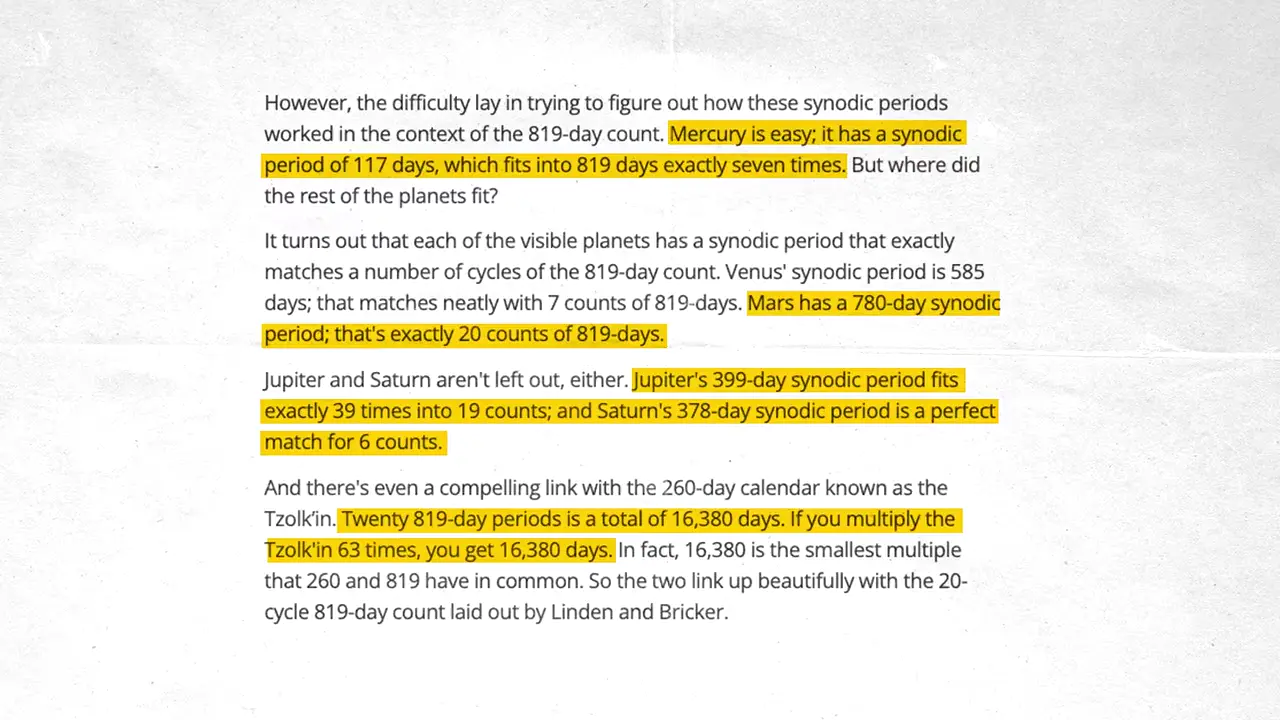
The 819-day count appears on Palenque's Tablet of the Sun and at Yaxchilan. Originally read as 4 stations (3,276 days—matching no known cycle). In April 2023, Linden and Bricker at Tulane extended it to 20 stations: 20 × 819 = 16,380 days aligns Mercury, Mars, Jupiter, and Saturn synodic periods with the sacred calendar!
819-day Maya calendar tracks all five visible planets over 16,380-day cycle
 MexicoArchaeoastronomyNew Research
Site mentioned
Key facts
- The 819-day count appears on the Tablet of the Sun at Palenque and at Yaxchilan
- Eric Thompson identified the count in 1943
- Heinrich Berlin and David Kelly published an interpretation through Tulane in 1961
- Original reading identified four stations, four directions, and four colors (red, yellow, black, white)
- Four stations total 3,276 days, about 9 years, which matched no known astronomical cycle
- 819 divides evenly into 7 periods of approximately 117 days, matching Mercury's synodic period
- In April 2023, John Linden and Victoria Bricker at Tulane extended the count to 20 stations
- 20 cycles of 819 days create a master timeframe of 16,380 days, almost 45 years
- The extended cycle aligns synodic periods of Mercury, Mars, Jupiter, and Saturn with different station points
- The extended cycle loops seamlessly into the 260-day sacred calendar
- Venus can also be incorporated into the extended system
Sources
How the Mayan Calendar Works: Scientists Finally ...popularmechanics.com
The Maya 819-Day Count and Planetary Astronomyresearchgate.net
Maya calendaren.wikipedia.org
Researchers solve ancient mystery of Maya calendarnews.tulane.edu
Was this story useful?
Keep exploring
Every site on this page sits on the globe, and the people who research them are on the Discord.
3D Globe · Sites by country · Story Archive · Research Library · Weekly Journal · Search
AI-generated text · images from the original sources · always verify with the sources.