

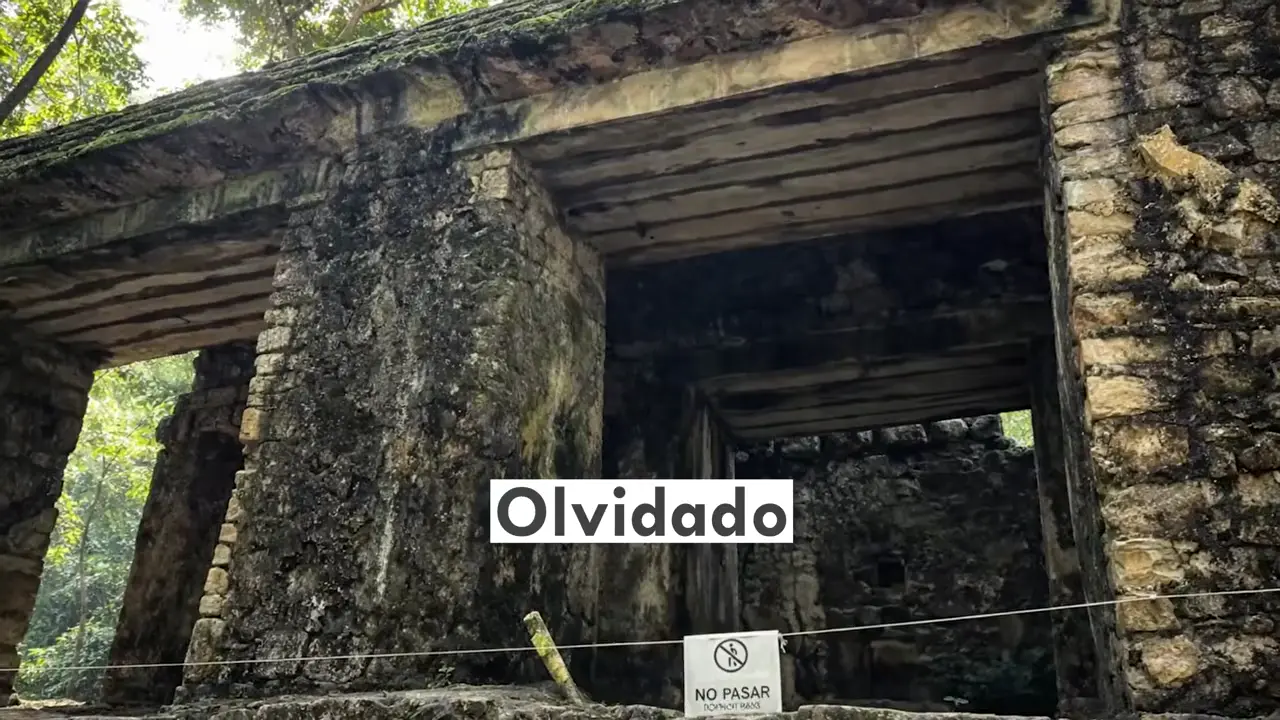
In 647 CE, at age 44, Pakal began Palenque’s double-chambered Olvidado temple in the Tokan area, about 1 km west of the centre. He began the palace in 654 with Building E, Sak Nuk Naah (“White Skin House”); his son K’inich Ahkal Mo’ Nahb I and grandson K’inich K’an B’alam II later added the other palace buildings, with major work dedicated in 720. The complex grew in phases around courtyards, not as one 654 project adding A-E. The video argues that the Olvidado was the Maya world’s first double-chamber building, that Pakal’s lime mortar and stucco surpassed other Maya construction, and that the lower palace represented a symbolic underworld; these are the video’s interpretations, not settled facts. House C preserves reliefs of captives and subordinate rulers. Pakal died in 683 at about 80.
Pakal builds the Olvidado and begins the Palace of Palenque
 MexicoArchitecture
Site mentioned
Key facts
- In 647 CE, at age 44, Pakal began his first Palenque construction project: the double-chambered Olvidado temple in the Tokan area, roughly 1 km west of the centre.
- The video describes the Olvidado as the Maya world’s first double-chamber building; that priority claim should be attributed to the video.
- Pakal began the palace complex in 654 with House E, Sak Nuk Naah (“White Skin House”). His son K’inich Ahkal Mo’ Nahb I and grandson K’inich K’an B’alam II later expanded it with Houses A-D; the expanded complex bears a dedicatory date of 720.
- The palace was assembled in phases around courtyards. Houses A-E were not all added as a single second-storey construction by Pakal in 654.
- Lime mortar and stucco were established Maya building techniques before Pakal. The video credits him with unusually advanced applications and argues that they were stronger than other Maya construction.
- The video interprets the lower palace level as a symbolic underworld. House C does preserve reliefs of captives and subordinate rulers.
- K’inich K’uk’ Bahlam was not Pakal’s son. The palace survives as a mixture of standing and ruined structures, so the claim that every related building still stands is too absolute.
- Pakal died in 683 CE at about age 80, and his son and grandson subsequently continued the palace programme.
Sources
The great Maya tombstone - Mexicoloremexicolore.co.uk
Pakal the Great transformed this Maya city into a glorious center of ...nationalgeographic.com
Palenque (Classic Period) - Smarthistorysmarthistory.org
Kʼinich Janaabʼ Pakal - Wikipediaen.wikipedia.org
Palenque: Temple XIXuncoveredhistory.com
Was this story useful?
Keep exploring
Every site on this page sits on the globe, and the people who research them are on the Discord.
3D Globe · Sites by country · Story Archive · Research Library · Weekly Journal · Search
AI-generated text · images from the original sources · always verify with the sources.