 ANCIENT NERDS
Ancient-Astronaut Artifact Claims and Scholarly Rebuttals
The paper concludes that ancient-astronaut interpretations of five artifacts—the Palenque sarcophagus lid of Pakal, Jōmon dogū figurines, Nazca lines, and the Saqqara Bird—are systematically undermined by iconographic and contextual evidence, with mainstream scholarship offering specific alternative readings (Maya World Tree cosmology, ritual/fertility functions, water-and-pilgrimage alignments, and toy or weather-vane identifications respectively). The author argues these pseudohistorical readings persist specifically because visual ambiguity rewards untrained perception while iconographic context must be actively learned, and identifies an open methodological gap in that no specialist has yet cross-compared the rhetorical and visual strategies that make the same misreadings recur across geographically and culturally unrelated artifacts.
In 1968, Erich von Däniken published “Chariots of the Gods?” and identified a Maya sarcophagus lid from Palenque – the tomb of the ruler K’inich Janaab’ Pakal – as showing an ancient king seated inside a spacecraft, with hands on controls, feet on pedals, and flames or exhaust erupting below. Subsequent Maya scholarship reads the same relief almost entirely differently: Pakal reclining at the base of the Maya World Tree (wacah chan), falling into the Underworld’s maw and being reborn as the Maize God, surmounted by the Principal Bird Deity Itzam Yeh. A skeletal centipede frame – the Quadripartite Monster – rings the composition, a double-headed vision serpent winds through the branches, and the cross-shaped tree carries iconographic markers (te/tree glyphs, mirror signs, jade celts) tying it to the same cosmological convention attested at Palenque’s Temple of the Cross. [1]
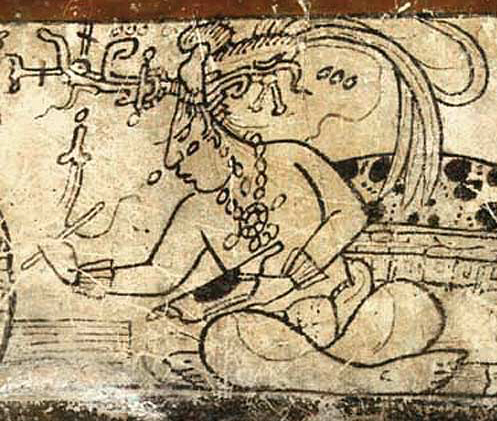
Illustration: Maya maize god. Photo: unknown Maya artist / Wikimedia Commons. The Maize God as scribe. Source
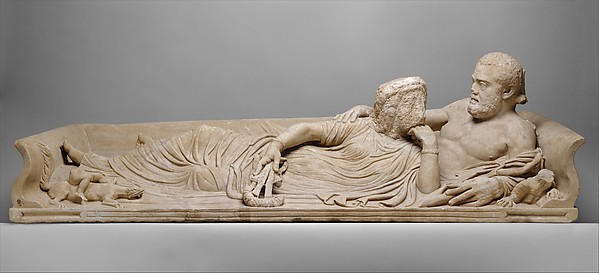
Marble sarcophagus lid with reclining couple. Photo: The Met / Open Access. Source
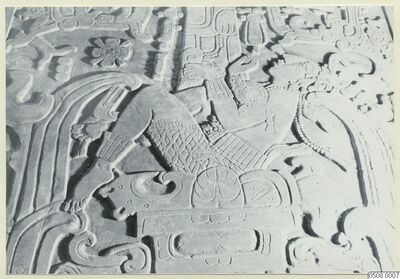
Palenque, Temple of the Inscriptions, Sarcophagus Lid (PAL: TISL). Photo: Europeana. Maya Artefact. Source
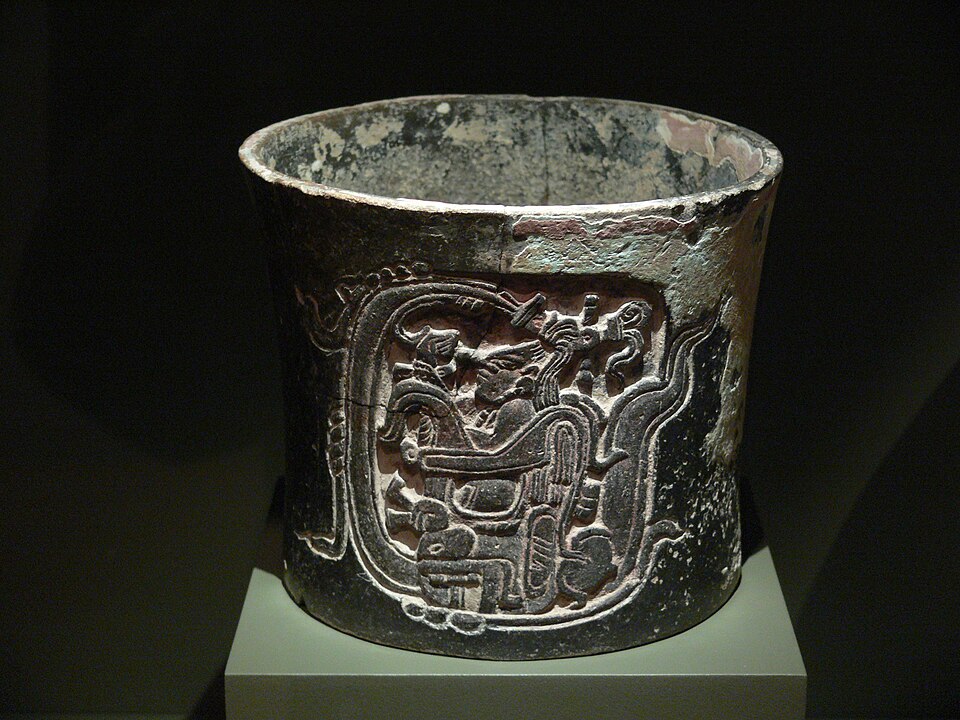
Illustration: Maya cylindrical vessel DMA 149-1990-4. Photo: Photo: User:FA2010 / Wikimedia Commons. Source
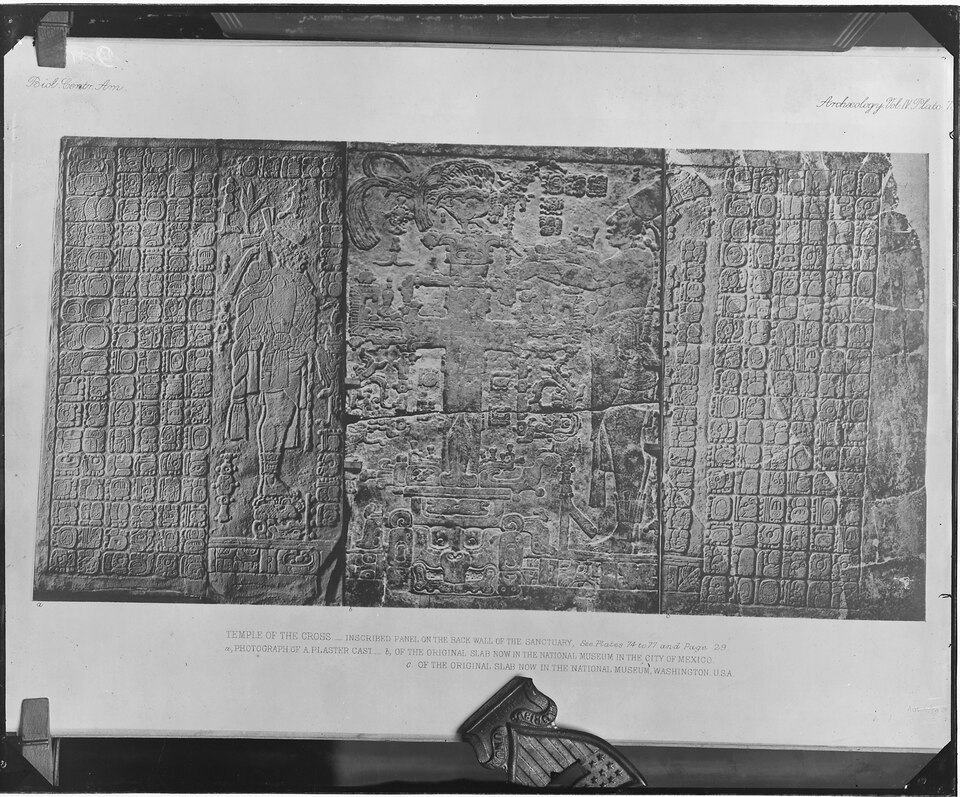
Illustration: Plaster cast of inscribed wall panel from Temple of the Cross, Palenque. - DPLA - 853e0b1521f27cc7e2df293efa80f735 (page 1). Photo: Smithsonian Institution. Bureau of American Ethnology. 1897-1965 / Wikimedia Commons. Source
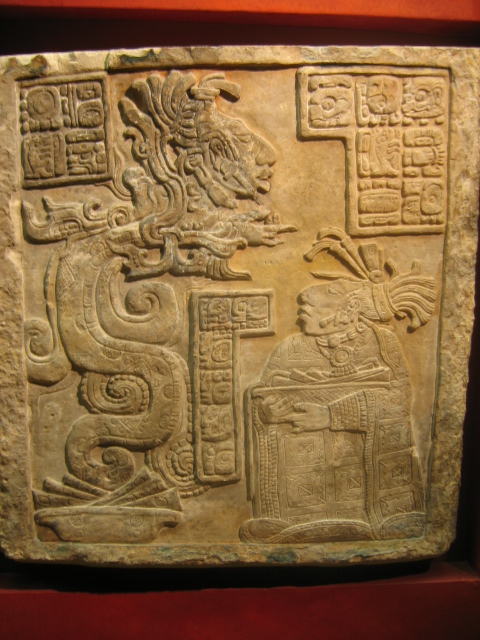
Illustration: London 176. Photo: Urban / Wikimedia Commons. The serpent winding through the branches is central to the Maya cosmological reading and has…. Source
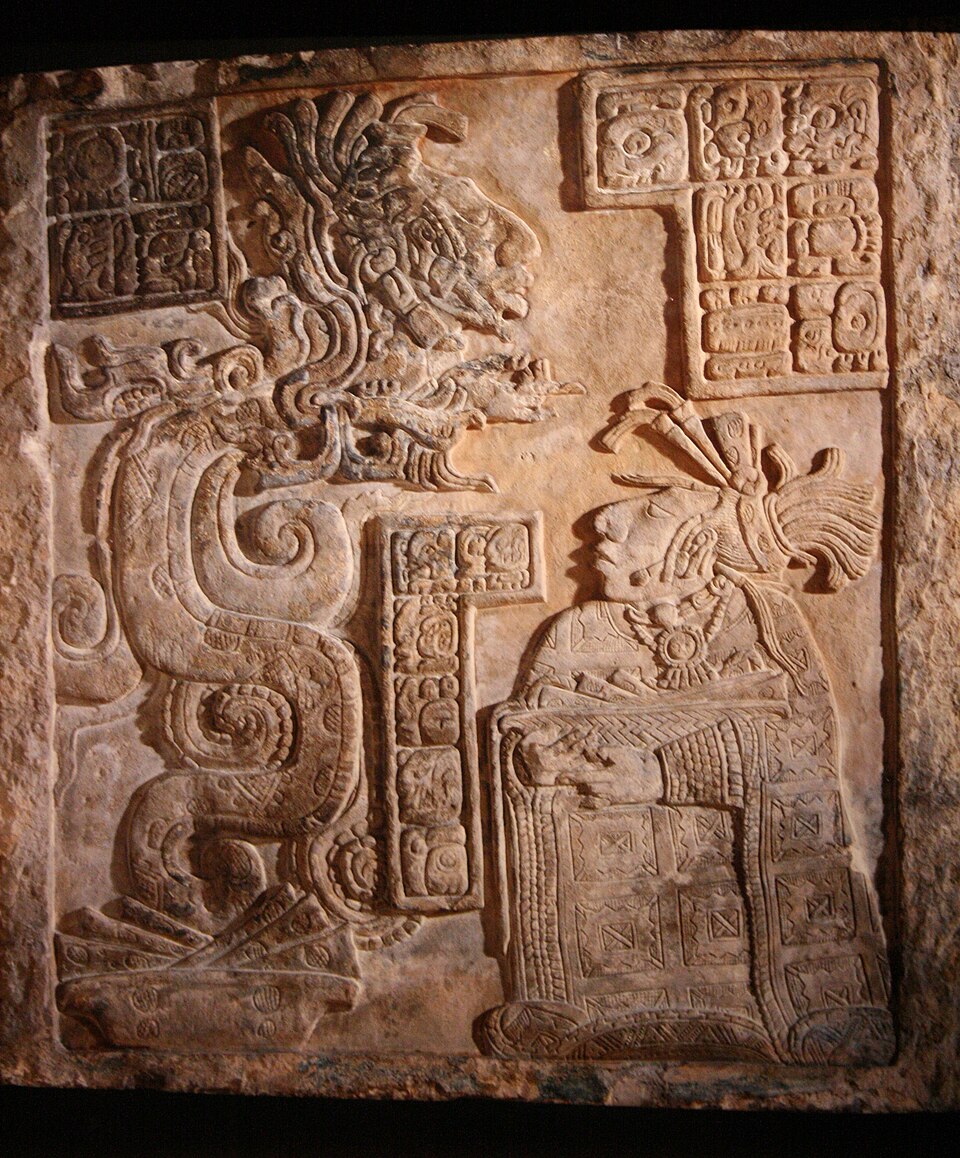
Yaxchilan Lintel 15. Photo: Wikimedia Commons. The serpent winding through the branches is central to the Maya cosmological reading and has…. Source
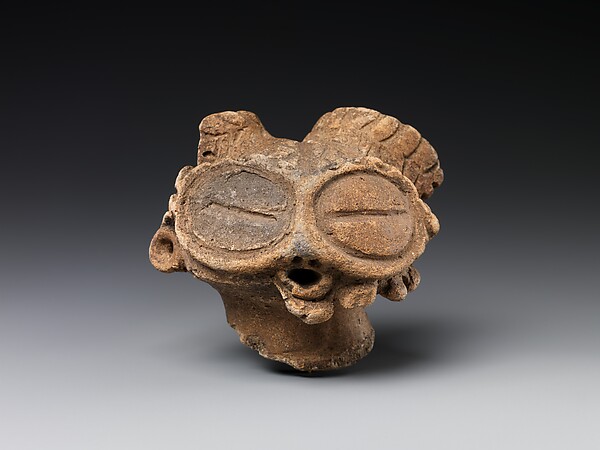
The same gap recurs in Japan. Goggle-eyed Jōmon shakōki-dogū figurines from the Final Jōmon period (c. 1000–400 BCE) have been described by pseudoarchaeology as figures in spacesuits, while mainstream archaeology states flatly that “archaeological evidence does not support claims that the figures wear spacesuits or depict extraterrestrials”. The shakōki label is a modern Japanese coinage drawn from the resemblance of those broad eyes to Arctic Inuit snow goggles, and the 18,000–20,000 dogū known across Japan map onto ritual, fertility, healing, and shamanistic functions rather than visitors from elsewhere. [2] [3] [4]
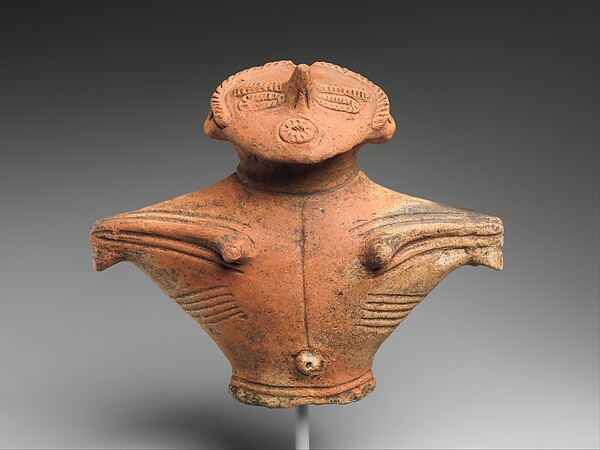
Illustration: Dogū (Clay Figurine). Photo: The Met / Open Access. Source
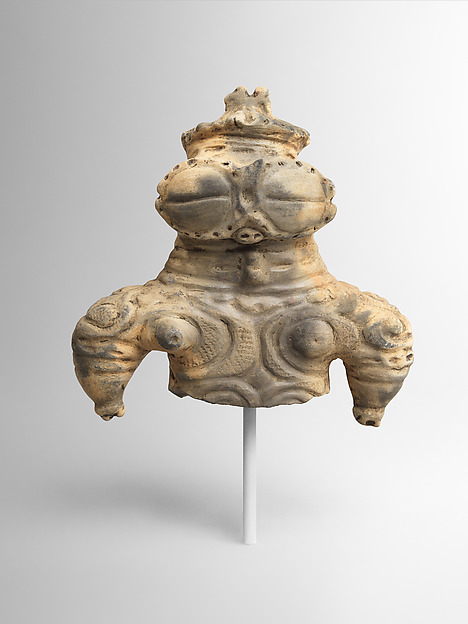
Copy of a Dogū (Clay Figurine). Photo: The Met / Open Access. Source

Head of a Clay Figure (Dogū). Photo: The Met / Open Access. Source
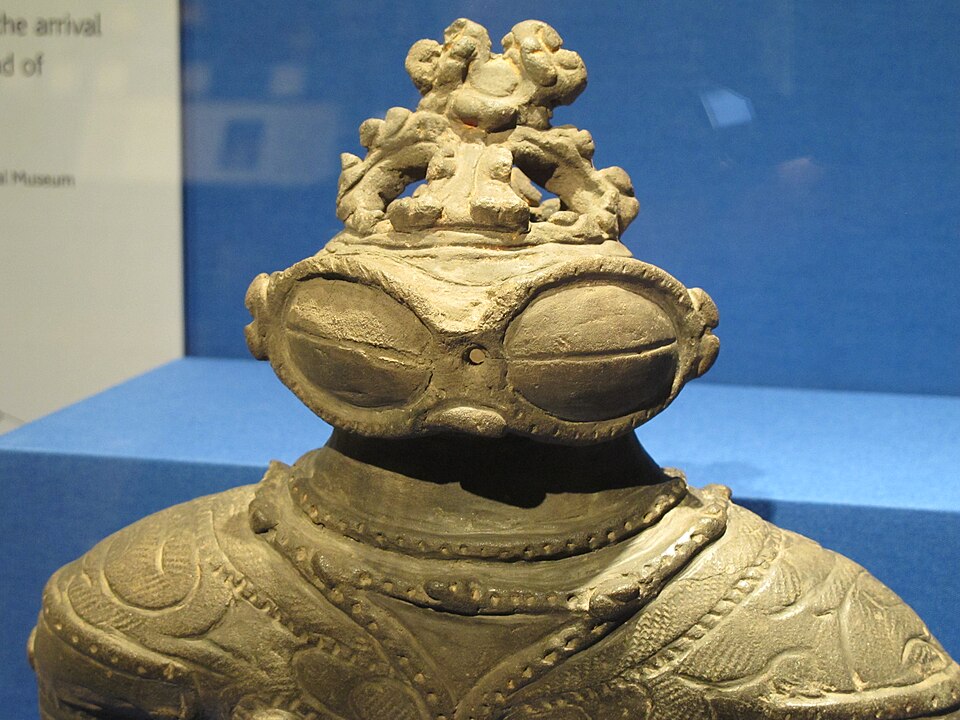
Dogu jomon period japan. Photo: davide ferro / Wikimedia Commons. From kamegaoka, Aomori prefecture. Final Jomon. 1000-300 BC. Source
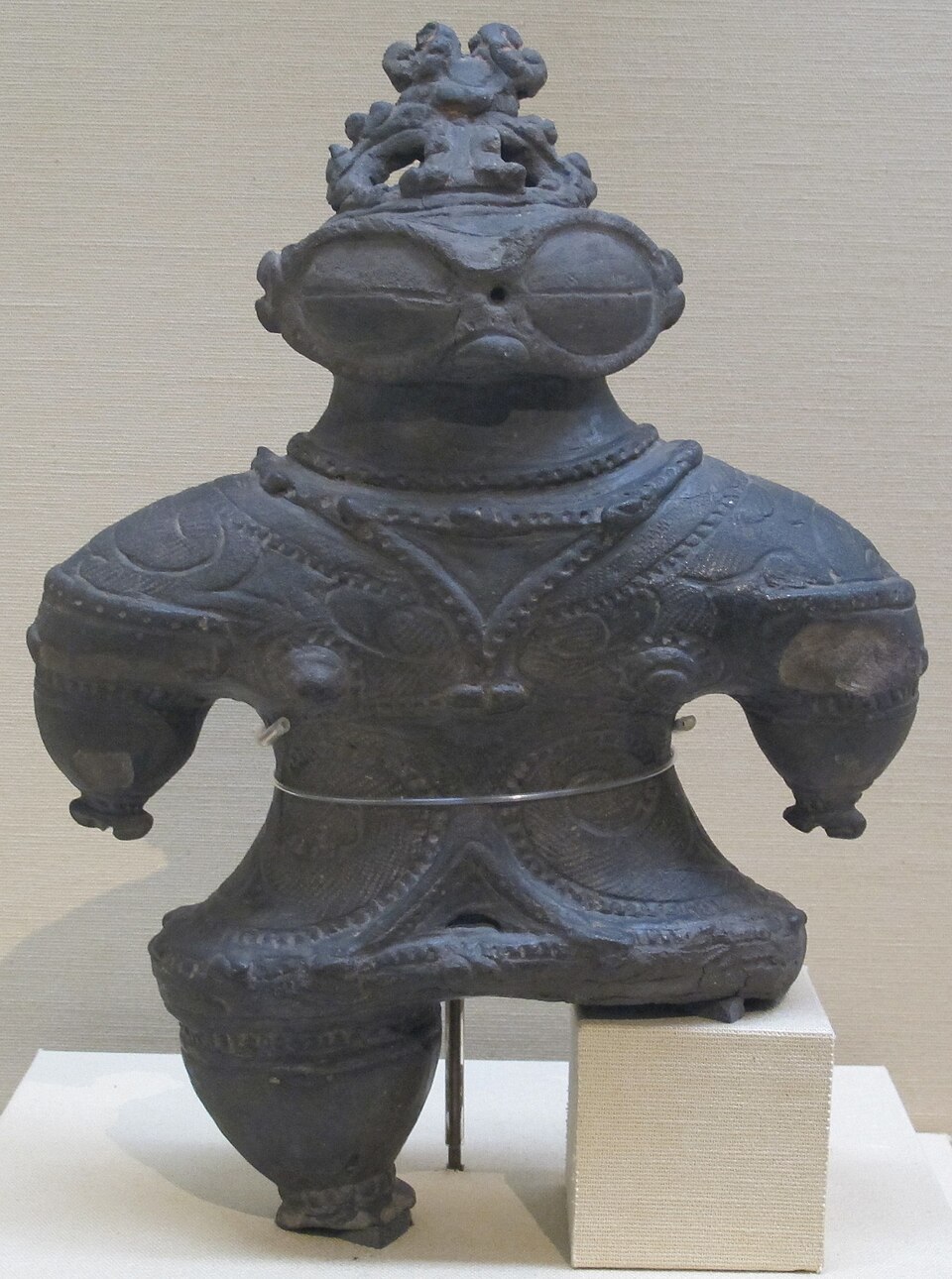
Periodo jomon, dogu, 2000-1000 a.c. 3. Photo: sailko / Wikimedia Commons. Source
Findings
The sarcophagus lid of K’inich Janaab’ Pakal I of Palenque was uncovered in 1952, when Mexican archaeologist Alberto Ruz Lhuillier reached the burial crypt at the base of an 80-foot rubble-filled stairway inside the Temple of Inscriptions at Palenque. Pakal’s dates are firmly anchored: born in 603 CE, acceded in 615 CE at age 12, and died in 683 CE at approximately age 80. Erich von Däniken’s 1968 Chariots of the Gods proposed that the carved limestone lid depicts the ruler piloting a rocket-like spacecraft, hands on controls and feet on pedals, with flames or exhaust emerging below. That reading collapses under iconographic analysis: the cross-shaped motif at the center of the lid is the Maya World Tree (wacah chan), identified by ‘te’ (tree) glyphs on its trunk and surmounted by the Principal Bird Deity Itzam Yeh, while the skeletal “exhaust” at the base is the Quadripartite Monster — the underworld portal, not rocket thrust. Pakal is iconographically identified as the Maize God at the moment of death and rebirth, framed by a double-headed vision serpent winding through the World Tree’s branches, with the deity K’awiil (God K) emerging from one serpent jaw. [5] [6]
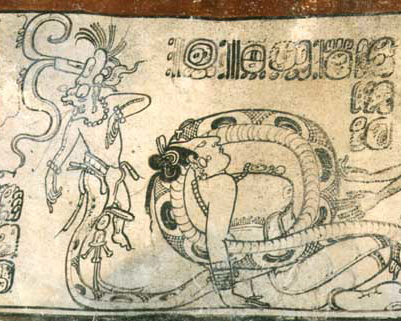
God K K’awiil. Photo: unknown Maya artist / Wikimedia Commons. Woman entwined by God K’s (K’awiil’s) serpent leg. Source
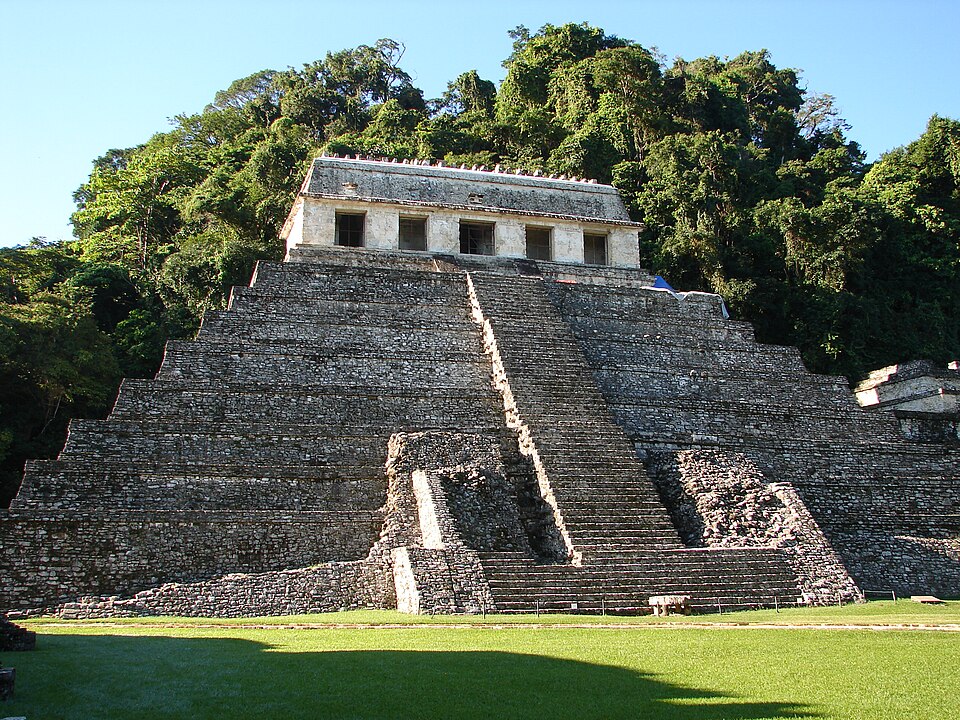
Temple of Inscriptions, Palenque. Photo: Antony Stanley from Gloucester, UK / Wikimedia Commons. Temple of Inscriptions, Palenque. Source
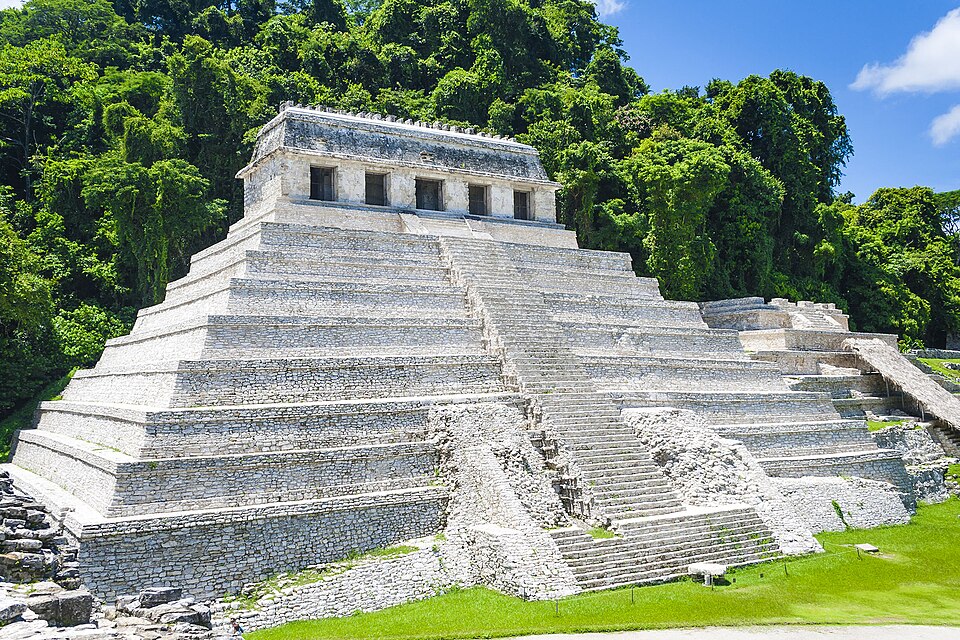
Palenque temple 1. Photo: Jan Harenburg / Wikimedia Commons. Palenque ( Chiapas ). Temple of inscriptions. Source
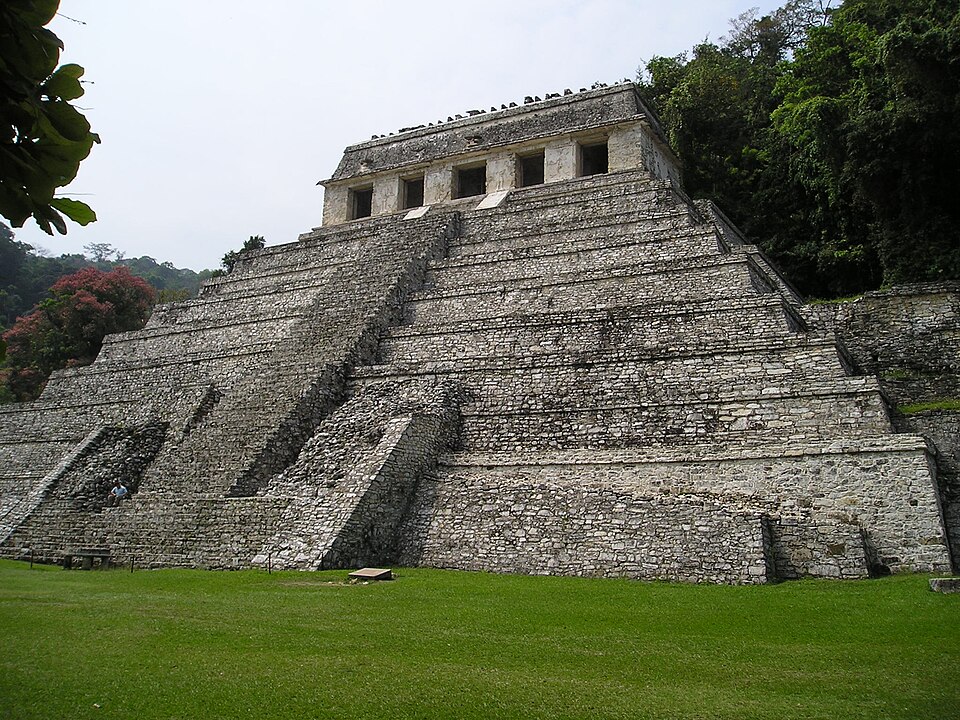
Palenque Temple of Inscriptions. Photo: Strobilomyces / Wikimedia Commons. Temple of Inscriptions at Palenque, Chiapas, Mexico. Source
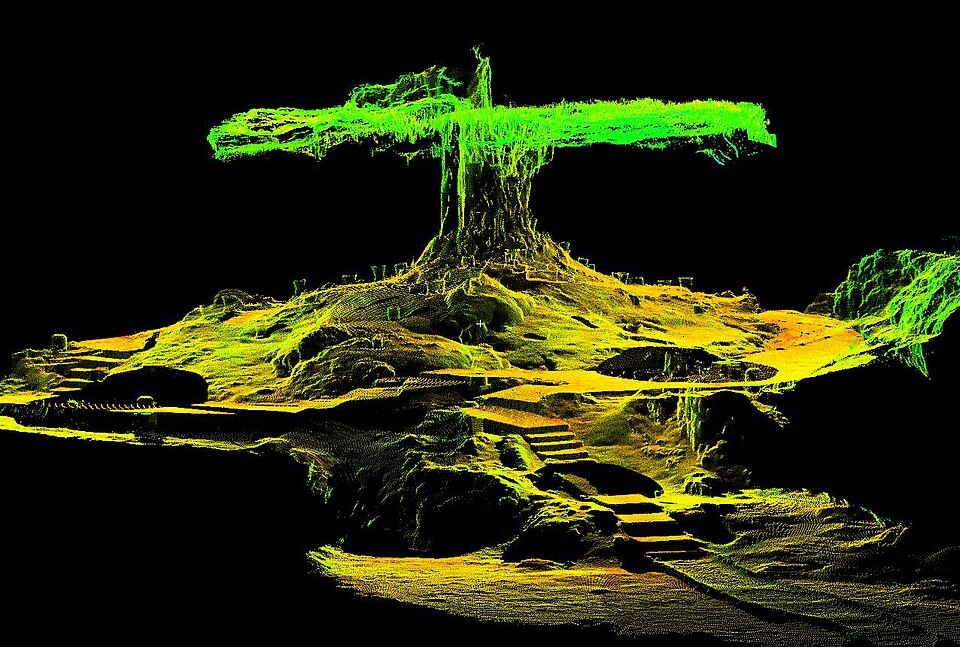
Balakanche1 cyark. Photo: CyArk / Wikimedia Commons. Source
The Nazca Lines were produced between roughly 500 BCE and 500 CE by the Nazca culture of Peru’s south coast, and the dominant mainstream interpretation today is Johan Reinhard’s water-ritual hypothesis: the lines functioned as sacred pilgrimage routes connecting ceremonial sites associated with underground water sources, not as runways. Erich von Däniken’s 1968 claim — that the long straight lines and wide trapezoids “look like runways from above” — runs into a problem the moment engineering tests are performed: the surface of the Nazca pampa is not engineered to support any aircraft, as Joe Nickell demonstrated by reproducing a 440-foot Nazca condor in a Kentucky field in 1982 using only stakes, ropes, and lime. The astronomical-calendar theory championed by Paul Kosok in 1941 and Maria Reiche for four decades — the “largest astronomy book in the world” — was statistically refuted by astronomer Gerald Hawkins, who concluded “The lines as a whole cannot be explained as astronomical nor are they calendric”. A 2024 AI-assisted aerial survey by Yamagata University and IBM Research identified 303 previously unknown figurative geoglyphs in six months, nearly doubling the known corpus from 430 to 733, and empirically distinguished two functional classes — relief-type figures visible from ground-level trails versus larger line-type figures for communal ritual — undermining any single-purpose “alien landing strip” interpretation. The humanoid figure known as the “Astronaut” or “Owl-Man” is read by mainstream scholars as a shaman or fisherman, not a space-suited alien. [7]
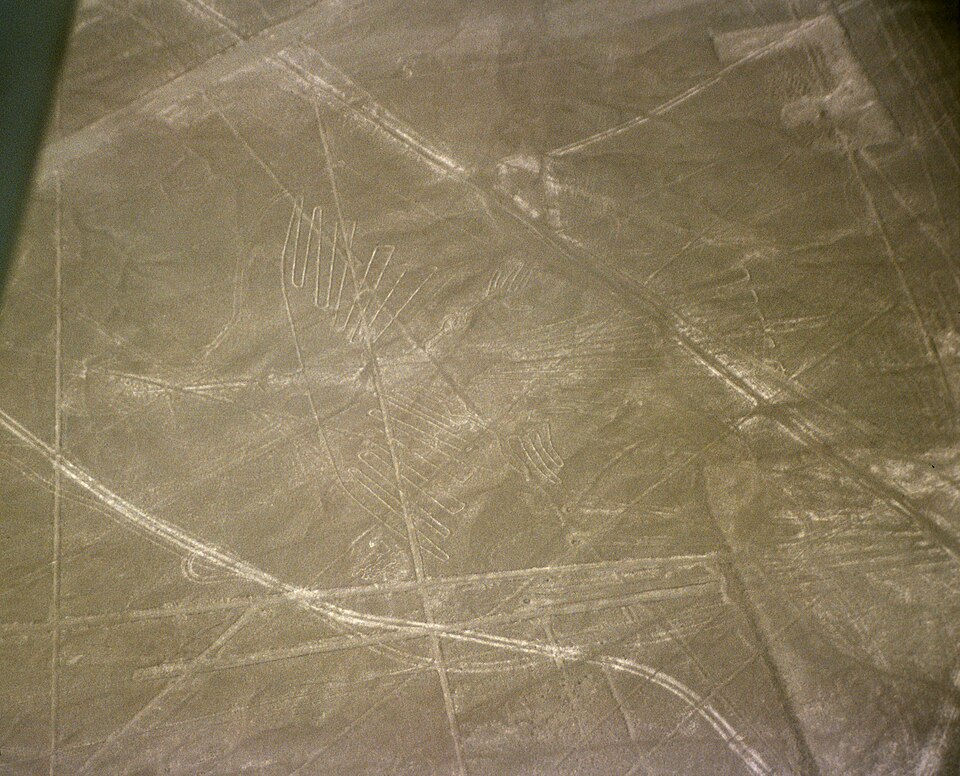
Illustration: Nazca-lineas-condor-c01. Photo: Wikimedia Commons. Source
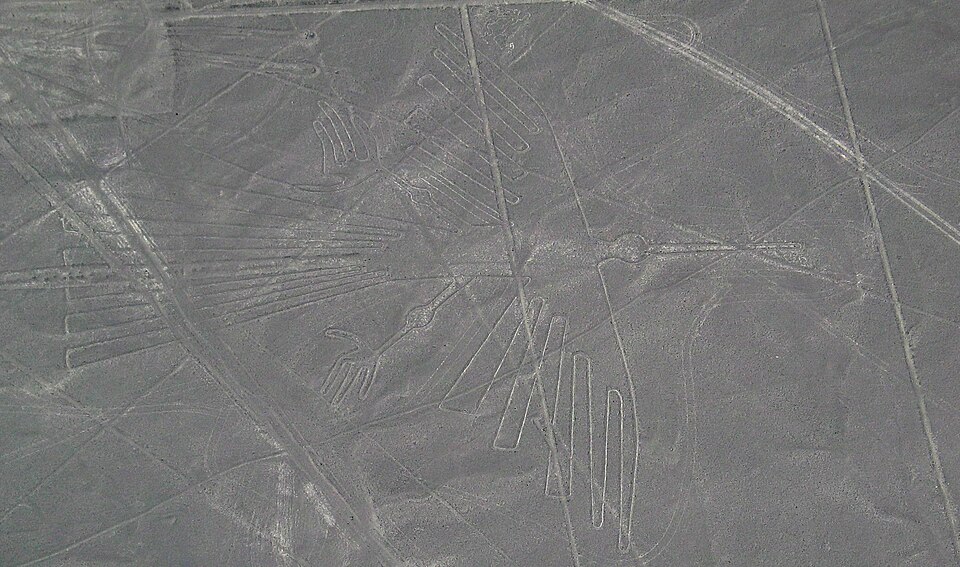
Nazca bird. Photo: Wikimedia Commons. Source
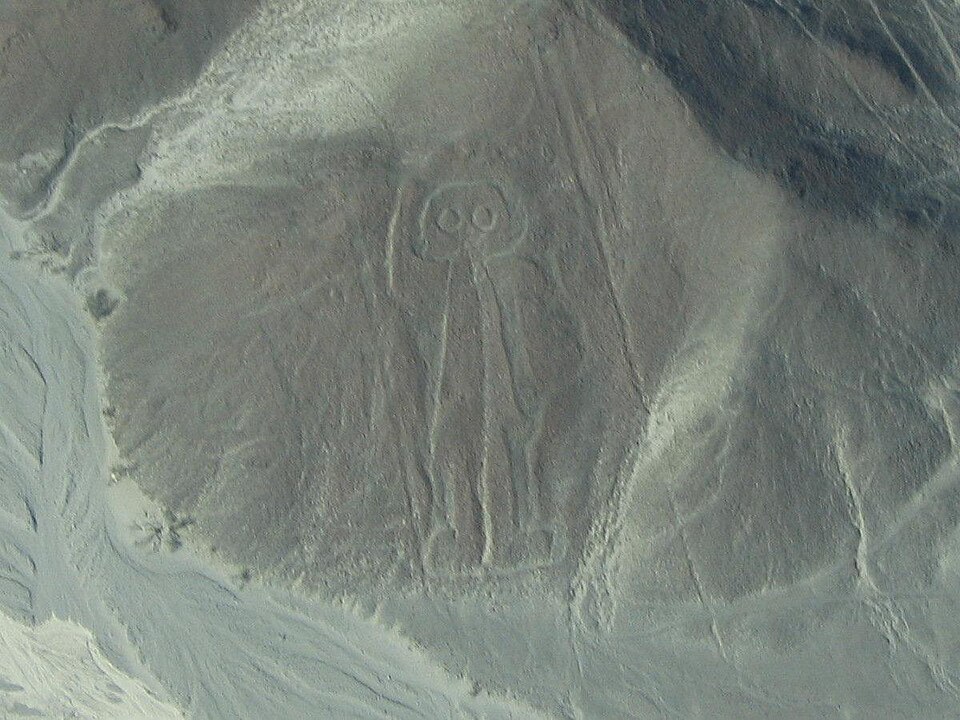
Nasca Astronaut 2007 08. Photo: Raymond Ostertag / Wikimedia Commons. Nasca (Peru), Astronaut, August 2007. Source
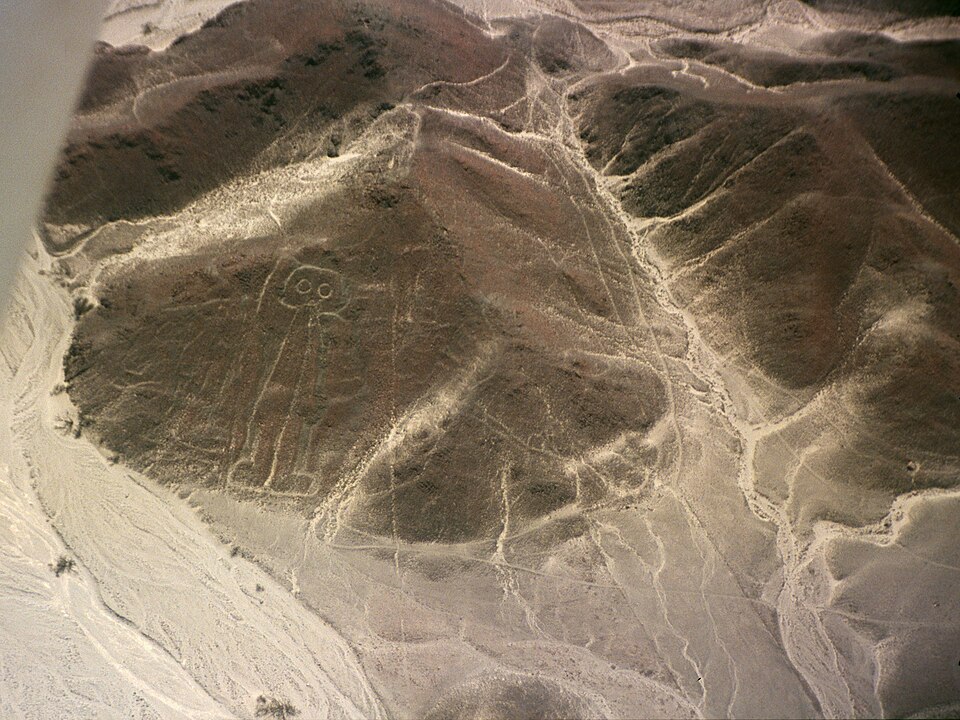
Nazca-lineas-astronauta-c01. Photo: Wikimedia Commons. Source
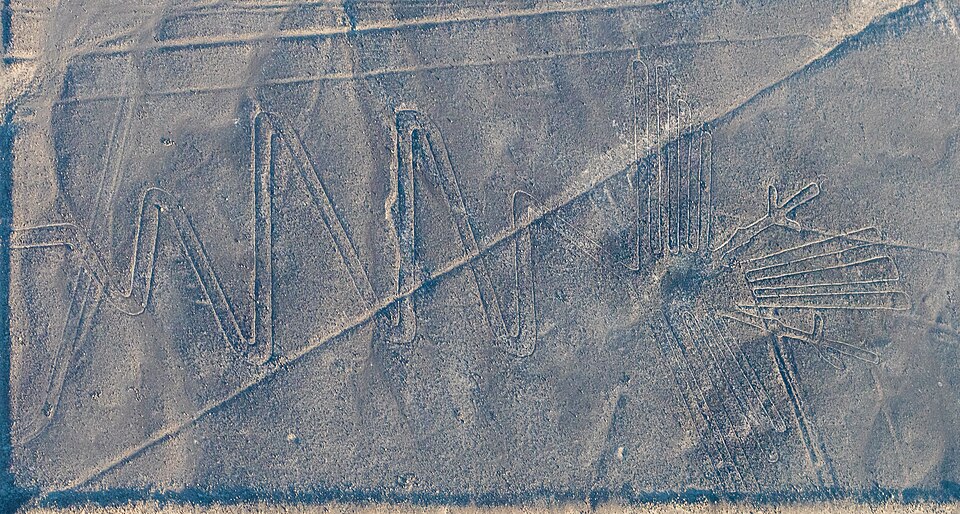
Líneas de Nazca, Perú, 2015-07-29, DD 64. Photo: Diego Delso / Wikimedia Commons. Source
The Saqqara Bird — a sycamore-wood figurine excavated in 1898 from the tomb of Pa-di-Imen at Saqqara, Egypt, dated to approximately 200 BCE, with a wingspan of 180 mm and a weight of 39.12 g — was championed by Egyptian physician Khalil Messiha in 1972 and 1991 as a 2,000-year-old model glider, a claim that has propagated through von Däniken’s circle. A 2023 peer-reviewed aerodynamic study by Zierow and Lesemann, using high-precision 3D scanning and computational flow simulation across multiple angles of attack, concluded that the artifact has a low maximum glide ratio, a center of gravity located at the trailing edge of the wing and behind the neutral point, longitudinal stability that fails modern specifications, and asymmetric spanwise lift distribution producing uncontrolled roll — explicitly stating that “the connection between the Bird of Saqqara and an alleged knowledge of aerodynamics in ancient Egypt could not be confirmed”. Glider designer Martin Gregorie’s 2002 independent replication produced measured glide ratios of just 2.18–2.79:1 — comparable to a wingsuit flyer (~2.5:1) and inferior to the Space Shuttle (3.7:1) — with the replica “totally unstable without a tailplane” and Gregorie’s verdict: “probably made as a child’s toy or a weathervane”. Mainstream Egyptology instead locates the Saqqara Bird within the votive animal-cult tradition at Saqqara’s Sacred Animal Necropolis, where falcons were sacred to Horus and the catacombs yielded millions of mummified raptors. [8] [9] [10] [11]
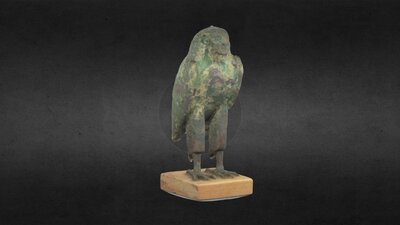
Illustration: Horus Falcon Figure in Bronze, MG 006. Photo: The Hunt Museum / Europeana. the immense volume and votive character of falcon burials at Saqqara, grounding the rebuttal that…. Source
The goggle-eyed (shakōki) Dogū figurines of Japan’s Final Jōmon period — the most-cited example being a hollow clay figure missing its left leg, unearthed in 1887 at the Kamegaoka Burial Site in Aomori Prefecture and dated to approximately 1000–400 BCE — are claimed by ancient-astronaut popularizers to depict humans wearing spacesuits, with the broad horizontal slit-eyes read as helmet visors. The mainstream reading is earthbound: the term “shakōki” (遮光器, “light-blocker”) refers to the visual resemblance of the broad eyes to Arctic snow goggles, not to any protective headgear or spacesuit technology. More than 20,000 Dogū have been excavated across Japan from sites ranging from pit dwellings and refuse deposits to ritual pits and occasional burials, with deliberate fragmentation — pieces of single figurines scattered across sites — interpreted as evidence of ritual deposition rather than preservation as representational “portraits”. Mainstream scholarship interprets Dogū as ritual/ceremonial objects tied to fertility, safe childbirth, healing, and shamanic practice, with many examples bearing breasts and protruding bellies consistent with female and pregnancy symbolism. The Metropolitan Museum of Art characterizes the Jōmon Maize God’s death-and-rebirth cycle — to which Dogū iconography is often tied — as a metaphor for regeneration, the same iconographic frame that mainstream Mayanists apply to the Pakal lid. [2]
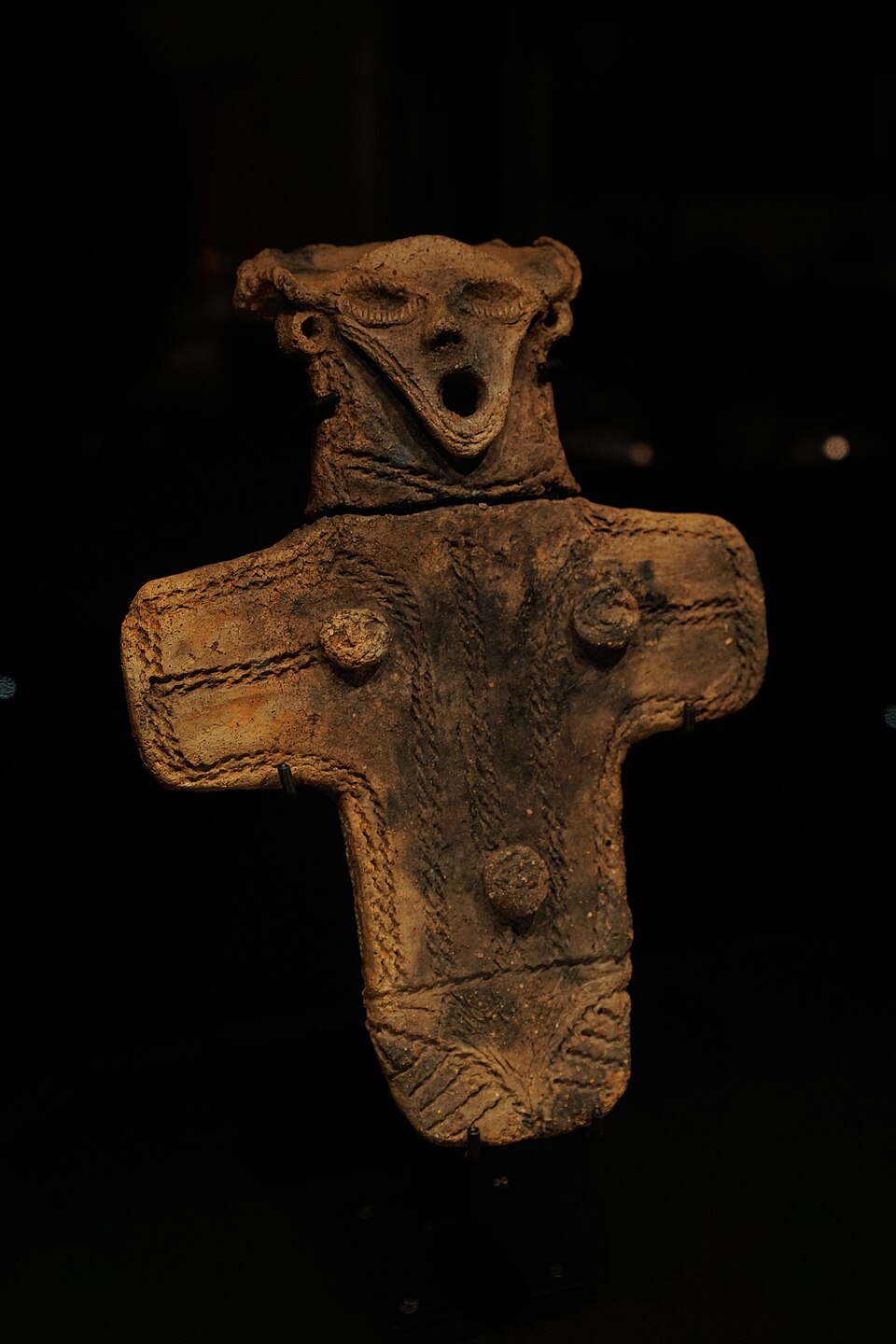
Illustration: Cross-shaped dogu in Sanmaru Museum. Photo: 掬茶 / Wikimedia Commons. Source
The Vaimanika Shastra — the Sanskrit text most often cited by ancient-astronaut proponents as evidence that ancient India possessed advanced “vimāna” flying machines — was first committed to writing between 1918 and 1923 when Pandit Subbaraya Shastry (1866–1940) of Anekal dictated the text, with scribe G. Venkatachala Sharma transcribing 23 exercise books and the engineering draughtsman T. K. Ellappa producing the illustrations in 1923. No manuscript of the work predates 1918. A 1974 critical study by five researchers at the Indian Institute of Science, Bangalore — H. S. Mukunda, S. M. Deshpande, H. R. Nagendra, A. Prabhu, and S. P. Govindaraju, published in Scientific Opinion — concluded that the heavier-than-air craft described are aeronautically non-feasible “poor concoctions” with geometries “unimaginably horrendous from the point of view of flying” and propulsion principles that “make them resist rather than assist flying,” with one design explicitly labeled “a decided impossibility”. The Sanskrit used in the text is modern rather than Vedic, and it cites numerous subsidiary texts — vimāna-candrikā, vyomayāna-tantra, yantra-kalpa, yāna-bindu, and others — that are never mentioned in any other Hindu work and survive in no manuscript tradition anywhere in India. The Pushpaka Vimana of the Ramayana, frequently invoked as an example of an ancient flying craft, is described in the epic itself as moving by invocation of mantras and tantras — not by any aerodynamic principle. The genuinely ancient Samarangana Sutradhara of King Bhoja (c. 1000–1055 CE) does describe bird-shaped yantras with mercury-and-flame propulsion, but these are framed as mechanical contrivances in an encyclopedic architectural treatise, not as working aircraft. [12]
Connecting the Dots
The Palenque sarcophagus lid shows a Maya ruler — K’inich Janaab’ Pakal, born 603 CE and died 683 CE — at the base of a cosmic World Tree (wacah chan) marked with ‘te’ (tree) glyphs, with the Principal Bird Deity perched above and the Quadripartite Monster maw below. When von Däniken recast this composition in 1968 as Pakal at the controls of a spacecraft, he stripped away every element of Late Classic Maya vocabulary that makes the scene legible. The same pattern appears in Japan’s Jōmon figurines: the broad-eyed shakōki-dogū of the Final Jōmon period (c. 1000–400 BCE) carry a modern descriptive label — shakōki means “light-blocking device” — retrofitted onto a stylized aesthetic convention found across a 15,000-piece corpus tied to fertility, healing, and shamanistic ritual. In Egypt, the Saqqara Bird’s vertical rudder-like tail and absent legs deviate from the standard Egyptian artistic convention of horizontal fan-shaped tails and visible legs, marking it as stylized falcon iconography tied to Horus, Sokar, and Ra-Horakhty rather than as an aerodynamic prototype from a 200 BCE tomb at Pa-di-Imen. [13]
The dating evidence collapses the ancient-astronaut timeline at every site. The Vaimanika Shastra, presented as transmitted by the sage Bharadvaja, was actually dictated between 1918 and 1923 by Pandit Subbaraya Shastry and cannot be dated earlier than 1904 according to the 1974 IISc analysis by Mukunda and colleagues. Nazca’s figurative geoglyphs — including the famous “Astronaut” measuring 32 meters — now extend back to 500 BCE–200 CE, attributed to Paracas and Topará cultures in a continuous tradition spanning over a thousand years before the Nazca period, as Castillo and the AI-accelerated drone survey have demonstrated. This continuous indigenous sequence directly contradicts the ancient-astronaut premise that the lines were “too large and precise” for the peoples who made them — a premise Kenneth Feder identifies as “not only pseudoscientific but also fundamentally racist” in its underlying assumption that indigenous societies could not have accomplished such works [14].
The same evidentiary pattern recurs across all five cases: an indigenous cultural feature is isolated from its context, then explained by reference to imagined external technology. The fabricated 3-D “rocket” rendering of Pakal’s lid exemplifies the pseudohistorical pattern of sensational claims, exclusive reliance on unreliable sources, and conflating possibility with actuality. David Stuart’s reading of the k’in bowl beneath Pakal as the hieroglyph EL (“to emerge, come out”) places the figure inside a coherent Late Classic Maya rebirth iconography attested across Palenque’s Temple of the Cross and Temple of the Foliated Cross. The aerodynamic tests align: Martin Gregorie’s 2002 balsa replica of the Saqqara Bird was “totally unstable without a tailplane” with “disappointing” glide performance, and the 2023 Zierow et al. study concluded that “the connection between the Bird of Saqqara and an alleged knowledge of aerodynamics in ancient Egypt could not be confirmed”. Each artifact, when read against its own cultural corpus, requires no alien engineer — a structural finding the ancient-astronaut framework cannot accommodate, since it depends on the very isolation of the artifact from context that makes its claims unfalsifiable. [15]
The Other Side
Conventional readings of the Nazca geoglyphs have moved far beyond the “alien landing strip” interpretation. The mainstream symbolic reading of the so-called “Astronaut” geoglyph depicts a shaman or priest, in contrast to the pseudoarchaeological reading of an astronaut or alien visitor. Maria Reiche’s fieldwork and subsequent AI-assisted surveys have catalogued hundreds of additional figures, situating the geoglyphs within a much larger ritual landscape. Two functional hypotheses now structure the field: Johan Reinhard and Anthony Aveni’s ritual-pilgrimage model, in which straight lines functioned as processional routes linking ceremonial centers, and the Mabee–Proulx literal-water hypothesis, in which the lines trace subsurface aquifers and water sources. Phyllis Pitluga’s computer-aided analysis argued that the spider geoglyph encodes an anamorphic diagram of the constellation Orion, with associated lines following the changing declination of Orion’s Belt. As for any aerial-landing-strip reading, the chronological mismatch is fatal: the first documented human flight was the Montgolfier brothers’ 1783 ascent, roughly seventeen centuries after Nazca line construction, meaning no contemporaneous observer could have conceived of an aircraft requiring such a strip. [16]
What We Actually Know
The ancient-astronaut readings aren’t fabrications – they’re interpretations of real artifacts, and that’s where their traction lives. Von Däniken’s 1968 “Chariots of the Gods?” built the Pakal-as-pilot claim on an actual Late Classic Maya relief, the Saqqara glider theory rests on a genuine 39-gram sycamore object excavated in 1898 from the tomb of Pa-di-Imen, and the dogū astronaut claim begins with thousands of excavated Jōmon clay figurines whose goggle eyes genuinely startle on first viewing. The claims persist because the visual surface is ambiguous: a Maya ruler in what looks like a control panel, Jōmon figures with enormous goggle-eyes, a bird-shaped wood artifact with a vertical tail unlike any standard Egyptian bird depiction. Eyes see, and eyes see spacesuits. The reading requires ignorance of iconographic context – but the context has to be learned. [17] [18]
The iconographic context, once surfaced, dissolves the readings. The Pakal lid’s cross-shaped tree is identified by specific diagnostic markers – te/tree logograms (Thompson T278/T279) on trunk and branches, mirror signs, jade celt imagery – as the Maya cosmic World Tree (wacah chan), a pan-Maya cosmological convention documented from the Preclassic period onward and persisting into the colonial period. The skeletal maw is the Quadripartite Monster, with the double-headed vision serpent winding through the branches and K’awiil emerging from one jaw. David Stuart’s epigraphic reading anchors the composition: the k’in (sun/day) bowl beneath Pakal serves as the hieroglyph EL (“to emerge”), the basis of elk’in (“east”), fusing birth and death iconographically. The dogū’s goggle eyes give the figure its name – shakōki-dogū, a modern Japanese descriptive label likening the broad eyes to Arctic Inuit snow goggles – and the figurines date to the Final Jōmon period (c. 1000–400 BCE), one late regional style within a corpus of over 18,000–20,000 dogū throughout Japan, with mainstream archaeology stating explicitly that “archaeological evidence does not support claims that the figures wear spacesuits or depict extraterrestrials”. [19] [20] [21]
For Nazca, the early Kosok–Reiche astronomical-calendar hypothesis dominated mid-century thinking but has been substantially undermined since the 1970s – astronomical alignments have not held up to systematic testing. The replacement is the water/ritual pilgrimage hypothesis (Reinhard, Aveni): the lines led to ritual sites tied to water sources, mountains, rivers, and underground aquifers, with biomorphic motifs encoding Andean water/fertility symbolism (spider = rain, hummingbird = fertility, monkey = Amazonian water abundance). A 2024 AI-assisted survey (Sakai et al., PNAS) empirically distinguished two functional classes of figurative Nazca geoglyphs – line-type (64% wild animals, community-level ceremonial use) and relief-type (81.6% humans/domesticated motifs, individual or small-group viewing from nearby trails) – undermining any single-purpose theory, including the alien-strip reading. The Saqqara Bird, dated ~200 BCE (Ptolemaic period), has mainstream interpretations as a child’s toy, weather vane, or masthead/finial ornament for a sacred barque. [22] [23]
What remains genuinely speculative is narrow. The Saqqara Bird’s vertical rudder-like tail and absence of legs are anomalous within Egyptian artistic convention – which consistently depicted birds with horizontal fan-shaped tails and visible legs – while ancient bird-shaped weather vanes are independently documented for Mesopotamia (c. 1800–1600 BCE), Greece (Tower of the Winds), and Han Dynasty China, so the object need not be unique as a wind-direction device. The glider reading persists but lacks direct evidence. Italian visual analyst Diego Cuoghi interprets the same putative astronaut images as religious symbolism consistent with period iconographic conventions – but as an informed amateur rather than a credentialed Mesoamericanist, his reading complements but does not substitute for peer-reviewed Maya scholarship (Stuart, Houston, Schele, Latin American Antiquity corpus). The largest question this corpus leaves open is methodological: no specialist directly compares the rhetorical and visual strategies across the five artifacts – how “selective cropping,” “argument from present ignorance,” and “appeal to lost knowledge” operate similarly or differently in each case – and no specialist documents how the canonical von Däniken version of each claim has continued to evolve through the “Ancient Aliens” TV format. The imagery is real, the readings are real, the rebuttals are real, but no one has mapped the rhetorical mechanics by which an unlearned eye keeps seeing spaceships. [13]
References
[1] (PDF) The Palenque Mythology: Inscriptions from the Cross … — https://www.academia.edu/32273450/The_Palenque_Mythology_Inscriptions_from_the_Cross_Group_at_Palenque (accessed 2026-08-28) [Academic]
[2] Dogū: from prehistoric figurines to collectible pocket monsters — https://jgeekstudies.org/2018/05/19/dogu-from-prehistoric-figurines-to-collectible-pocket-monsters/ (accessed 2026-08-28)
[3] Japanese Pottery - Clay Figurines from the Jomon Period — http://www.e-yakimono.net/html/jomon-dogu.html (accessed 2026-08-28)
[4] Dogū Figurines: Meaning, Types and Jōmon Mystery — https://www.daiyokai.com/en/post/dogu-jomon-figurines-mystery/ (accessed 2026-08-28)
[5] the quadripartite badge: narratives of power and resurrection in — https://sciences.ucf.edu/anthropology/wp-content/uploads/sites/2/2013/09/Ingalls_Victoria.pdf (accessed 2026-08-28) [Academic]
[6] The Quadripartite Badge: Narratives Of Power And Resurrection In Maya Iconography — https://stars.library.ucf.edu/etd/2393 (accessed 2026-08-28) [Academic]
[7] The Nazca Lines Still Don’t Make Sense [8:01-9:35] — Michael Button (YouTube) — https://youtu.be/RJJbiHUO534?t=481 (accessed 2026-08-28)
[8] AERODYNAMIC INVESTIGATION ON THE ARTEFACT “BIRD … — https://sciendo.com/pdf/10.2478/ama-2023-0046 (accessed 2026-08-28)
[9] The Saqqara Bird: Artifact, Icon, or Ancient Technology? — https://www.archaeo-acoustics.com/post/the-saqqara-bird-artifact-icon-or-ancient-technology (accessed 2026-08-28)
[10] Does the Saqqara Bird Show That Ancient Egyptians Knew … — https://www.popularmechanics.com/science/archaeology/a73172123/egyptian-saqqara-bird-glider/ (accessed 2026-08-28)
[11] Saqqara Bird — https://en.wikipedia.org/wiki/Saqqara_Bird (accessed 2026-08-28) [Reputable]
[12] Why the Indian Scientific Community is to Blame for the Lack of Science … — https://caravanmagazine.in/vantage/indian-science-congress-ancient-aviation-criticism (accessed 2026-08-29)
[13] [PDF] Between Heaven and Earth - Birds in Ancient Egypt — https://isac.uchicago.edu/sites/default/files/uploads/shared/docs/oimp35.pdf (accessed 2026-08-28) [Academic]
[14] Erich von Däniken Criticism: Foolsgold of the Gods — https://www.enotes.com/topics/erich-von-daniken/criticism/kenneth-l-feder (accessed 2026-08-28)
[15] Researchers Thought This 2200-Year-Old Egyptian Artifact … — https://indiandefencereview.com/researchers-thought-egyptian-artifact-could-fly-science-settled-debate/ (accessed 2026-08-29)
[16] The 8 Most Intriguing Nazca Lines — https://www.thecollector.com/most-intriguing-nazca-lines/ (accessed 2026-08-28)
[17] The Saqqara Bird - Virtual Museum — https://sites.google.com/stjohns.bc.ca/acacchioni-saqqarabird/home (accessed 2026-08-28)
[18] Flying the Saqqara Bird - Catchpenny Mysteries of Ancient Egypt — https://www.catchpenny.org/birdtest.html (accessed 2026-08-28)
[19] Detail drawing of Pakal’s Sarcophagus Lid — https://www.ancientamericas.org/es/node/10583 (accessed 2026-08-28)
[20] iconography – Maya Decipherment — https://mayadecipherment.com/tag/iconography-2/ (accessed 2026-08-28)
[21] How a sarcophagus in a Mayan temple depicts the Tree … — https://www.ldsliving.com/how-a-sarcophagus-in-a-mayan-temple-depicts-the-tree-of-life-the-veil-and-the-resurrection/s/89267 (accessed 2026-08-28)
[22] Accelerated Discovery of Nasca Geoglyphs Guided by AI — https://www.dlr.de/en/eoc/latest/news/2024/accelerated-discovery-nasca-geoglyphs-by-ai (accessed 2026-08-28)
[23] Scientists discover 4 new Nazca Geoglyphs using AI deep … — https://arkeonews.net/scientists-discover-4-new-nazca-geoglyphs-using-ai-deep-learning/ (accessed 2026-08-28)
Keep exploring
Every site on this page sits on the globe, and the people who research them are on the Discord.
3D Globe · Sites by country · Story Archive · Research Library · Weekly Journal · Search