

New research shared by a Saqqara Research team member describes Saqqara's central field as an Old Kingdom limestone quarry before its development as a mastaba field. The video argues that palace-facade decoration originated in Mesopotamia, appeared in pre-dynastic northern Egypt as a symbol of elite power, and was later adopted for early dynastic palaces, royal tombs and royal sarcophagi. At the Fifth Dynasty tomb of Prince Waserif-Re, a rock-cut niched projection predates his burial; a later mudbrick superstructure covered part of it, and an unidentified Fifth Dynasty official's tomb was built against its already-eroded facade.
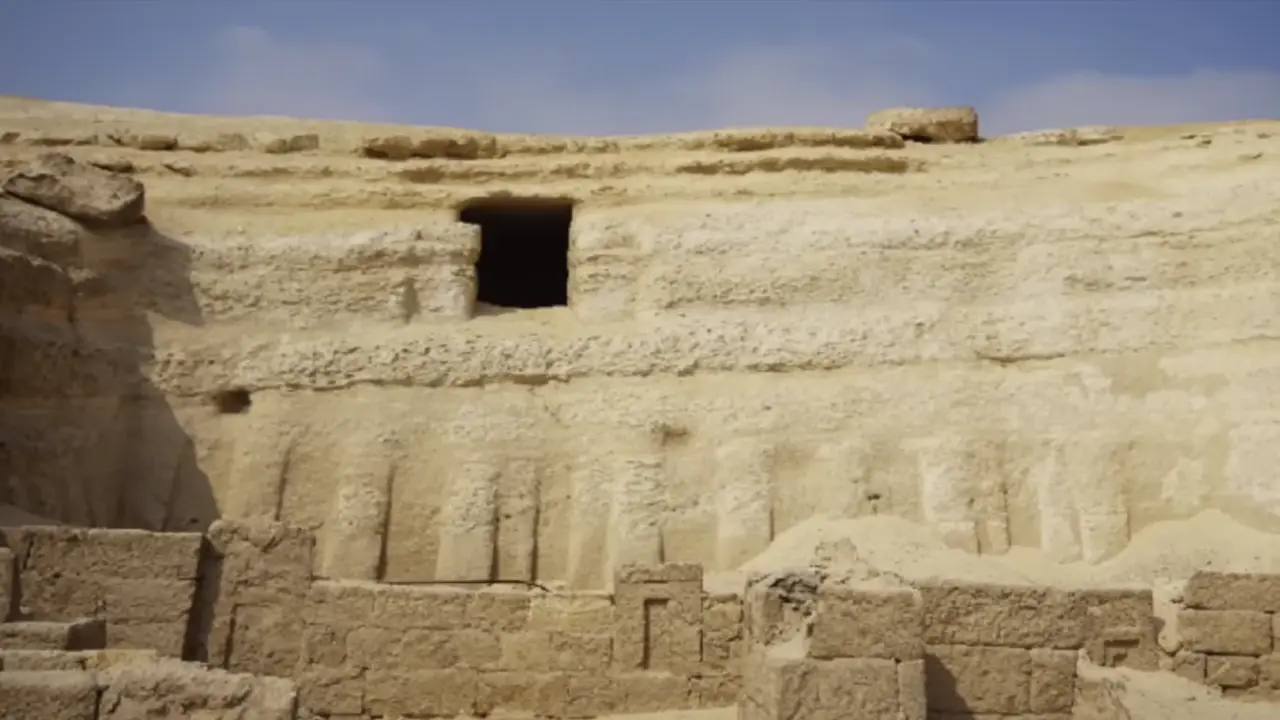
Waserif-Re's tomb preserves an earlier palace facade on its southern and eastern sides
Site mentioned
📍 Saqqara, Mastaba of Kagemni🌍 Show on the globe
Key facts
- The monument described is the Tomb of Waserif-Re, an early-to-mid Fifth Dynasty prince, with palace-facade decoration carved on its southern and eastern exterior, facing the wadi and Nile.
- Its rock-cut entrance projection had repeated niches on all three exposed sides and predates Waserif-Re's burial.
- A later mudbrick superstructure obscured parts of the facade decoration carved into the bedrock.
- The presenter notes that the niche pattern was not reproduced on the mudbrick and interprets this as showing that the earlier decoration was not central to the burial project.
- An adjacent tomb belonging to an unidentified Fifth Dynasty official was built against the already-eroded facade.
- The presenter infers from the erosion and time gap that the decoration predates the Fifth Dynasty, possibly before the Fourth Dynasty.
- The presenter interprets a diagram in Colin Reader's work as suggesting that the related facades at Khentkawes's and Kai's tombs formed an earlier continuous project.
Sources
Unique Egyptian family statue discovered in Saqqara redefines Old ...archaeologymag.com
Unique Old Kingdom family statue at Saqqara reveals innovative blend of relief and 3D carving, reshaping Egyptian art history.
New Discoveries in Saqqara Unveil Hidden Secrets Of Old, New ...sis.gov.eg
One tomb, located near the northern edge of the Saqqara plateau, features a limestone-sealed shaft leading to a burial chamber. The other ...
New discoveries in Saqqara unveil hidden secrets of ... - Ahram Onlineenglish.ahram.org.eg
“This new evidence suggests that Saqqara was not only a major burial site during the Old Kingdom but also became significant during the New ...
Old and New Kingdom tombs at Saqqara - The Pastthe-past.com
One of the tombs, with a limestone sealed shaft, was discovered near the northern edge of the Saqqara plateau, indicating that the necropolis ...
Limestone relief disappears from Egypt's Saqqara necropolistheartnewspaper.com
The work, taken from the tomb of a vizier called Khentika, features a motif that is extremely rare in Ancient Egyptian art.
Opening of the Lost Tombs - On FOX LIVE 3/2/99 - Guardian.netguardians.net
Long-lost secrets of ancient Egypt were revealed Tuesday evening when the mummified body of the ancient Egyptian high priest Kai was discovered in its burial ...
Zahi Hawass: The Tombs of Kai at Giza. Description and ...books.ff.cuni.cz
The Giza Plateau, one of Egypt's most iconic archaeological sites, houses hundreds of tombs from the Old Kingdom as well as later periods.
Administrator Kaiegypt-museum.com
This seated statue of the administrator Kai was discovered in November of 1850, at the Memphite Necropolis.
Was this story useful?
Keep exploring
Every site on this page sits on the globe, and the people who research them are on the Discord.
3D Globe · Sites by country · Story Archive · Research Library · Weekly Journal · Search
AI-generated text · images from the original sources · always verify with the sources.