

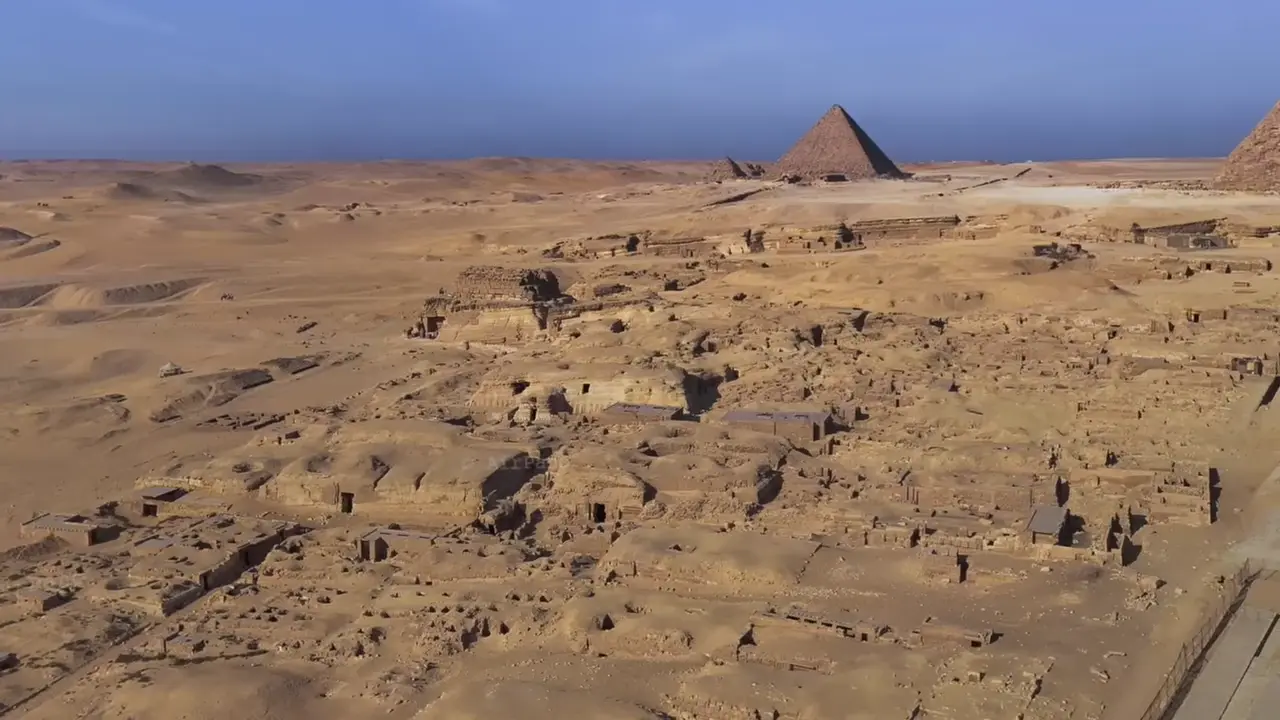
Old Kingdom limestone quarries in Giza’s Central Field supplied Khufu and Khafre’s pyramids, and parts of the area were later reused for mastabas. The video argues that some cuts began in the pre-Dynastic period and that palace-façade decoration reached northern Egypt from Mesopotamia at that time; these are the presenter’s interpretations, not conclusions established by the cited quarry evidence. The related settlement is Maadi, near Memphis, where evidence of trade links Upper Egypt with the southern Levant and Mesopotamia. 🏛️
Giza’s Central Field was quarried in the Old Kingdom, then partly reused for mastabas
 EgyptArchitecture
Key facts
- Quarrying in Giza’s Central Field supplied stone for Khufu and Khafre’s Old Kingdom pyramids; parts of the quarrying area were later reused for Fourth- and Fifth-Dynasty mastabas.
- The video argues that some rock cuts began in the pre-Dynastic period and were reworked in the Fourth and Fifth Dynasties. The cited evidence supports Old Kingdom quarrying but does not establish that earlier date.
- The video presents the introduction of palace-façade decoration from Mesopotamia into pre-Dynastic northern Egypt, and its use as an elite symbol, as its own interpretation.
- Palace-façade decoration appeared in later early dynastic and Old Kingdom contexts, including royal architecture, monumental tombs, coffins and material associated with Menkaure’s fragmentary sarcophagus; these examples do not establish the claimed pre-Dynastic origin.
- The settlement’s name is Maadi, not Madi. The pre-Dynastic and early dynastic site near Memphis provides evidence of exchange linking Upper Egypt with the southern Levant and Mesopotamia.
Sources
[PDF] Pyramid Construction. New Evidence Discovered at Gizagizamedia.rc.fas.harvard.edu
I. Evidence of pyramid base construction found to the east of Khufu's pyramid. II. The location of the quarry. III. The discovery of the ramp of Khufu's pyramid.
Central Field, Giza - Grokipediagrokipedia.com
Structurally, Central Field tombs innovated by integrating natural rock formations into substructures, resulting in hybrid mastaba-rock-cut designs that ...
An Incremental Mastaba-Based Construction Framework for Old ...researchgate.net
The central innovation is an alternating block placement strategy that enables cribbing access while maintaining structural integrity.
[PDF] The Stones of The Pyramids - Harvard Universitygizamedia.rc.fas.harvard.edu
According to REISNER83, the bedrock of the eastern and western mastaba fields were also used as quarries. ... of the main quarry area known today as the "Central ...
Central Field, Giza - Wikipediaen.wikipedia.org
It is the site of some large stone quarries that provided the stones for the construction of the first two pyramids built at Giza (the Great Pyramid and the ...
Giza on line -The Pyramids -page 3- Quarriestheglobaleducationproject.org
Quarries have been located at Giza ... Nearly all of the granite apparently came from the area around Aswan and Elephantine Island, a distance of 500 miles.
Archaeology at Giza - Digital Giza - Harvard Universitygiza.fas.harvard.edu
Georg Steindorff of Germany (Hildesheim) received the middle section and the Khafre Pyramid, along with the area behind the Sphinx known as the Central Field.
Giza-0015 central field overviewflickr.com
The central field is located at the site of some large stone quarries that provided the stones for the construction of the first two pyramids ...
Was this story useful?
Keep exploring
Every site on this page sits on the globe, and the people who research them are on the Discord.
3D Globe · Sites by country · Story Archive · Research Library · Weekly Journal · Search
AI-generated text · images from the original sources · always verify with the sources.