

In 25 BC, Greek writer Strabo visited Abydos and described a remarkable structure built of solid stone. He compared it to the labyrinth he had described, though noted it was not multiplex. He had no framework to explain what he'd seen—nothing in the Greco-Roman world had been built at this scale. The only similar structure in size, scale, and construction was Khafra's Valley Temple at Giza.
Strabo described Osirion's vaulted galleries of enormous monoliths in 25 BC
 EgyptGeneral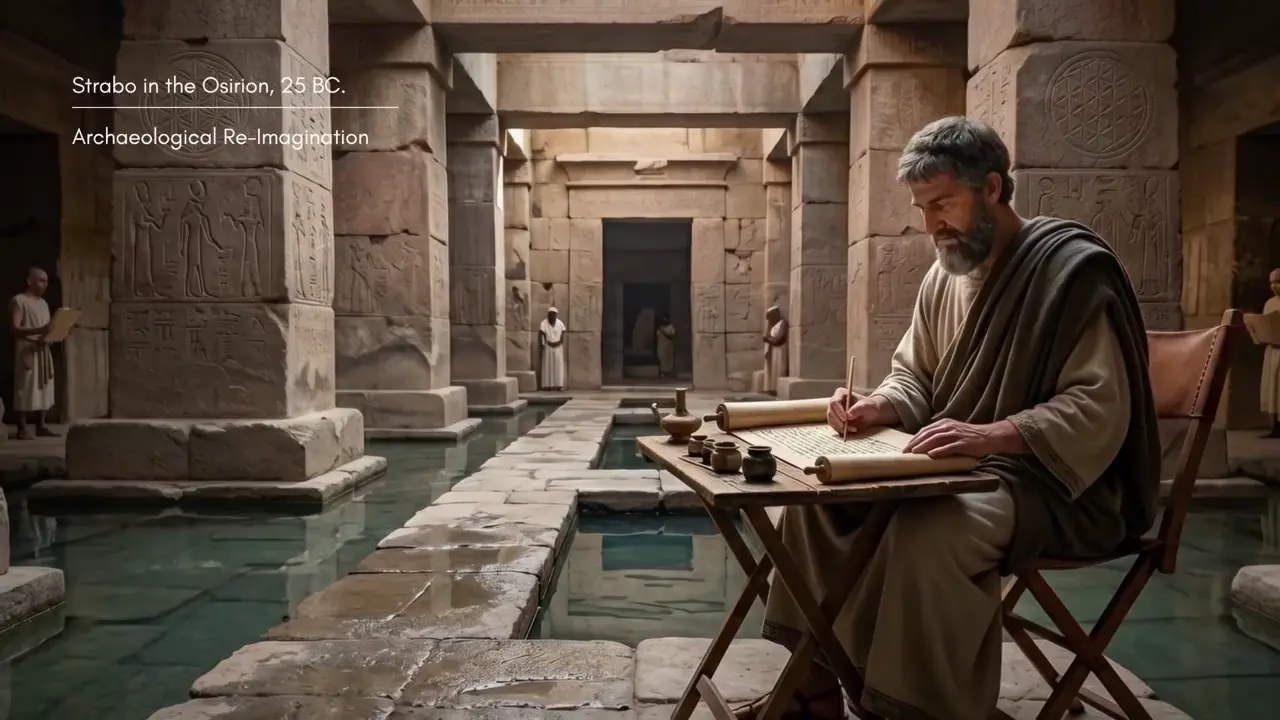
Key facts
- In 25 BC, Greek writer Strabo visited Abydos and described a remarkable structure built of solid stone
- Strabo described 'a fountain at great depth' accessed by 'vaulted galleries made of monoliths of surprising size and workmanship'
- He compared it to the labyrinth he had described, though noted it was not multiplex
- Strabo had no framework to explain what he'd seen, as nothing in the Greco-Roman world had been built at this scale
- The only similar structure in size, scale, and construction was Khafra's Valley Temple at Giza
- The Osirion remained buried under 40 feet of sand and rubble for the next 1,900 years
Site mentioned
Sources
Abydoss: The Osireion - Ancient-Wisdomancient-wisdom.com
Abydoss has revealed itself to be one of the most important archaeological sites in Egypt. It is the site of the pre-dynastic royal graveyard, ...
Abydos (Hellespont) - Wikipediaen.wikipedia.org
Abydos was founded in c. 670 BC at the most narrow point in the straits, and thus was one of the main ...
Place - ToposTexttopostext.org
Strabo, Geography (Str.) §17.1.42 a form of government after the Grecian mode. Above this city is Abydos, where is the palace of Memnon, constructed in a ...
The World According to Strabo about 25 B.C. / Map of the World ...artsourceinternational.com
The World According to Strabo about 25 B.C. / Map of the World According to Eratoshenes about 225 B.C. ; Size: 10 x 13 inches ; Condition: Very Good, light age ...
LacusCurtius • Strabo's Geography — Book XVII Chapter 1 (§§ 25‑54)penelope.uchicago.edu
Ælius Gallus made the voyage about 25 B.C., but that Chaeremon was a tutor of Nero after A.D. 49. ❦. 161 The Epitome reads "three years," and Diogenes ...
Was this story useful?
Keep exploring
Every site on this page sits on the globe, and the people who research them are on the Discord.
3D Globe · Sites by country · Story Archive · Research Library · Weekly Journal · Search
AI-generated text · images from the original sources · always verify with the sources.