

In 1902, Sir William Flinders Petrie uncovered a mysterious depression behind Seti I's temple at Abydos and assigned Margaret Murray to investigate, beginning one of archaeology's most physically demanding excavations. The Osirion was buried under 40 feet of loose sand with perfectly vertical walls, requiring workers to essentially mine downward. They uncovered 10 monolithic rose granite columns, each 4 meters high, with roof lintels weighing 60 to 100 tons. Murray concluded in 1904 it was built for the worship of Osiris and celebration of the mysteries.
Flinders Petrie and Margaret Murray excavate Osirion in 1902, discovering massive megalithic architecture
 EgyptExcavation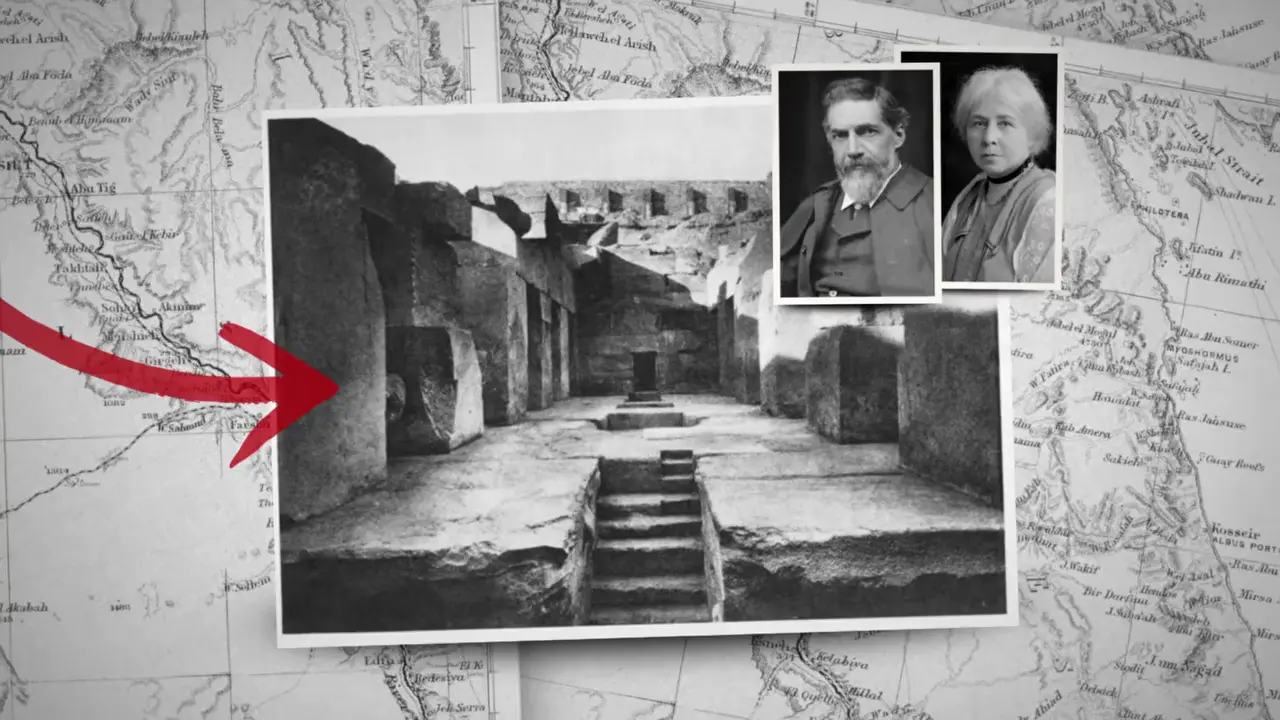
Key facts
- In 1902, Sir William Matthew Flinders Petrie noticed a mysterious depression behind the Temple of Seti I at Abydos
- Petrie assigned Margaret Murray to investigate the site, beginning one of the most physically demanding excavations in Egyptian archaeology
- The Osirion was buried under approximately 40 feet of loose sand with perfectly vertical walls
- Workers had to cut straight down, essentially mining a shaft rather than digging a trench
- Two days of high winds once buried an entire cleared section back up to roof level overnight
- The excavation uncovered 10 monolithic rose granite columns, each 4 meters high, cut from single blocks of Aswan granite
- Roof lintels weighing 60 to 100 tons spanned gaps between columns
- Surrounding walls were made of red sandstone 5 meters thick with 17 small chambers carved into them
- A subterranean moat surrounded a central raised platform, a stone island in an underground lake
- Murray concluded in her 1904 publication that the structure was built for the worship of Osiris and celebration of the mysteries
Site mentioned
Sources
The Osirion at Abydos (Abtu)ascendingpassage.com
This simple map drawn by Miss Murray shows the floor plan of the Temple of Seti I and the portion of the Osirion she discovered in the 1903-4 season.
Murray, Margaret Alice: The Osireion at Abydos (London ...digi.ub.uni-heidelberg.de
Murray, Margaret Alice: The Osireion at Abydos; Universitätsbibliothek Heidelberg.
Margaret Murray - The Osireion — Abydososireion.info
Margaret Alice Murray (1863–1963) was a British Egyptologist and archaeologist who participated in Flinders Petrie's excavation at Abydos in 1902.
The Osireion – links & further reading - Dr Chris Nauntonchrisnaunton.com
Margaret Murray's report, The Osireion at Abydos (1904), includes her description of the discovery of the monument and the first excavations, and is ...
The Osireion , A very early but one of the most detailed ...academia.edu
The Osireion at Abydos reveals unique architectural and religious insights, particularly regarding burial practices. Excavations uncovered ...
Was this story useful?
Keep exploring
Every site on this page sits on the globe, and the people who research them are on the Discord.
3D Globe · Sites by country · Story Archive · Research Library · Weekly Journal · Search
AI-generated text · images from the original sources · always verify with the sources.