

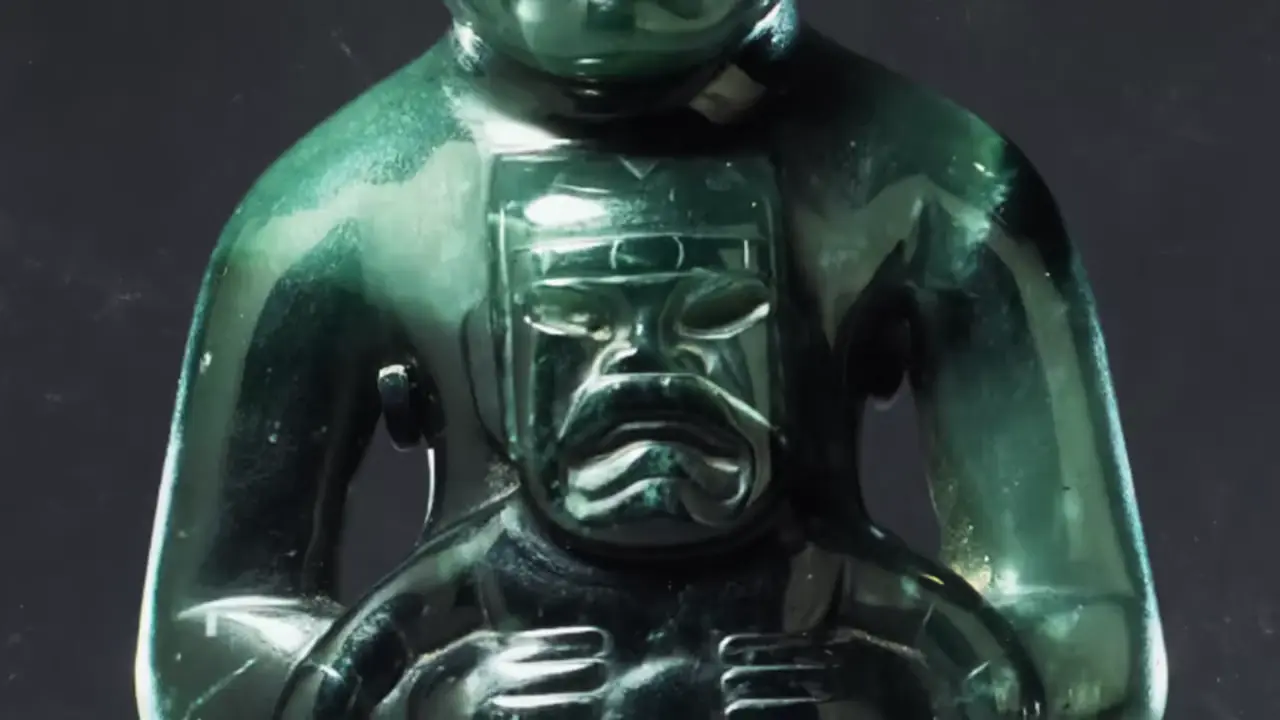
Archaeologists have traced the were-jaguar motif across Mesoamerica, finding thousands of human-jaguar hybrid depictions. This motif appears widely in the Olmec archaeological record and is characterized by almond-shaped eyes, a downturned open mouth, and a cleft head. The Olmec, or at least their royal lineage, believed they were descended from a Jaguar God. While the were-jaguar is strongly associated with the Olmec, jaguar motifs and feline deities appear throughout later Mesoamerican cultures including Maya and Aztec civilizations. The were-jaguar motif represents a central element of Mesoamerica's first great religion.
Sterling tracks were-jaguar motif across Mesoamerica 1947-1957
Key facts
- The were-jaguar appears on nearly every Olmec monument excavated
- Nowhere in later Mesoamerican cultures (Maya, Zapotec, Teotihuacan, Aztec, Toltec) was the were-jaguar seen
- From 1947-1953, Sterling led four expeditions into Panama tracking were-jaguars
- He discovered the oldest known ancient sites in Panama with man-made mounds
- Found artifacts of gold, pottery, stone tools, weapons, and depictions of were-jaguars
- In 1954, he investigated Costa Rica for ceramic artifacts influenced by Mesoamerica
- In 1956-1957, his final expedition returned to Ecuador discovering pre-Colombian sites
- Found man-made earthn mounds and were-jaguar depictions in Ecuador's jungled highlands
- There are thousands of depictions of human-jaguar hybrids in the Olmec realm
Sources
Introduction: The Origin and Development of Olmec Researchdoaks.org
The archaeological evidence argues for an entirely Indigenous development, however, and many Olmec traits are traceable to earlier cultures of Early Formative ...
Were-jaguars and jaguar babies in Olmec religion | Essex Student ...publications.essex.ac.uk
This project draws the conclusion that the jaguar was a natural choice as a symbol of the “royal house” but had a religious importance that predated this ...
The ferocious and mysterious were-jaguar of the ancient Olmecshistoryskills.com
The Olmec civilisation developed in the Gulf Coast region of Mexico, within the tropical zones of present-day Veracruz and Tabasco. Archaeological evidence ...
Jaguar Cult — Down's Syndrome — Were-Jaguar - Penn Museumpenn.museum
A comparison of many of the Olmec were-jaguar representations with individuals affected by Down's syndrome shows such striking similarities.
The Werejaguar and the Lost Religion of the Olmechistoricmysteries.com
Discover the mystery of the Olmec werejaguar — a half-human, half-jaguar deity at the heart of Mesoamerica's first great religion.
Was this story useful?
Keep exploring
Every site on this page sits on the globe, and the people who research them are on the Discord.
3D Globe · Sites by country · Story Archive · Research Library · Weekly Journal · Search
AI-generated text · images from the original sources · always verify with the sources.