

De Soto's 1539 La Florida expedition brought seven ships, 600 men, 237 horses and 200 pigs, with a colonizing directive from Queen Isabella. Spanish chroniclers counted about 100,000 people in the Apalachee kingdom. Their capital Anhikaha lay beneath modern Tallahassee — metal artifacts from the expedition confirmed it. 🏺
De Soto's 1539 siege of the Apalachee capital Anhikaha, found under Tallahassee
Site mentioned
📍 Anhikaha
Key facts
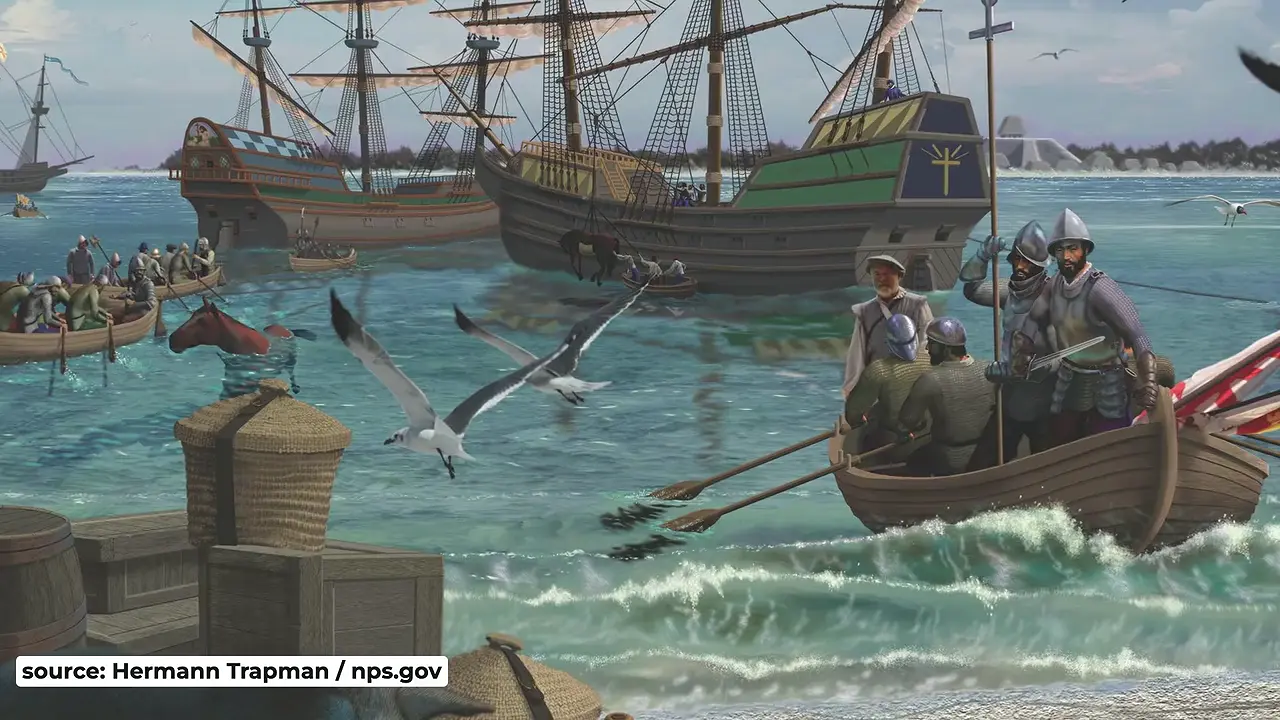
- Hernando de Soto's 1539 expedition landed in Tampa Bay with seven ships, 600 men, 237 horses and 200 pigs, carrying a directive from Queen Isabella to colonize La Florida; the expedition lasted three years and reached the Mississippi River
- Spanish chroniclers described the town of Uzita as having a tall earthen pyramid with a ruler's palace on top; de Soto had his furniture hauled up and lived there about a month
- The palace platform top was wide and flat, with room for a main palace and smaller buildings arranged around it, and the perimeter was enclosed by a tall palisade wall
- The Apalachee capital Anhikaha had about 200 houses both inside and outside its palisade, plus a public market, sweat baths, public meeting halls, canals irrigating cornfields and reservoirs inside the city; the Spanish said it was not unlike an average European city of the period
- Anhikaha had only one earthen pyramid, the one carrying the king's palace, while other towns in the kingdom had more and larger pyramids; the Spanish recorded this as an oddity
- The Spanish estimated about 100,000 people lived in the Apalachee kingdom across dozens of towns and small cities, many with their own pyramids and palisade walls, under a central leadership seated at Anhikaha
- De Soto obtained a meeting with the Apalachee king after ransoming a captured leader related to the king, then took the king hostage and enslaved the population, using Anhikaha as his winter camp for six months
- Archaeologists have identified Anhikaha beneath modern Tallahassee, roughly half a mile from the state capitol, with metal and other European artifacts from the de Soto expedition confirming the identification
- Lake Jackson Mounds, north of Tallahassee, is a larger Mississippian site with two plazas, seven earthen platforms and Mississippian iconography; archaeologists date its abandonment to before 1500 CE
- The video argues that because Lake Jackson Mounds was abandoned before 1500 CE, Anhikaha was likely a newly relocated capital moved from Lake Jackson a few decades before de Soto arrived, which could explain its single small pyramid
Sources
TRACING DE SOTO'S JOURNEYhiddenhispanicheritage.com
"This was the first major European expedition to the interior of the southeastern United States. The De Soto expedition had landed at Tampa Bay, Florida, in ...
Hernando de Soto Arrives and Explores Floridafcit.usf.edu
On May 25th, they made landfall in the Tampa Bay area. De Soto's expedition initially landed at Piney Point. They made camp at Uzita, which was a native ...
Hernando De Soto Expedition at Congaree National Parknps.gov
The expedition landed near present day Tampa Bay, Florida in May of 1539, along with 11 ships, and approximately 250 horses, a 1000 foot ...
De Soto Winter Encampment Site Historic State Parktrailoffloridasindianheritage.org
It is the only place that the Spanish explorer, Hernando de Soto, is confirmed to have visited during his 1539-1540 expedition of the Southeastern United States ...
Hernando de Sotoen.wikipedia.org
In May 1539, de Soto landed nine ships with over 620 men and 220 horses in an area of La Florida generally identified as the current location of south Tampa ...
Was this story useful?
Keep exploring
Every site on this page sits on the globe, and the people who research them are on the Discord.
3D Globe · Sites by country · Story Archive · Research Library · Weekly Journal · Search
AI-generated text · images from the original sources · always verify with the sources.