

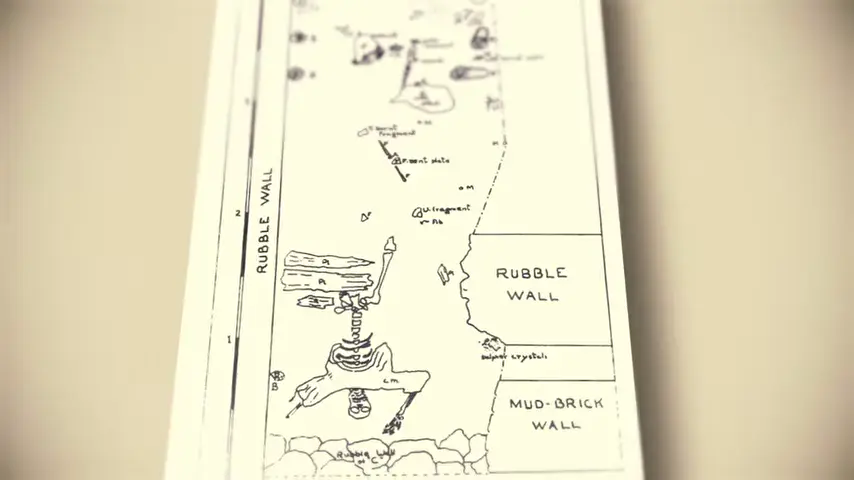
Twenty Roman soldiers at Dura-Europos in Syria died in what archaeologist Simon James identified as the earliest known chemical-warfare attack. During the Sasanian Persian siege of about 256 CE, James argued, Persian forces burned sulfur and bitumen, filling a tunnel with poisonous fumes. The bodies were found piled three to four high, blocking the tunnel entrance. French archaeologists discovered the remains in the 1930s and initially treated them as combat deaths. James re-examined the evidence in 2009, and his analysis was published in 2011. The remains lay sealed and undisturbed for roughly 1,700 years.
Simon James Identified 20 Dura Europos Soldiers as Earliest Known Chemical Warfare Victims
 SyriaExcavation
Key facts
- Twenty Roman soldiers were killed during the Sasanian Persian siege of Dura-Europos around 256 CE.
- Simon James argued that Persian forces burned sulfur and bitumen, filling the tunnel with poisonous fumes.
- The bodies were found piled three or four high, blocking the tunnel entrance.
- French archaeologists uncovered the remains in the 1930s and initially interpreted them as combat deaths.
- Simon James, a Roman archaeologist at the University of Birmingham, re-examined the evidence in 2009; his analysis was published in 2011.
- The remains lay sealed and undisturbed at the site for roughly 1,700 years.
Sources
Earliest Chemical Warfare - Dura-Europos, Syriaarchive.archaeology.org
In a narrow tunnel under the fortress-city of Dura (now Dura-Europos) in the eastern Syrian desert, 20 Roman soldiers met their fate defending the city from the
One of the First Known Chemical Attacks Took Place 1,700 Years ...smithsonianmag.com
In approximately 256 C.E. Dura-Europas, a Roman fort known as “the Pompeii of the Syrian Desert,” fell victim to a Sasanian Persian siege in ...
Stratagems, Combat, and “Chemical Warfare” in the Siege Mines of ...journals.uchicago.edu
The Sasanian Persian siege that destroyed Roman-held Dura-Europos, Syria, ca. 256 C.E. left some of the best evidence ever recovered for the nature and ...
Death in the dark at Dura-Europos: Did the Sassanids use chemical ...academia.edu
A recent theory has suggested a further distinction for Dura-Europos, as the site of the first recorded use of chemical warfare. But can the evidence support ...
Stratagems, Combat, and “Chemical Warfare” in the Siege Mines of ...ajaonline.org
The Sasanian Persian siege that destroyed Roman-held Dura-Europos, Syria, ca. 256 CE left some of the best evidence ever recovered for the nature and practices ...
Stratagems, Combat, and “Chemical Warfare” in the Siege ...journals.uchicago.edu
The Sasanian Persian siege that destroyed Roman-held Dura-Europos, Syria, ca. 256 C.E. left some of the best evidence ever recovered for the ...
Siege of Dura-Europos (256)en.wikipedia.org
The siege was notable for the early use of chemical weapons by the attacking Persian army. bitumen and deduced that methane was also likely a by-product of the ...
How the Sasanians Used Chemical Warfare to Beat Rome ...thecollector.com
The Sasanians, under Shapur I, besieged and destroyed Dura Europos in 256 CE using one of the first recorded instances of chemical warfare ...
Was this story useful?
Keep exploring
Every site on this page sits on the globe, and the people who research them are on the Discord.
3D Globe · Sites by country · Story Archive · Research Library · Weekly Journal · Search
AI-generated text · images from the original sources · always verify with the sources.