

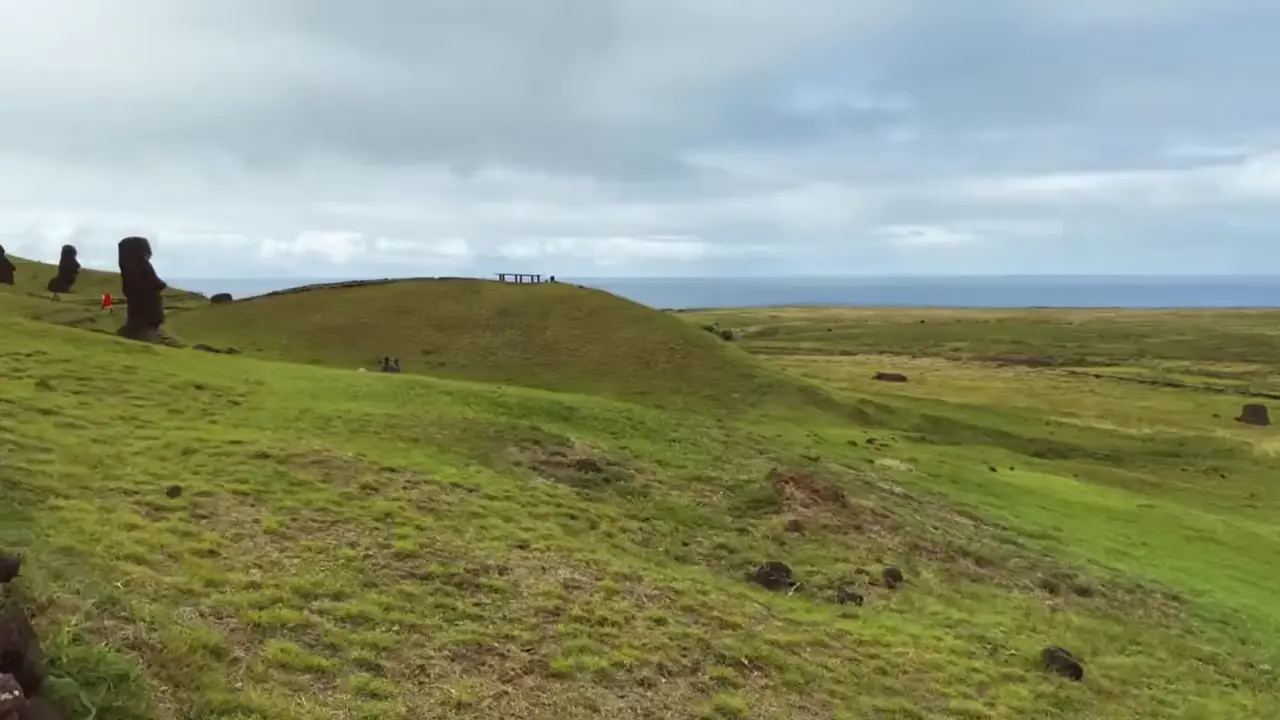
Rano Raraku is Easter Island's main moai quarry, holding roughly 400 statues in volcanic lapilli tuff dated to about 300,000 years. The moai themselves were carved mainly in the 12th–15th centuries. The site was both quarry and workshop, with unfinished and toppled moai still in place. The video argues that some statues may have been slid down natural slopes and raises a tsunami or debris-flow explanation for the quarry's history; both interpretations remain debated. The 1960 Chile earthquake affected the site, but there is no support for a moai being pushed hundreds of feet inland.
Rano Raraku: About 400 Moai carved in 300,000-year-old volcanic tuff
 ChileGeneral
Site mentioned
Key facts
- Rano Raraku contains roughly 400 moai and supplied about 95% of Rapa Nui's known monolithic sculptures.
- The quarry stone is volcanic lapilli tuff, also called lapil tuff, from Terevaka and dated to roughly 300,000 years ago; “Lapil Tough” is not the rock's name.
- Most moai were carved in the 12th–15th centuries; 300,000 years refers to the tuff, not the statues.
- Rano Raraku is established as both a quarry and a carving workshop; unfinished and toppled moai remain there.
- Moai were carved directly into the tuff, including on the crater slopes.
- The video suggests that some statues were slid down natural slopes; their transport beyond the quarry remains debated.
- The video also presents a possible tsunami or debris-flow explanation for the quarry's history; that is an interpretation, not an established tsunami event.
- In 1960, the Chile earthquake affected statues at Rano Raraku, but the claim that one was pushed hundreds of feet inland is unsupported.
Sources
Rano Raraku - The Quarry - The Road Lance Traveledtheroadlancetraveled.com
All were human heads-on-torsos carved in the male form from rough hardened volcanic ash. The largest one erected was 33 feet high and weighed 90 ...
Rano Raraku - Wikipediaen.wikipedia.org
Rano Raraku is a volcanic crater formed of consolidated volcanic ash, or tuff, and located on the lower slopes of Terevaka in the Rapa Nui National Park on ...
Rano Raraku, moai statue quarry - Easter Island Traveleasterisland.travel
Rano Raraku is the legendary moai quarry with hundreds of abandoned statues scattered around. Learn about it here!
The Easter Island Statues: How the Moai Were Made - ThoughtCothoughtco.com
The main bodies of most of the moai statues at Easter Island were sculpted out of the volcanic tuff from the Rano Raraku quarry, the remains of ...
New 3D reconstruction reveals how Rapa Nui's iconic moai were ...archaeologymag.com
A new high-resolution 3D model of Rano Raraku reveals how Rapa Nui's moai were carved and offers fresh insights into ancient production ...
The Crater where the Moai Were Madeartsandculture.google.com
Rano Raraku is a volcanic crater on the southeastern coast of the island where most of the moai were made during the 12th to 15th centuries. Easter Island by ...
Rano Raraku Quarry Stock Photosgettyimages.com
famous quarry where the moais were carved on easter island. Rano Raraku is a volcanic crater formed of consolidated volcanic ash and located on the slopes
RANO RARAKU - The moai statue quarry | Imagina Easter ...imaginarapanui.com
Rano Raraku became the quarry where almost all of the 1,000 statues that have been found on Easter Island were sculpted. Here the moai were carved
Was this story useful?
Keep exploring
Every site on this page sits on the globe, and the people who research them are on the Discord.
3D Globe · Sites by country · Story Archive · Research Library · Weekly Journal · Search
AI-generated text · images from the original sources · always verify with the sources.