

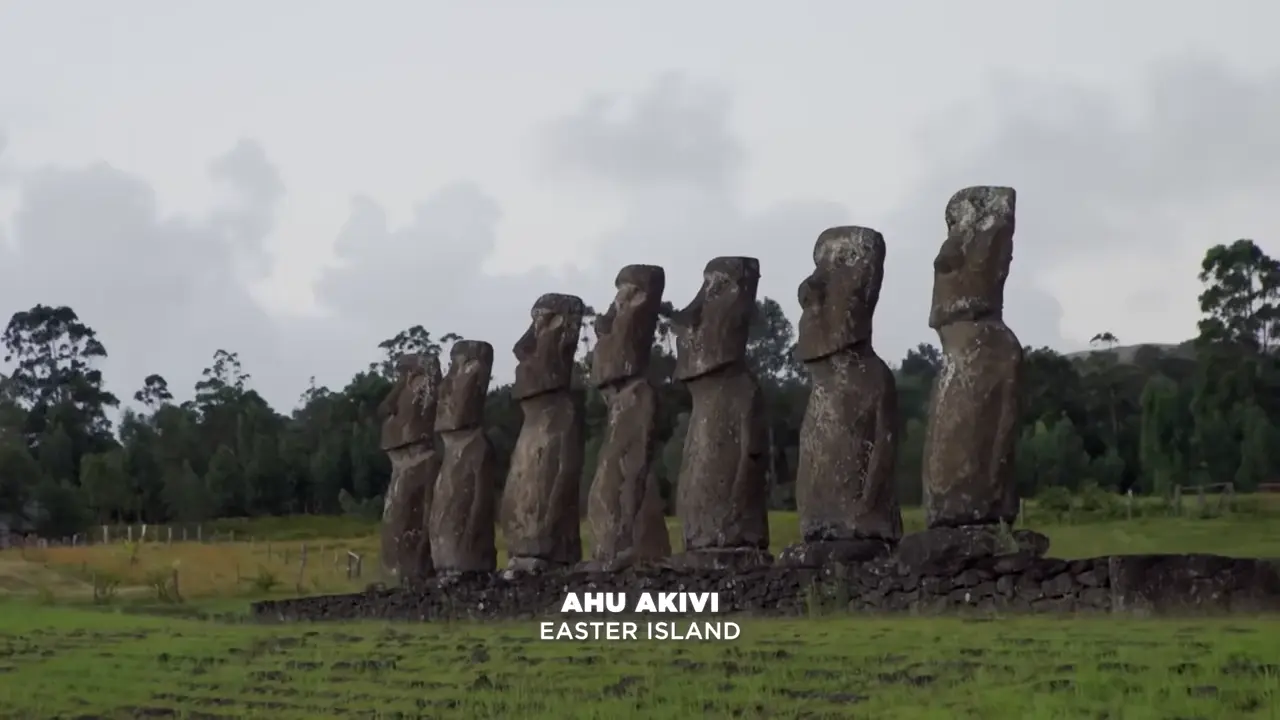
Rapa Nui lies about 3,500 km from mainland Chile and 4,300 km from French Polynesia. It has about 1,000 moai, including roughly 900 at Rano Raraku, with quarrying spanning the 13th–16th centuries. The average moai weighs about 12.5 tonnes; the unfinished Rano Raraku giant reaches about 21.6 m and is estimated at 145–270 tonnes. “Walking” a standing moai has been demonstrated in experiments, but historical transport methods remain debated. Ahu Vinapu is among the oldest surviving ahu. Genetic evidence supports contact with Peru, while the Rapa Nui population fell to about 110–111 by 1877 amid epidemics and Peruvian slave raids. The video argues that Rapa Nui society was resilient; research does challenge a simple climate-driven collapse model and documents adaptation and cultural continuity alongside ecological and social disruption.
Easter Island moai and the debate over Rapa Nui’s collapse
 ChileGeneral
Site mentioned
Key facts
- Rapa Nui is about 3,512 km from the nearest point on mainland Chile and roughly 4,255–4,270 km from French Polynesia.
- Rapa Nui has about 1,000 moai, roughly 900 at Rano Raraku; quarrying spanned the 13th to 16th centuries, not a single 100-year period.
- The average moai weighs about 12.5 tonnes. The largest unfinished moai at Rano Raraku is about 21.6 m tall and estimated at 145–270 tonnes; the largest erected moai weighs roughly 80–86 tonnes.
- Some moai were moved long distances from Rano Raraku, but 15 km was not the distance for every statue. Experiments show that “walking” a standing moai is feasible, while the historical methods remain debated.
- Ahu Vinapu is among Rapa Nui’s oldest surviving ahu.
- The Rapa Nui population fell to about 110–111 by 1877 amid epidemics and Peruvian slave raids; ecological stress and colonial forced labour also affected the wider history.
- Genetic and archaeological evidence supports contact between Rapa Nui and South America, including Peru.
- The video argues that Rapa Nui society was resilient; this reflects active research that challenges a simple climate-driven collapse model and documents adaptation and cultural continuity.
Sources
ANCIENT GIANTS THAT WALKED ACROSS EASTER ...weirddarkness.com
The team built a 4.35-ton replica moai with the distinct forward-lean design and successfully moved it about 328 feet in 40 minutes with a team ...
Rapa Nui (Easter Island) Moaismarthistory.org
The moai were probably carved to commemorate important ancestors and were made from around 1000 C.E. until the second half of the seventeenth century. Over a ...
Easter Island quarry reveals how Polynesians made ...cnn.com
The average statue was 4 meters (13 feet) tall and weighed 12.5 tons, with some exceeding 20 tons, Lipo said.
The truth behind the 'walking' statues of Easter Islandbbc.com
For years, the island has been the subject of intrigue. Who built the Moai? How did they move such huge statues without the use of modern tools?
Easter Island moai statues — history, meaning, transport ...easterisland.travel
The moais were built in approximately 1400 - 1650 A.D. by the natives of this island also known as Rapa Nui. Many know them as the Easter Island heads . This is ...
Easter Islanden.wikipedia.org
2,075 kilometres (1,289 mi) away; the nearest continental point lies in central Chile, 3,512 km (2,182 mi) away.
Qnieonline.com
At a distance of nearly 2,200 miles, mainland Chile is a bit closer to Easter Island than Tahiti.
Where Is Easter Island (Rapa Nui)? Map & Distancesrapanuitravelguide.com
Rapa Nui (Easter Island) is in the south-eastern Pacific Ocean, about 3,700 km west of Santiago, Chile. It is the south-eastern corner of the Polynesian ...
Was this story useful?
Keep exploring
Every site on this page sits on the globe, and the people who research them are on the Discord.
3D Globe · Sites by country · Story Archive · Research Library · Weekly Journal · Search
AI-generated text · images from the original sources · always verify with the sources.