

Jinsha, discovered in 2001 during pipe construction 40km from Sanxingdui, may have been the relocated capital after flooding drove people from the plain. Its most famous find: a ~20g gold disc showing four birds around a sun, echoing Sanxingdui's bronze tree. Strikingly, Sanxingdui left no decipherable writing—unlike Shang oracle bones, Egyptian inscriptions, or Mesopotamian cuneiform.
Population relocated to Jinsha; Sanxingdui left no decipherable writing
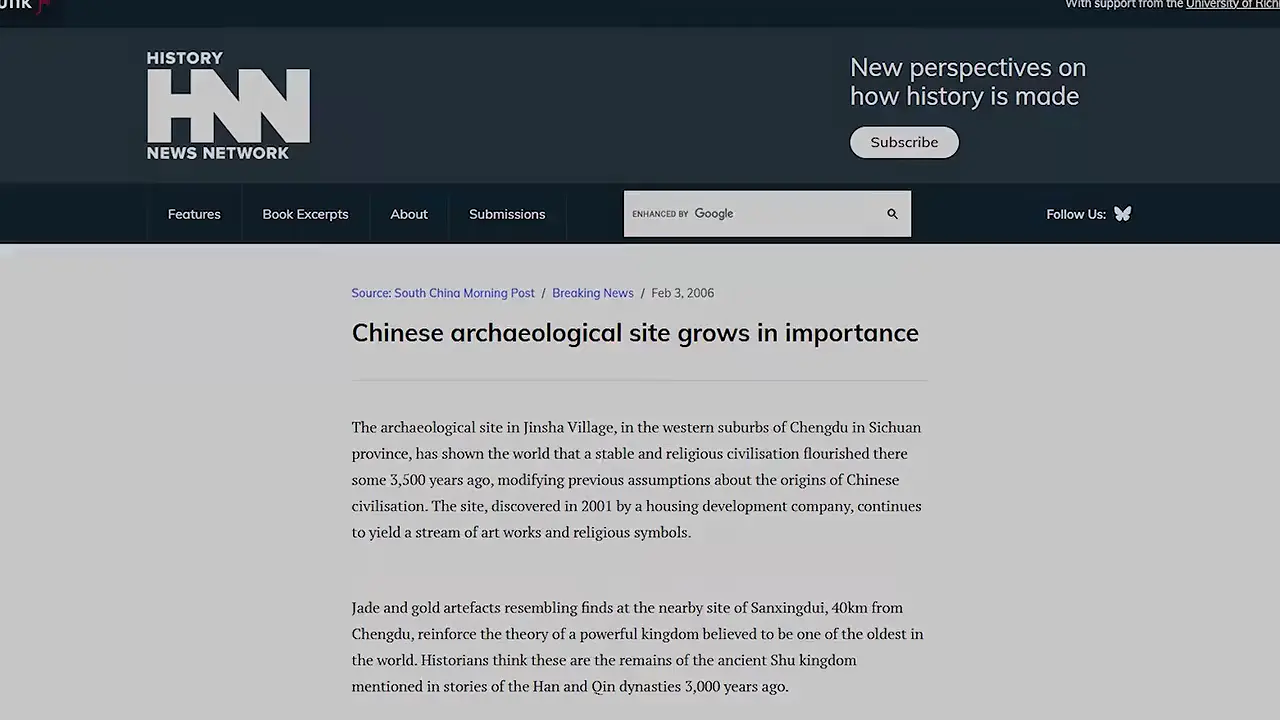
Site mentioned
Key facts
- Jinsha site discovered in 2001 during pipe construction in Chengdu, 40 km from Sanxingdui
- Archaeologists believe the population shifted their capital to Jinsha and continued their civilization for centuries
- Flooding on Sanxingdui's plain may have driven relocation, though a catastrophic river-course-change theory has been challenged
- Most famous Jinsha artifact is a ~20 g gold disc thinner than cardstock depicting four birds flying around a central sun, echoing birds on Sanxingdui's 4-m bronze tree
- Jinsha artisans continued gold masks and jade blades in the Sanxingdui style but at smaller scale; they never rebuilt the giant statues, leaving the originals buried
- Sanxingdui has produced no decipherable written records; only a few random scratched symbols on metal and stone were found
- Writing may have existed on silk or bamboo that rotted, or the culture may have relied entirely on oral tradition
- This contrasts with Shang oracle bones (Fu Hao's 1976 tomb at Anyang held 1,900 objects and ~7,000 cowrie shells inscribed with details of her life), Egyptian temple inscriptions, Mesopotamian cuneiform, and Mayan glyphs
- The regional name "Shu" was applied by outsiders centuries later; no native names for the city, rulers, or gods survive
Sources
sixthtone.com
Linked in video description
archaeology.org
Linked in video description
artsandculture.google.com
Linked in video description
Jinsha Site Museumjinshasitemuseum.com
Jinsha site was named one of the Top Ten Archaeological Discoveries in China in 2001, a national key cultural relic protection unit and one of the first batch ...
Jinsha siteen.wikipedia.org
The site is one of the major archaeological discoveries in China. Discovered 8 February 2001 … 500 BCE and 200 BCE. The term 'Jinsha site' was coined after the ...
Jinsha Site Museum 金沙遗址博物馆chengdu-expat.com
This ancient Shu kingdom dates back around 3,000 years to the Shang dynasty. Then, in 2001, they discovered the Jinsha ancient settlement in Chengdu. Because of ...
The Jinsha Site: An Introductionresearchgate.net
In 2001, hundreds of objects of gold, bronze, jade, stone, and other materials were unearthed at Jinsha, and subsequent fieldwork has revealed that the site was ...
1 Day Rita Jinsha Site Museum Travel Story ...chinadiscovery.com
Jinsha Site was unearthed in February 2001 in Chengdu in an area spreading across about 5 square kilometers. It was the capital of the ancient Shu state,
Was this story useful?
Keep exploring
Every site on this page sits on the globe, and the people who research them are on the Discord.
3D Globe · Sites by country · Story Archive · Research Library · Weekly Journal · Search
AI-generated text · images from the original sources · always verify with the sources.