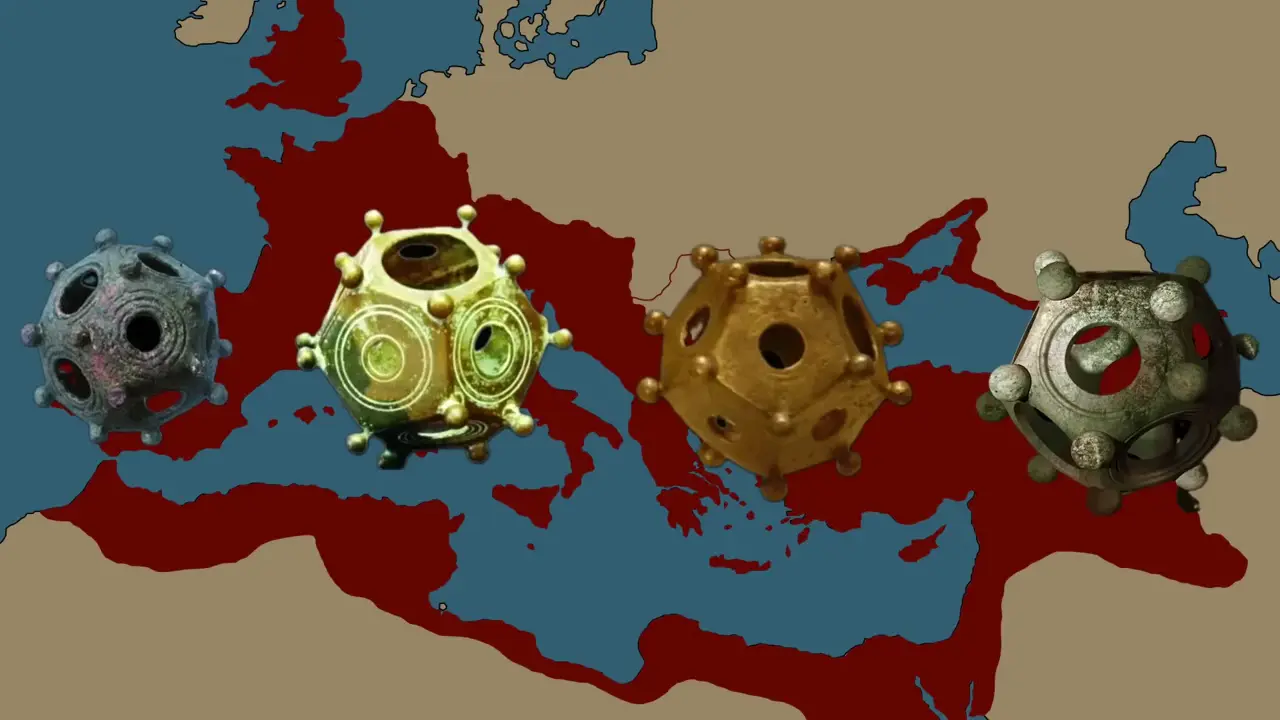
Hollow copper alloy objects with 12 pentagonal faces. Each corner has a small knob. Size varies 40-85mm, weight 35-330g. Each face has a circular hole of varying sizes. Cast using lost wax method.
Key facts:
- Primarily copper alloy (bronze), with rare iron examples documented
- All hollow with 12 pentagonal faces, 30 edges, 20 corners
- Each corner has a solid ball pinned and soldered to the body
- One exception from London has three balls per corner
- Height range: 40-85mm, weight: 35-330g (one outlier at 1,044g)
- Found mainly in Western Europe (Roman Empire / Gallo-Roman territories)
Sources
The Decahedr-What? - Pages By Pagephspagesbypage.comIt has twelve flat pentagonal faces with each face having a circular hole of varying diameter in the middle. The holes connect to the hollow ...
School Art Supplies 2019 - Priceless Catalogue - FlipHTML5fliphtml5.comContains 4 each of sizes 20mm, 40mm & 60mm. Sizes 20mm, 40mm, 60mm. HHB60 ... Size: 35 x 43 x 35 H cm Weight: 31 kg Size: 35 x 57 x 35 H cm Weight: 38 ...
Download PDF Catalogue - Carba-Tec - YUMPUyumpu.com40 tap set of 3pc each size round<br />. die 1/8” x 40, 5/32” x 40, 3 ... They have marking holes at every<br /> .5mm as well!<br ...
Download Catalogue (PDF - 38.2mb) - Carba-Tec - YUMPUyumpu.comAUSTRALIA'S LARGEST RANGE OF TOOLS FOR WOOD<br />. CATALOGUE<br />. May 2013. Table of Contents<br />. Woodworking Articles<br />.
[PDF] middle/late iron age site and anglo-saxon cemetery - UCL Discoverydiscovery.ucl.ac.ukFig 2.1 Plan of features and selected sections pre-dating the Middle/Late Iron Age .
AI-generated text · images from the original sources · always verify with the sources.