

Okinawa's Gusuku castles from the 12th-14th centuries contain a remarkable surprise: Roman coins from the 4th century AD, predating construction by roughly 1,000 years. These Cyclopean coral limestone walls actually predate Japanese mainland masonry by at least 400 years and resemble Italian constructions more than Chinese architecture. Just six original Gusuku structures remain after the 1609 Japanese invasion and WWII bombings.
Okinawa Gusuku contain 4th-century Roman coins predating construction
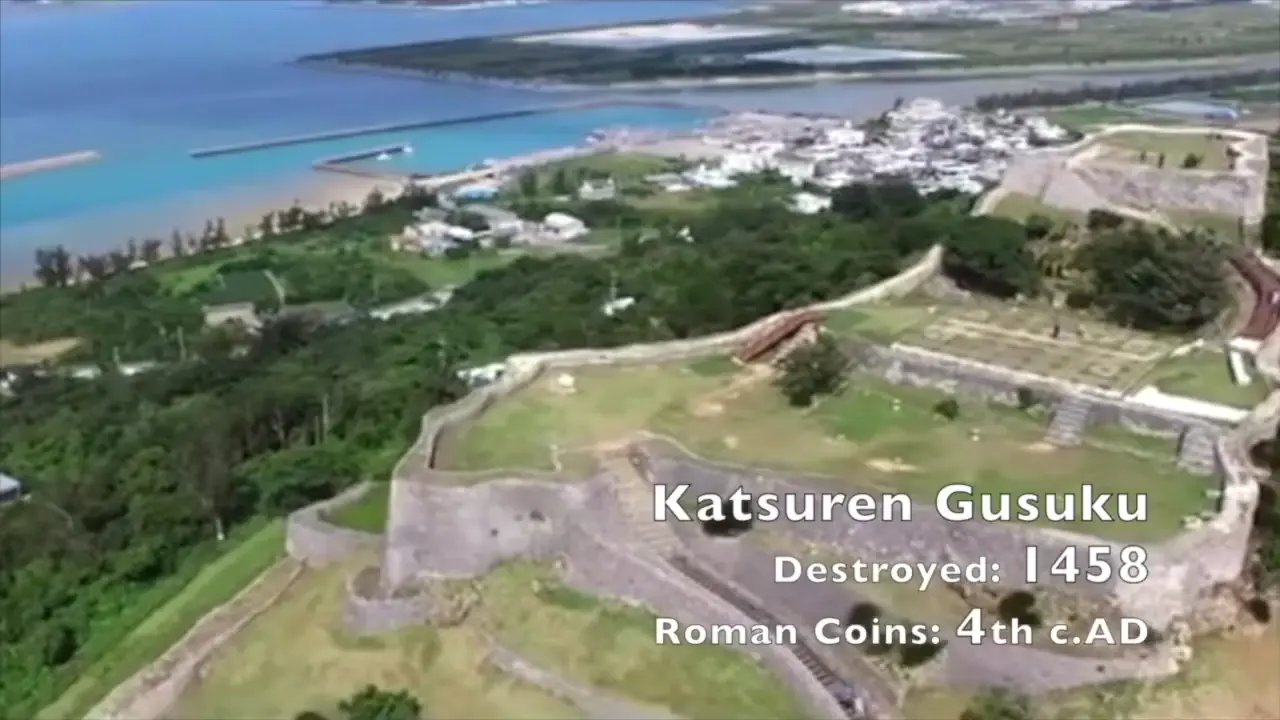
Site mentioned
📍 Katsuren Castle
Key facts
- Gusuku period in Okinawa dates from 12th to 14th centuries, possibly older
- Cyclopean walls at least 400 years older than Japanese mainland constructions
- Katsuren Castle (14th century) yielded Roman coins from 4th century AD, 1,000 years earlier than expected
- Before Gusuku period, Okinawans lived as shellfish collectors with no architecture for 6,000 years
- Built from local coral limestone using global polygonal masonry techniques
- Okinawan Gusuku resemble Italian constructions and differ from Chinese architecture
- Only six original Gusuku structures remain due to Japanese invasion (1609) and WWII bombings
Sources
Katsuren Castle - Wikipediaen.wikipedia.org
"Ancient Roman coins unearthed from castle ruins in Okinawa". Japan Times Online. Kyodo. 26 September 2016. Retrieved 13 August 2018. ↑ Jozuka, Emiko (27 ...
Coins From The Roman Empire Found In Ruins Of Japanese Castlenpr.org
The four Roman coins were found at the Katsuren Castle — a World Heritage Site in Japan's southwestern city of Uruma. The excavation was ...
Ancient Roman coins found in an old Japanese castle - CNNedition.cnn.com
When archeologist Hiroyuki Miyagi heard that a bunch of ancient Roman and Ottoman coins had been unearthed from the ruins of an old castle in Okinawa, ...
Roman coins ID'd in Japanese ruins, but their origin baffles - Phys.orgphys.org
The 10 copper coins were unearthed in December 2013 at the 12th-15th century Katsuren Castle, a UNESCO World Heritage site, during an annual ...
How did Roman coins from the fourth century get to a castle in Japan?coinworld.com
10 ancient coins from the Roman and Ottoman empires were unearthed in the ruins of a Japanese castle, thousands of miles from their place of origin.
Was this story useful?
Keep exploring
Every site on this page sits on the globe, and the people who research them are on the Discord.
3D Globe · Sites by country · Story Archive · Research Library · Weekly Journal · Search
AI-generated text · images from the original sources · always verify with the sources.