

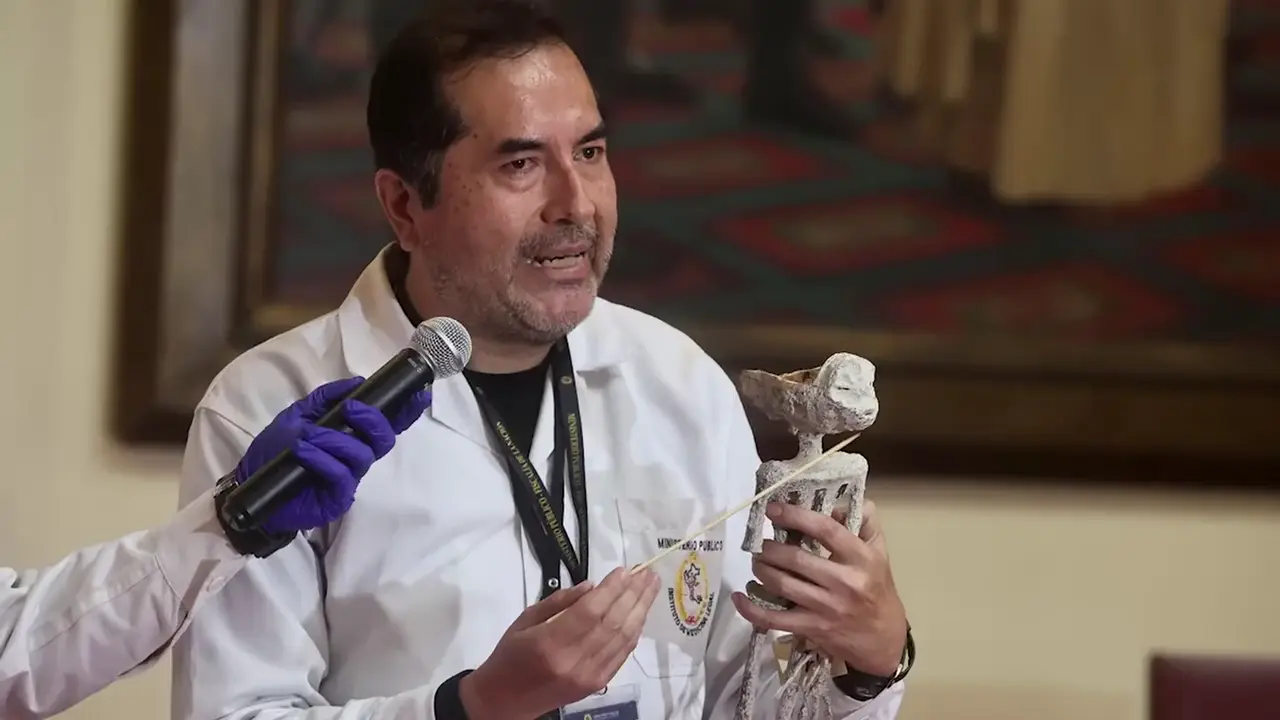
Nazca Tridactyl Mummies Exposed as Crude Composites of Human and Animal Remains. Bodies allegedly discovered in 2015 in Nazca region of Peru by tomb robbers Promoted by Alien Project organized by French explorer Thierry Jaumart and Enkari Cusco Institute Presented as small mummified figures with elongated skulls and three-fingered hands

🦴 The 'Nazca mummies' saga is over. Peruvian forensic experts confirmed seized bodies contained human bones, animal bones, paper, glue & metal. Small mummified figures with elongated skulls and three-fingered hands were actually dolls made from earthly bones. Most experts dismissed them as a fraud—possibly mutilated ancient human mummies combined with animal parts. 😬

Key facts claimed:

- Bodies allegedly discovered in the Nazca region of Peru

- Promoted by various proponents as non-human entities

- Presented as small mummified figures with elongated skulls and three-fingered hands

- Promoters claimed bodies were ancient artifacts

- Lacked proper archaeological context as discoverers refused to reveal cave location

Key Facts

  • Bodies allegedly discovered in 2015 in Nazca region of Peru by tomb robbers
  • Promoted by Alien Project organized by French explorer Thierry Jaumart and Enkari Cusco Institute
  • Presented as small mummified figures with elongated skulls and three-fingered hands
  • Promoters claimed bodies were approximately 1000 years old based on carbon dating
  • Lacked proper archaeological context as discoverers refused to reveal cave location
  • PaleoDNA laboratory at Lakehead University found samples matched homo sapiens at 99-100%
  • Radiocarbon dating showed 245-410 AD range with warning of contamination risk
  • Russian experts Stanislav Dorbashevski and Alexei Bonderov judged bodies as crude fakes made from mixed human and animal remains
  • 2021 analysis concluded one skull constructed from deteriorated llama brain case and animal remains
  • World Committee on Mummy Studies condemned affair as fraud
  • January 12 2024: Peruvian forensic archaeologist Flavio Estrada confirmed two seized bodies (Wawita and Maria) were not ancient
  • Seized bodies composed of human bones, camelid bones, wool, polypropylene, rubber, tissue fibers, paper, and modern synthetic glue
  • Peru's Ministry of Culture stated objects did not come from prehispanic period
  • Wawita identified as real mummy that scammers modified by removing and readjusting fingers and toes
  • Metal implants found in some bodies consistent with known pre-Colombian metallurgy including copper-rich and gold-silver-copper alloys
  • One implant found rich in chromium possibly steel or cast iron, inconsistent with known pre-Colombian manufacturing