

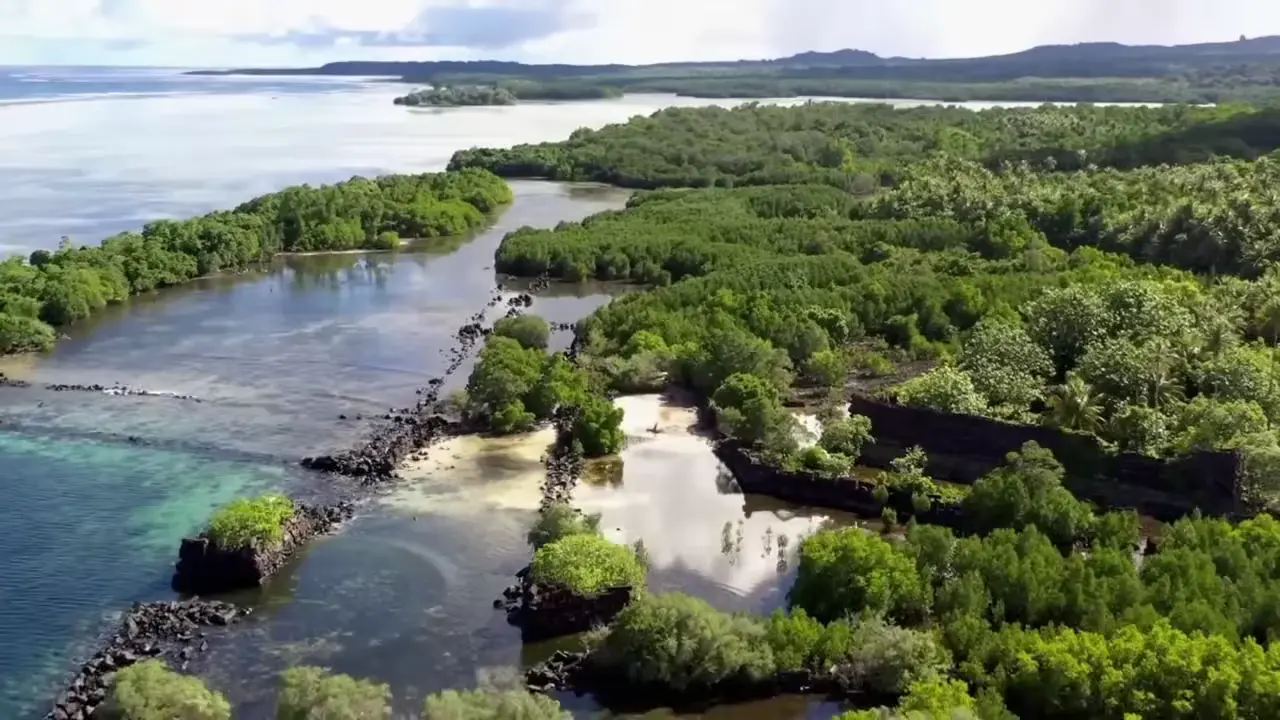
Nan Madol on Pohnpei island: ~100 artificial islets, walls nearly 60ft high & 17ft thick, ~750,000 tons of basalt. Stones up to 50 tons each. Built around 1180-1200 AD by a population thought to number around 1,000 people. Bamboo raft experiments showed even smaller stones would sink. Underwater structures reportedly extend beneath the ocean. 🌊🗿
Nan Madol: 750,000-ton Pacific coral reef complex defies conventional construction explanation
Site mentioned
Key facts
- Located on Pohnpei island in Pacific Ocean, built on coral reef in shallow waters
- Consists of 92 artificial islets connected by network of canals lined with stone
- Massive walls rise nearly 60 feet high, up to 17 feet thick
- Stones weigh 5 to 50 tons each
- Estimated 750,000 tons of stone used in construction
- Conventional dating places construction around 1180 AD by Sordel dynasty
- Basalt columns transported from distant quarries across rugged terrain and water
- Bamboo raft experiments showed even smaller stones would sink
- Population of Pohnpei at time estimated only 20,000-30,000 people
- Local legend attributes construction to brothers Olyipa and Olopa with ability to fly stones
- Anthropologist John Kubari explored site in 19th century, collected artifacts, ship wrecked on return
- German governor Victor Berg reportedly found enormous skeletal remains of 10-foot-tall giants in sealed tomb in 1907, died next day
- Japanese investigators claimed to find platinum coffins with giant skeletons on ocean floor
- Explorers report underwater pillars, tunnels, caves, and stone structures extending beneath ocean
- Some theories link site to legendary lost continent of Moo
- Basalt magnetic properties and location in typhoon zone led some to propose ancient energy or weather control installation theory
Sources
Nan Madol: “In the space between things” (article) - Khan Academykhanacademy.org
Nan Madol is a complex of close to 100 artificial rectilinear islets spread over 200 acres that are thought to have housed up to 1000 people.
The Non-Mystery of Nan Madol - Skeptoid Podcastskeptoid.com
There are some 92 of these artificial islets, mostly constructed in a sort of log cabin style made with long basalt columns, with walls and ...
Nan Madol: The City Built on Coral Reefs - Smithsonian Magazinesmithsonianmag.com
Our destination is Nan Madol, near the southern side of the island, the only ancient city ever built atop of a coral reef. Its imposing yet ...
Nan Madol (U.S. National Park Service)nps.gov
Nan Madol is the only extant ancient city built on top of a coral reef. Constructed in a lagoon and surrounded by water on three sides with a stone wall ...
Nan Madol - Wikipediaen.wikipedia.org
Nan Madol is an archaeological site adjacent to the eastern shore of the island of Pohnpei, now part of the Madolenihmw district of Pohnpei state
Was this story useful?
Keep exploring
Every site on this page sits on the globe, and the people who research them are on the Discord.
3D Globe · Sites by country · Story Archive · Research Library · Weekly Journal · Search
AI-generated text · images from the original sources · always verify with the sources.