

Over 2,100 megalithic jars up to 10 feet tall dot Laos' Xieng Khouang Plateau, dating to roughly 1240 BCE. Creators remain unknown, with local myths saying giants carved the jars to store rice wine after battle. UNESCO has designated the Plain of Jars as a World Heritage Site, with some archaeologists proposing shared ancient burial traditions across Southeast Asia. Some jars were carved from sandstone and granite.
Megalithic jar fields in Laos and Indonesia
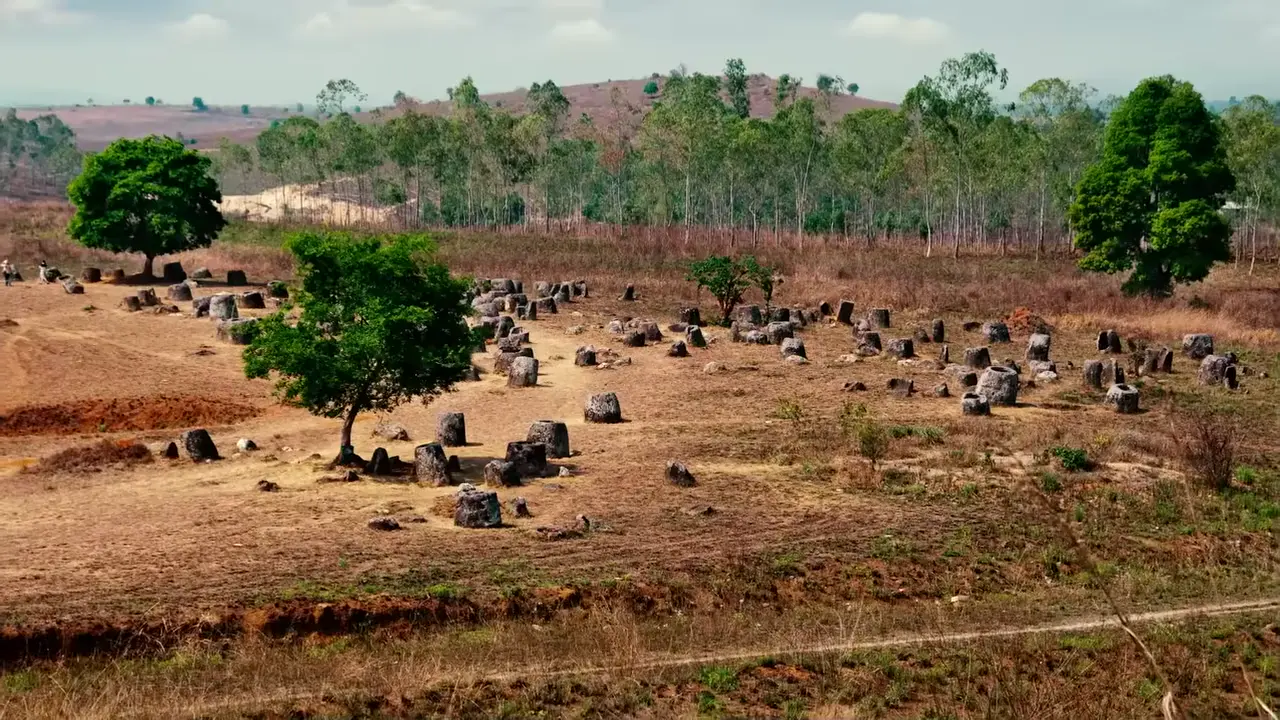
Site mentioned
📍 Plain of Jars
Key facts
- Over 3,000 megalithic jars are scattered across the Shiin Kuang Plateau in northern Laos
- Some jars stand nearly 10 ft tall, carved from sandstone, granite, and limestone
- The Laos jars date as far back as 1240 BCE, creators remain unknown
- Local myths say giants created the jars to store rice wine after battle
- In Indonesia's Bada Valley, Kambas are massive circular stone vats under jungle canopy
- Many Indonesian jars bear lids and are decorated with faces, monkeys, and lizards
- Local tribes believe the Indonesian jars were used for bathing or punishment, not burial
- Excavations at Pocakeaya reveal cremated remains of elite families
- UNESCO notes similarities between both sites: massive stone jars, uses, and strange iconography
- Some archaeologists propose both belong to a larger forgotten jar burial tradition across Southeast Asia
Sources
The Ancient Mystery of Laos' Plain of Jars - Regina G Beachreginagbeach.com
An ancient civilization related to the Khmu tribe created megalithic urns to decompose corpses prior to cremation or burial.
Plain of Jars in Laos, a land of enigmas and scars - Terra Culturaterra-cultura.com
Shrouded in mist, the highlands of Xieng Khouang reveal giant stone jars emerging from the earth like remnants of another world. Some rise up to ...
Megalithic Jar Sites in Xiengkhuang – Plain of Jarswhc.unesco.org
More than 2100 tubular-shaped megalithic stone jars used for funerary practices in the Iron Age give the Plain of Jars its name. This serial ...
The Plain of Jars - Xieng Khouang Attractions - Go Guideshoteles.com
The jars were carved from both sandstone and granite. The tallest jar is about 3.5 metres high and some of them are thought to be over 2,000 years old.
Plain of Jars - Wikipediaen.wikipedia.org
The Plain of Jars is a megalithic archaeological landscape in Laos. It consists of thousands of stone jars scattered around the upland valleys and the lower ...
Was this story useful?
Keep exploring
Every site on this page sits on the globe, and the people who research them are on the Discord.
3D Globe · Sites by country · Story Archive · Research Library · Weekly Journal · Search
AI-generated text · images from the original sources · always verify with the sources.