

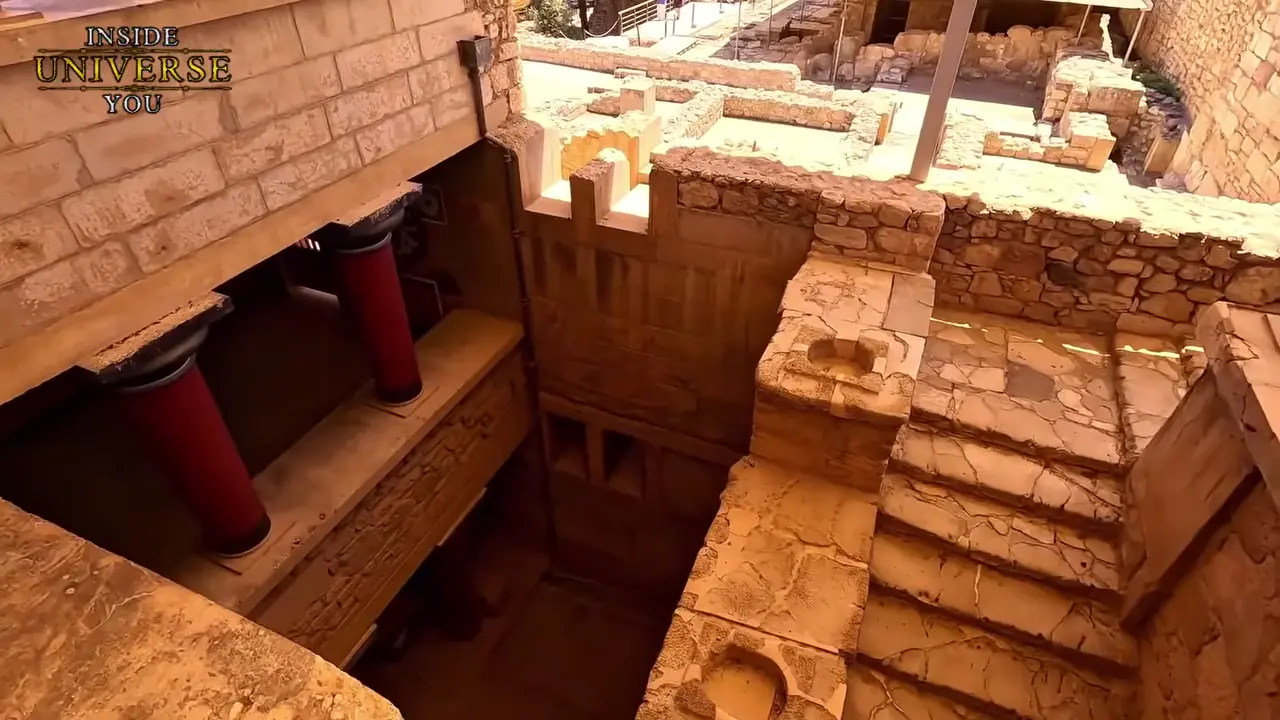
Linear A script remains undeciphered despite decades of effort. The massive Thera eruption, roughly 70 miles north, buried Akrotiri like Pompeii and sent tsunamis to Crete. Mycenaeans later invaded, ending Minoan independence. Sir Arthur Evans excavated from 1900 and controversially reconstructed parts with reinforced concrete. 📜🌋
Linear A undeciphered; Thera eruption and Mycenaean conquest ended Europe's first advanced civilization
Key facts
- Knossos lacked the colossal defensive walls found at Mycenaean citadels, relying on naval power
- Minoan trade reached Egypt, the Levant, Anatolia, and Sicily, with Minoan pottery appearing in Egyptian nobles' tombs
- Minoans imported tin from Anatolia, ivory from Africa, lapis lazuli from Afghanistan, and ostrich eggs from Egypt
- Kamares ware, with white and red designs on black backgrounds, was exported across the Mediterranean as luxury ceramics
- Linear A script used on clay tablets, vessels, seals, and religious objects remains undeciphered despite recognized signs and numerical structure
- Phaistos Disc discovered in 1908 at the Palace of Phaistos, featuring stamped symbols in spiral arrangement
- Thera volcano (modern Santorini), located roughly 70 miles north of Crete, erupted with extraordinary force during the second millennium BC
- Akrotiri settlement on Thera was buried beneath volcanic deposits, preserving buildings, pottery, and frescoes like Pompeii
- Tsunamis generated by the eruption hit parts of Crete's coastline, damaging maritime infrastructure
- Knossos survived but was damaged by earthquakes; trade and culture continued for generations afterward
- Mycenaeans from mainland Greece invaded and conquered Crete, ending Minoan independence
- Knossos was first excavated on a significant scale in 1878 by Cretan antiquarian Minos Kalokairinos
- Major excavations launched in 1900 by British archaeologist Sir Arthur Evans, who coined the name 'Minoans' after King Minos
- Evans reconstructed substantial portions of Knossos using stone, timber, and reinforced concrete beginning in the early 20th century
Sources
Cretan Fortifications (Part 1) - Archaeology Wikiarchaeology.wiki
Another type of defence architecture developed in palaces: the guard rooms located in Phaistos and Knossos. Beacons (“Piles'') are among the ...
Lesson 12: Narrative – Aegean Prehistoric Archaeologysites.dartmouth.edu
Another feature that is above all typical of Knossos is the lavish decoration of the walls of the palace with figured wall-paintings on several different scales ...
Knossos - Wikipediaen.wikipedia.org
The site was occupied from the Neolithic period into the first millennium AD and became the largest and best-known centre of the Minoan civilisation.
Mycenaean Architecture: Cyclopean Walls, Lion Gate & Ancient ... - Athenstickets-athens.com
The Cyclopean walls of Mycenae were built with limestone boulders weighing up to 20 tons, stacked without mortar. These walls, up to 8 meters thick, enclosed ...
Knossos and the Minoans of Crete - The Royal Tourtheroyaltourblog.com
Knossos Palace would have had four gates, basically corresponding to the compass points, and would have been surrounded by a full city, though ...
Was this story useful?
Keep exploring
Every site on this page sits on the globe, and the people who research them are on the Discord.
3D Globe · Sites by country · Story Archive · Research Library · Weekly Journal · Search
AI-generated text · images from the original sources · always verify with the sources.