

The same Member I Giza limestone found in Khentkawes and Kai's tombs also appears in the Sphinx enclosure. Researchers propose late pre-dynastic/early dynastic people shaped a natural limestone formation as a commanding feature visible to travelers below. Evidence of late Predynastic burials found at Giza near the Great Pyramid suggests substantial activity on the plateau before the 4th Dynasty. ⛏️
Limestone strata composing tombs of Khentkawes and Kai is Member 2 Giza limestone, same as exposed in Sphinx enclosure, extends across Giza plateau
 EgyptTheory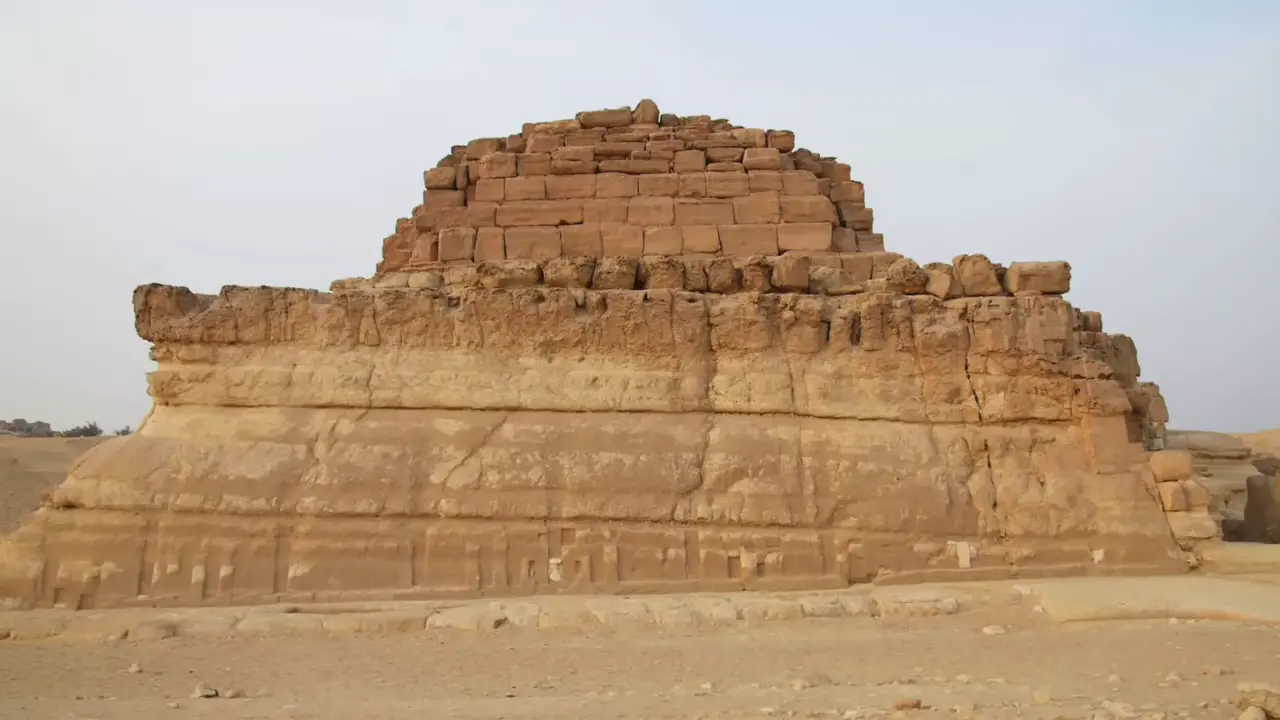
Site mentioned
Key facts
- Limestone strata composing tombs of Khentkawes and Kai is Member 2 Giza limestone, same as exposed in Sphinx enclosure, extends across Giza plateau
- Geological analysis identified natural escarpment running through central field influenced by local geology
- Escarpment faced south overlooking main Wadi and east-facing section present
- Southern side of Khentkawes tomb and southern/eastern sides of Kai tomb align with former natural escarpment line
- Hypothesis: late pre-dynastic or early dynastic people carved natural escarpment with palace facade decoration as statement of importance
- Palace facade decoration at Abidos royal enclosures faces vegetated Nile Valley; Giza decoration faces vegetated valleys and waterways, suggesting commanding statement to river travelers
- Copper contamination spike in sediments dated 3265-3185 BCE (late pre-dynastic) shows substantial settlement on plateau
- Colin Reader attributes majority of features to 2nd dynasty; alternative interpretation suggests pre-dynastic elite settlement at Giza
- Sphinx grotto possibly pre-dynastic rock-cut dwelling; Sphinx enclosure and first phase Sphinx temple potentially late pre-dynastic features
Sources
[PDF] Institute for the Study of Ancient Cultures - The University of Chicagooi.uchicago.edu
... Giza, not only illustrate the rise of scribes within the administration of the late Fourth and early Fifth Dynasty, they also demonstrate how sensitive any ...
Further considerations on development at Giza before the 4th Dynastyacademia.edu
As can be seen in figure 2 the original limestone surface between the top of the southern Sphinx enclosure wall and the causeway was excavated ...
Major Geological Fissure through Prehistoric Lion Monument at Giza ...scirp.org
The baboon can be seen on a limestone slab found in the First Dynasty mastaba tomb S3507 in the sarcophagus chamber of Herneith (Figure 5) where ...
[PDF] Rewriting the History of the Great Sphinx - Archaeopressarchaeopress.com
Part 2 of the book provides a general introduction to the geology of. Egypt, together with a focus on the geology of both the Giza Plateau and the Great Sphinx.
Giza Before the Fourth Dynasty - Hall of Maathallofmaat.com
There has been a great deal of debate about the age of the Great Sphinx of Giza, much of which has focussed on the weathering of the limestones ...
Was this story useful?
Keep exploring
Every site on this page sits on the globe, and the people who research them are on the Discord.
3D Globe · Sites by country · Story Archive · Research Library · Weekly Journal · Search
AI-generated text · images from the original sources · always verify with the sources.