

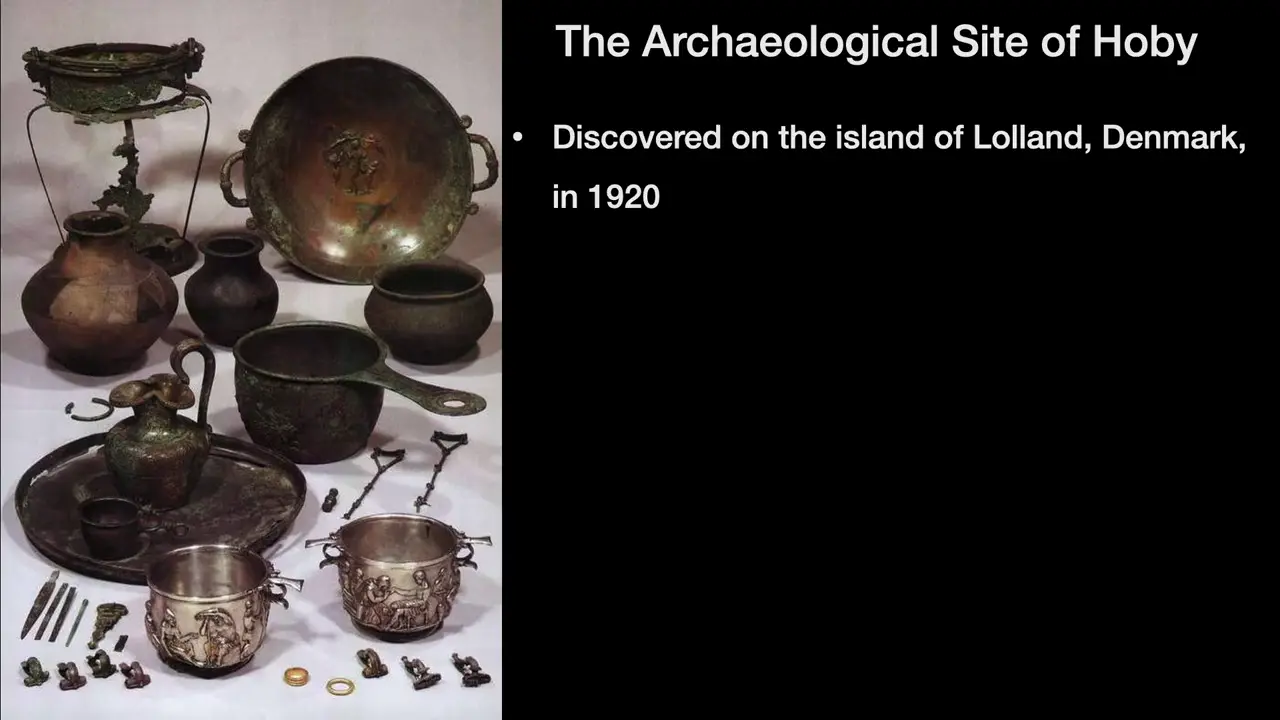
The Hoby Treasure, discovered in 1920 on Lolland, Denmark, contained remarkable artifacts including two silver cups depicting scenes from the Trojan War. One cup shows King Priam kneeling before Achilles, begging for Hector's body. The other depicts Odysseus visiting Philoctetes. Strontium analysis shows the buried individual, aged 25-35, was native to the area.
Hoby Treasure discovered 1920 on Lolland island with Trojan War cups
Site mentioned
📍 Hoby🌍 Show on the globe
Key facts
- The Hoby Treasure was discovered in 1920 at the archaeological site of Hoby on the island of Lolland, Denmark
- The grave contained a silver cup with bronze handle, bronze knife, bone pin, wooden casket, bronze mountings for a drinking horn, sheets of bronze and iron, two gold rings, a belt buckle, seven fibulae, three pottery vessels, and remains of two cured hams
- The table set consists of a washing basin, wine bucket, jug, tray, and two silver cups
- One cup depicts King Priam of Troy kneeling before Achilles, begging for Hector's body
- The second cup shows Odysseus visiting Philoctetes, depicting former rivals putting aside anger to achieve victory
- The silver cups bear the name of a governor who fought in Germania
- Strontium analysis revealed the buried individual was native to the area and died between ages 25 and 35
Sources
File:Silver cup Hoby Priam Nationalmuseet n1.jpgcommons.wikimedia.org
Silver cup made in Capua, south Italy, in the early 1st century AD. Found in 1920 in the grave of a ca. 30-year-old man in Hoby, Lolland, Denmark. Français : ...
The Silver Cups From Hoby - Guideservice·Danmarkguideservicedanmark.dk
The Silver Cups from Hoby are silver cups from the large silver treasure found at Hoby in Lolland, 1920. The Cups are from the pre-Roman Iron age.
Hoby treasure - Wikipediaen.wikipedia.org
The Hoby treasure is the grave goods from a Roman Iron Age grave at Hoby on the island of Lolland in Denmark. It was discovered in 1920.
The Hoby cups: Tracing connections in Iron Age Denmark - The Pastthe-past.com
The Hoby cups: a pair of silver vessels that date to the first half of the 1st century AD. The scenes show episodes from the Trojan War, with ...
Re- visiting the Roman Iron Age Hoby chieftain burial after 100 ...tidsskrift.dk
It revealed a large number of luxurious Roman goods, including two silver drinking cups decorated with Greek-inspired scenes from Homer's Iliad.
Was this story useful?
Keep exploring
Every site on this page sits on the globe, and the people who research them are on the Discord.
3D Globe · Sites by country · Story Archive · Research Library · Weekly Journal · Search
AI-generated text · images from the original sources · always verify with the sources.