

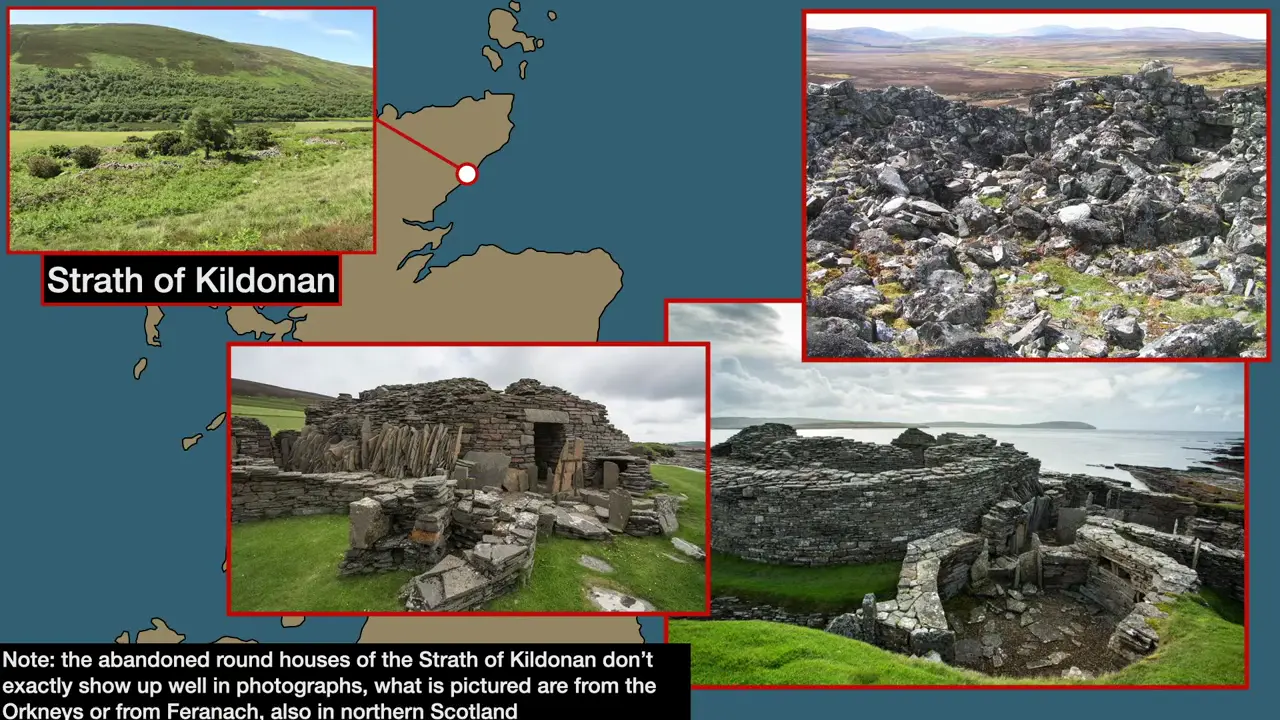
Hekla 3 eruption linked to Bronze Age settlement changes in British Isles around 1150 BC. Around 1150 BC in Strath of Kildonan, approximately 2,000 stone roundhouses appear abandoned Scottish roundhouses shrink from 78 square meters around 1000 BC to 40 square meters around 800 BC Shrinkage begins in west and moves eastward across Scotland

🏚️ Around 1100 BC, ~2,000 stone roundhouses in Scotland were abandoned! House sizes shrank from 78m² to 40m². Acid rain from Hekla 3 may have wrecked soils, forcing major societal shifts — including communal hilltop feasting sites 🍖

Key facts claimed:

- Around 1100 BC in Strath of Kildonan, approximately 2,000 stone roundhouses appear abandoned

- Scottish roundhouses shrink from 78 square meters around 1000 BC to 40 square meters around 800 BC

- Shrinkage begins in west and moves eastward across Scotland

- Higher elevation cultivations abandoned within two centuries

- Barley grown in higher elevations, hardier than wheat

Key Facts

  • Around 1150 BC in Strath of Kildonan, approximately 2,000 stone roundhouses appear abandoned
  • Scottish roundhouses shrink from 78 square meters around 1000 BC to 40 square meters around 800 BC
  • Shrinkage begins in west and moves eastward across Scotland
  • Higher elevation cultivations abandoned within two centuries
  • Barley grown in higher elevations, hardier than wheat
  • Settlement patterns change drastically after abandonment
  • Hilltop enclosures develop in Wales, England, and Ireland
  • Hilltop enclosures used for communal gatherings and feasting, not military defense
  • One prominent site covers 3.5 hectares with walls approaching 2 meters thickness
  • Pig bones from site came from up to 20 km away
  • Genetic study indicates migration into southern Britain 1200-800 BC from across English Channel
  • Three competing eruption date ranges: 1135 BC ±130 years, 1021 BC ±130 years, 929 BC ±34 years
  • Potential date range 1265-895 BC creates uncertainty
  • Early 1990s doctoral dissertation found inconclusive results
  • Volcanic tepra found in soil cores but only one layer showed high sulfur and iron levels
  • Climate reconstruction shows late Bronze Age (1200-800 BC) had wet periods, drier phases, and river flooding around 800 BC
  • Carbon-14 evidence indicates decreased solar activity
  • Bog evidence shows wetter climate 1395-1155 BC despite general dry period
  • Climate shifts to wet period around 850 BC
  • Acid rain from volcanic sulfur and acidic materials may have altered soil pH
  • Agricultural devastation may have forced societal reorganization and development of feasting centers