

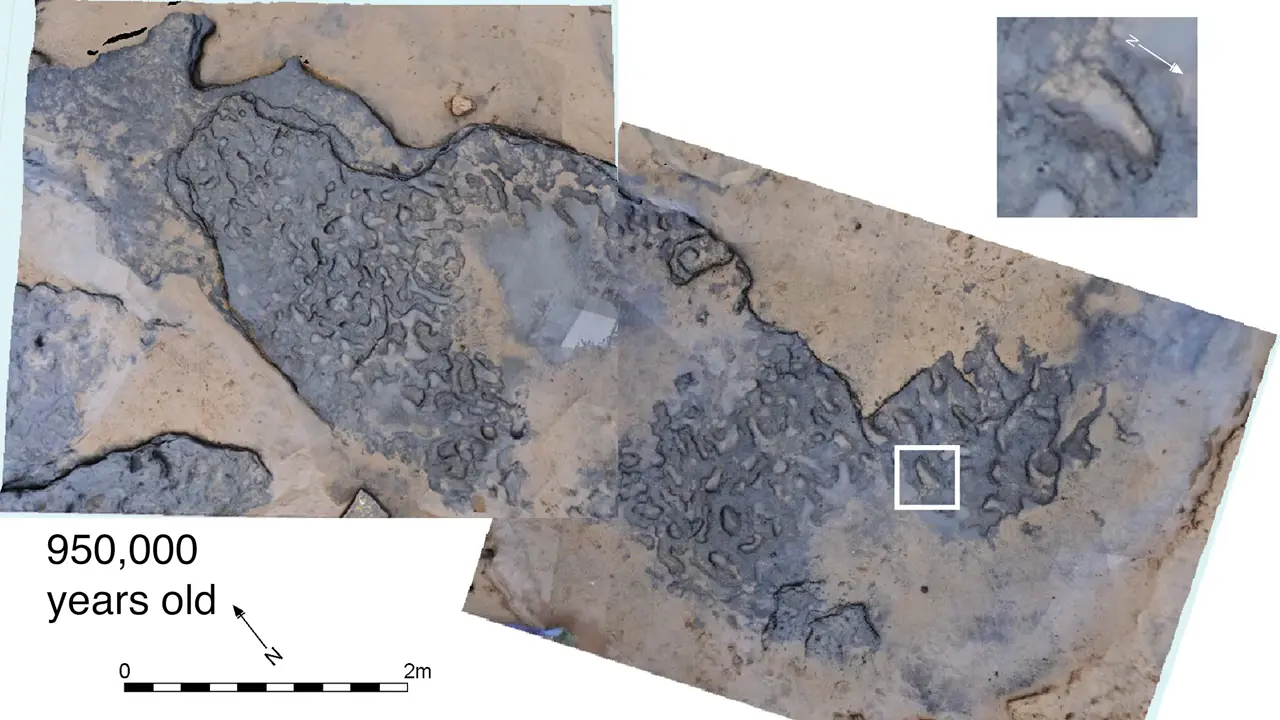
In 2000, a dog walker at Happisburgh on the British coast found a handaxe, sparking research. Researchers uncovered ~950,000-year-old footprints from at least five individuals — adults and a child — suggesting a family group. Britain was then connected to mainland Europe, making this the northernmost known hominin expansion. No fire, no fitted clothing. 👣
Happisburgh: 950,000-year-old human footprints found in Britain
Site mentioned
📍 Happisburgh🌍 Show on the globe
Key facts
- In 2000, a handaxe was found by a man walking his dog at Happisburgh on the British coast, prompting investigation
- Preserved human footprints were recovered from the area
- Footprints dated to approximately 950,000 years old
- Cluster of prints represents at least five individuals, including adults and at least one child, suggesting a family group
- Footprints show distinctive human features including a longitudinal arch and aligned big toe
- At the time, Britain was connected to the European continent via a land bridge
- Represents the northernmost known expansion of humans at that time
- Hominins lacked fire, fitted clothing, and likely only had animal skins draped over them
Sources
A History of the World - Object : Pre-historic hand-axe 700000 years oldbbc.co.uk
The Happisburgh handaxe is prime evidence … this beautiful ovate flint handaxe was found on a Norfolk beach in 2000 by a local man walking his dog. around 700, ...
The Happisburgh Hand Axe – the oldest hand axe in north-west Europemuseumcrush.org
The Happisburgh hand axe was found relatively recently, in 2000, and its discovery meant that we actually found evidence for human occupation ...
Record ID: NMS-ECAA52 - PALAEOLITHIC handaxefinds.org.uk
This has become known as "The" Happisburgh handaxe. It was the first beach find to be recovered from a dateable context … discovery: Saturday 1st January 2000 ...
500000 Year Old Hand Axe Found in Norfolk Rewrites British Prehistoryexploringgb.co.uk
Discovered by a man walking his dog in Norfolk in 2000, this is North West Europe's oldest hand axe, showing human occupation in Britain 200, ...
The Happisburgh Handaxe 20 Years Onpabproject.org
The Happisburgh handaxe was found by a Norfolk resident walking the beach. Discovered in 2000 this was the first beach find to be recovered ...
Was this story useful?
Keep exploring
Every site on this page sits on the globe, and the people who research them are on the Discord.
3D Globe · Sites by country · Story Archive · Research Library · Weekly Journal · Search
AI-generated text · images from the original sources · always verify with the sources.