

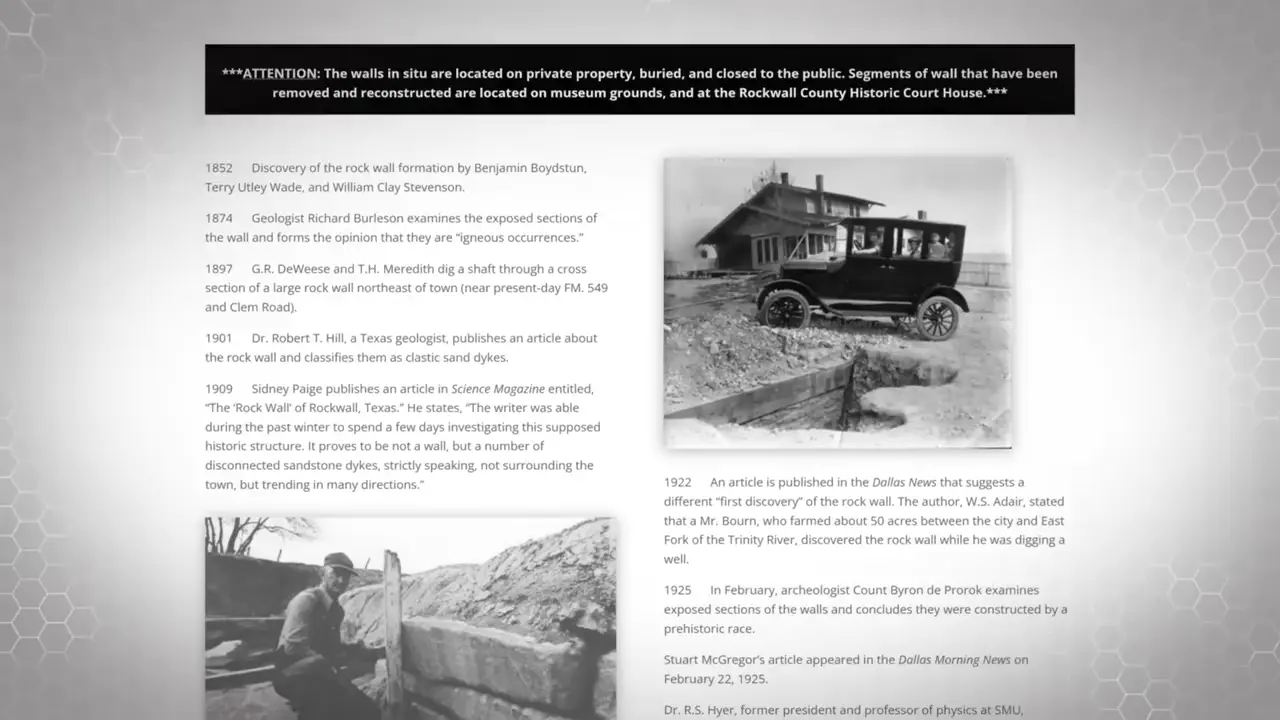
Scientists remain divided over Rockwall's origin. Geologist Robert T. Hill in 1901 identified it as natural sandstone dikes—vertical sheets of sediment filling ancient cracks. In 1925, archaeologist Count Byron de Prorok declared it prehistoric man-made construction. In 1979, UT-Arlington's Kenneth Schaar confirmed natural formation, while 1996 architect John Lindsey argued it showed evidence of human engineering.
Geological vs archaeological debate over Rockwall's origin
Site mentioned
📍 Rockwall
Key facts
- Geologist Robert Hill identified the formation as sandstone dikes - vertical sheets of sediment filling ancient cracks
- US Geological Survey and Smithsonian researchers in early 20th century concluded it was naturally formed disconnected sandstone veins
- In 1925, archaeologist Count Byron de Prorok examined the wall and became convinced it was a prehistoric man-made edifice
- In 1979, University of Texas at Arlington geologist Kenneth Schaar studied two sections and concluded they were naturally formed sandstone, but left room for uncertainty about unexamined portions
- In 1996, architect John Lindsey conducted a study arguing the formation showed evidence of being a prehistoric structure engineered by human hands
- No obvious artifacts, tools, or cultural remains have been documented in direct association with the wall
Sources
The Texas Rockwall Mystery - Hernando Sunhernandosun.com
This week, I am sharing a story of a place in Texas named Rockwall. It has a landmark, which is how the county got its name.
[PDF] Origin Of The Clastic Dikes In The Rockwall Area, Texasscholar.smu.edu
Since the first of many elastic dikes was discovered near Rockwall, Texas, in 1851. their origin has been a subject of much controversy.
The Mysterious Rock Walls of Rockwall, Texas - TodayIFoundOut.comtodayifoundout.com
Robert T. Hill classified them as clastic sand dykes, while in 1909, Sidney Paige agreed with Hill, and described the feature as “a number of ...
The Rock Wall of Texas - Skeptoid Podcastskeptoid.com
Then in 1901, the prolific Texas geographer Robert T. Hill, in the employ of the US Geological Survey, identified the walls as clastic dikes.
The Rock 'Wall' in Rockwall, Texas: Prehistoric Man, Extra ...texashillcountry.com
Dr. Robert T. Hill had concluded as far back as 1901 that the “wall” was, in fact, no more than a naturally formed sandstone dike.
Was this story useful?
Keep exploring
Every site on this page sits on the globe, and the people who research them are on the Discord.
3D Globe · Sites by country · Story Archive · Research Library · Weekly Journal · Search
AI-generated text · images from the original sources · always verify with the sources.