

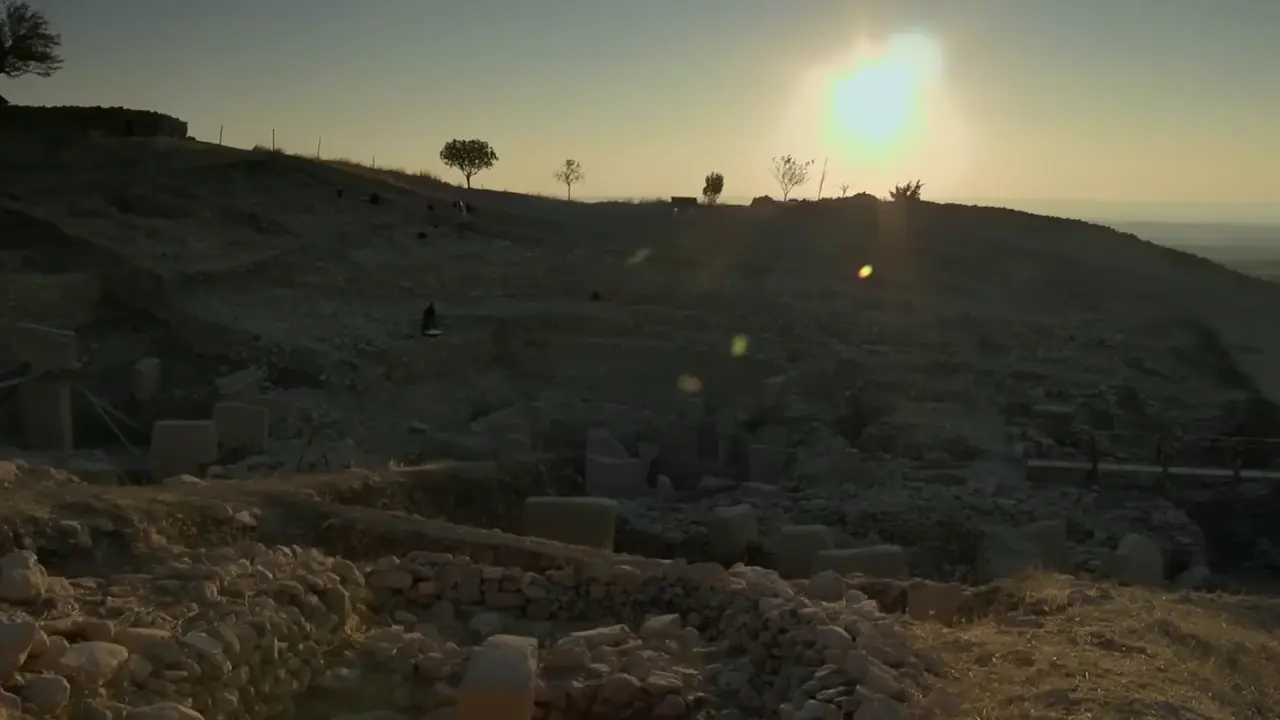
Göbekli Tepe's earliest monumental phase dates to about 9600 BCE, roughly 11,600 years ago. Identified during Klaus Schmidt's 1994 survey and excavated from 1995, the hunter-gatherer site predates Stonehenge by roughly 6,500 years. Its T-shaped limestone pillars reach about 5.5 metres and are often estimated at up to 20 tonnes. Some bear stylized arms and hands. The video compares them with Easter Island moai and links the site's motifs to worldwide imagery; those links are not established archaeological findings. The tell was deliberately backfilled, but the video's suggestion that this served as "a message" is not established fact.
Göbekli Tepe: Monumental hunter-gatherer site dating to around 9600 BCE
 TürkiyeGeneral
Key facts
- The earliest construction is generally dated to about 9600 BCE, roughly 11,600 years ago; the supplied results do not establish a single ±150-year margin.
- The site was identified in a 1994 survey led by Klaus Schmidt and excavated from 1995. The supplied results do not support attributing its discovery to shepherds.
- Stonehenge's main construction began around 3000 BCE, so the earliest Göbekli Tepe structures are roughly 6,500–6,700 years older.
- The builders are generally described as hunter-gatherers. The scholarly debate concerns the site's implications for social complexity, not whether it existed or its basic identification.
- The largest T-shaped limestone pillars are about 5.5 metres high and are commonly estimated at up to roughly 20 tonnes.
- Some pillars carry stylized arms and hands. The video argues that their pose matches Easter Island moai and that the motifs correspond with worldwide imagery; neither comparison is an established archaeological finding.
- The site was deliberately backfilled. The video suggests this may have been "a message", but no message purpose has been demonstrated.
Sources
Göbekli Tepe - Wikipediaen.wikipedia.org
Göbekli Tepe is a Neolithic archaeological site in Upper Mesopotamia (al-Jazira) in modern-day Turkey. The settlement was inhabited from around 9500 BCE to ...
The massive Turkish ruin that's 6,000 years older than Stonehengesaexpeditions.com
Dating back 11,500 years, Göbekli Tepe in southern Turkey – and a number of lesser-known sites in the Fertile Crescent – are rewriting the ...
Göbekli Tepe - UNESCO World Heritage Centrewhc.unesco.org
Göbekli Tepe is located in Upper Mesopotamia, a region which saw the emergence of the most ancient farming communities in the world. Monumental structures, ...
Göbekli Tepe (archaeological site) | Anthropology | Research Startersebsco.com
Göbekli Tepe is an ancient archaeological site located in Southeast Turkey, dating back to the Neolithic Era, around 11,500 to 12,000 years ago.
Gobekli Tepe: The World's First Temple? - Smithsonian Magazinesmithsonianmag.com
The megaliths predate Stonehenge by some 6,000 years. The place is called Gobekli Tepe, and Schmidt, a German archaeologist who has been working ...
The Tepe Telegrams - DAI Newsblogdainst.blog
What is Göbekli Tepe? — History, Significance & Discoverygobekli-tepe.com
The name means "Potbelly Hill" in Turkish — a deceptively modest label for the most important archaeological discovery of the past half-century.
Göbekli Tepe: The Mysterious Site Older Than Stonehengehistory.com
Gobekli Tepe is a monumental stone complex built more than 11000 years ago by hunter-gatherers in Upper Mesopotamia ...
Was this story useful?
Keep exploring
Every site on this page sits on the globe, and the people who research them are on the Discord.
3D Globe · Sites by country · Story Archive · Research Library · Weekly Journal · Search
AI-generated text · images from the original sources · always verify with the sources.