

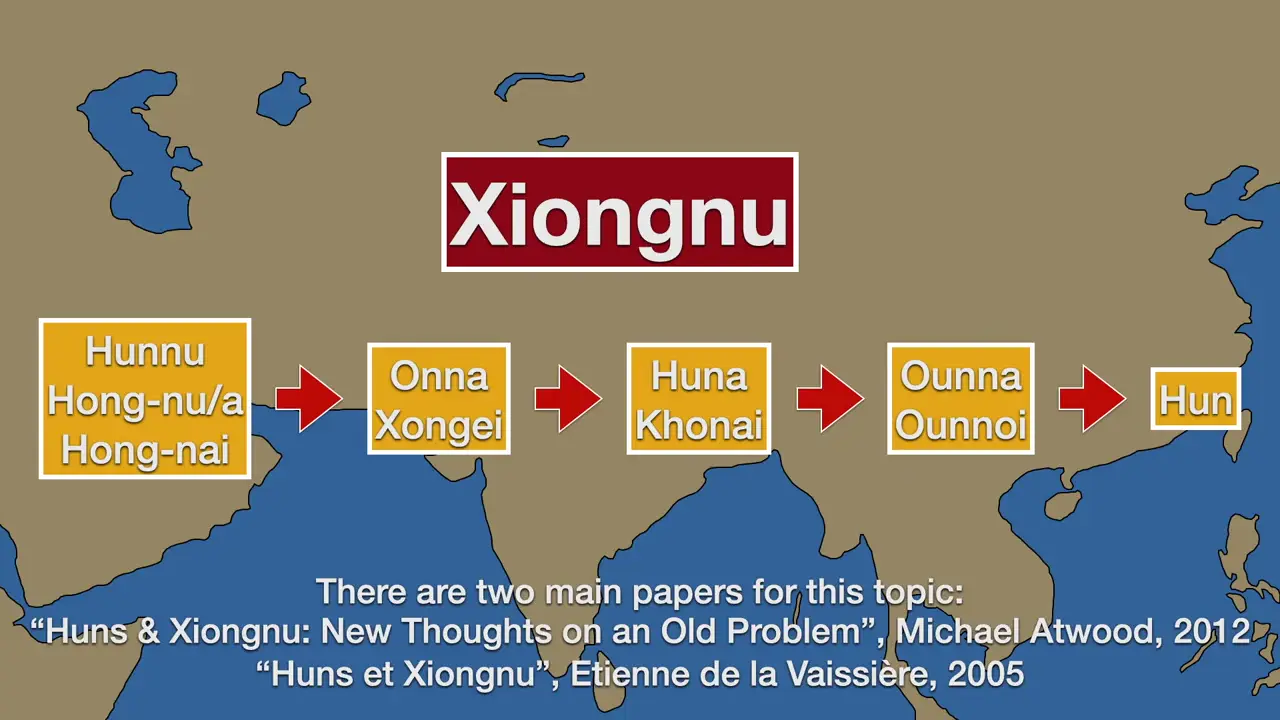
The Chinese term Xiongnu was likely pronounced something like 'honnu' or 'hungu,' and Greek/Sanskrit rendered it as 'Huna' via Caspian trade routes. One genetic marker links original eastern Xiongnu to later Huns invading Rome — though 'Hun' functioned as a political label in Central Asia, not necessarily ethnic identity.
Etymology and origins of the Xiongnu/Hun term in Central Asia
Key facts
- The Chinese term Xiongnu was likely pronounced something like "honnu," "hungu," or "hungai"
- The term "Hun" is best understood as a political term in Central Asian contexts, not necessarily indicating direct ethnic connection
- At least one genetic marker connects some of the original Xiongnu population on the eastern steppe to later Huns who invaded the Roman Empire
- Spread of Huna people out of Central Asia occurred around the mid-4th century, roughly corresponding to a period of drought and climatic and political turmoil on the Eurasian steppe
- Modern Chinese term Xiongnu was transliterated into Greek and Sanskrit as something like "Chonai" or "Huna," likely via Greek merchants dealing with these people around the Caspian
Sources
Automatic Reconstruction of Ancient Chinese Pronunciationsaclanthology.org
Our work significantly advances the digitization and computational reconstruction of ancient Chinese phonology, providing a more complete and temporally ...
How to pronounce Xiongnu in Mandarin Chineseforvo.com
Pronunciation guide: Learn how to pronounce Xiongnu in Mandarin Chinese with native pronunciation. Xiongnu translation and audio pronunciation.
Xiongnu (Hunnic) Shanyulanguagelog.ldc.upenn.edu
The current scholarly consensus is that the Modern Standard Mandarin (MSM) pronunciation should be chányú. Although it is much contested, the ...
Xiongnu = Huns? | History Forumhistorum.com
Standard Chinese (Mandarin), the name is spelled xiôngnú in the pinyin romanization system, but actually it is pronounced [ɕjuŋnu].
Xiongnuen.wikipedia.org
The Old Chinese pronunciation has been reconstructed as *xiuoŋ-na or as *qhoŋna according to Wang Li and Zhengzhang Shangfang respectively, the two most widely ...
Was this story useful?
Keep exploring
Every site on this page sits on the globe, and the people who research them are on the Discord.
3D Globe · Sites by country · Story Archive · Research Library · Weekly Journal · Search
AI-generated text · images from the original sources · always verify with the sources.