

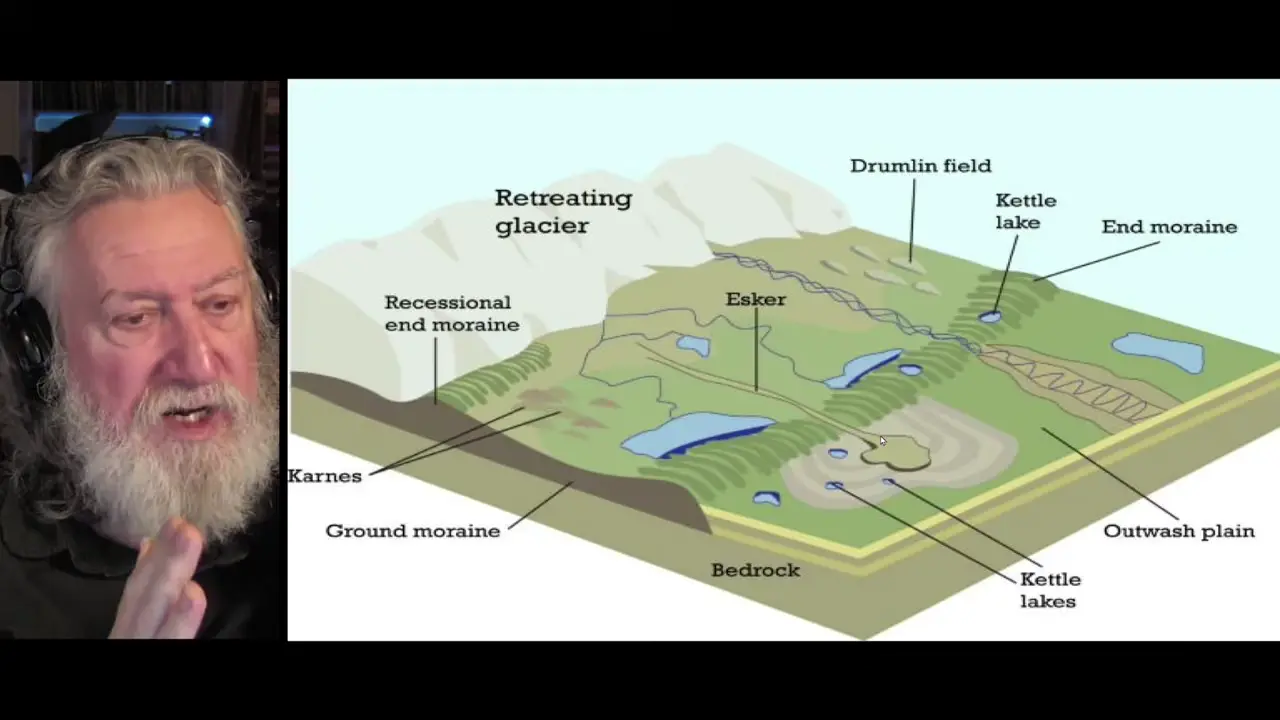
Eskers are sinuous ridges formed when meltwater flows through fractures between ice masses. As water slows, it deposits sediment in long, snake-like patterns. These features form confined within glacial margins then spread beyond terminal moraines during ice sheet collapse and breakup. 🏔️💧 21:30-24:30
Esker formation in subglacial fractures
Key facts
- Eskers form when meltwater flows through fractures between ice masses
- When the water slows, it deposits sediment in long, sinuous patterns
- Eskers are confined within glacial margins then spread beyond terminal moraines
- Eskers form during the collapse and breakup of ice sheets
- The formation involves both large-scale fracturing and melting of ice masses
Sources
Esker - Wikipediaen.wikipedia.org
An esker, eskar, eschar, or os, sometimes called an asar, osar, or serpent kame, is a long, winding ridge of stratified sand and gravel, examples of which ...
Esker - American Ground Water Trustagwt.org
A feature of glacial deposition, formed of sands and gravels which occur in elongated and often sinuous ridges. Eskers originate as deposits ...
How Are Eskers Formed? - Up Here Magazineuphere.ca
Scientists generally agree that eskers form from sediment deposited by meltwater as glaciers retreat.
eskers - Michigan State Universityproject.geo.msu.edu
Eskers --- long narrow winding ridges of stratified gravel, sand and silt. They formed under stagnant rather than moving ice.
Esker | Formation, Deposits, Processes - Britannicabritannica.com
Esker, a long, narrow, winding ridge composed of stratified sand and gravel deposited by a subglacial or englacial meltwater stream.
Was this story useful?
Keep exploring
Every site on this page sits on the globe, and the people who research them are on the Discord.
3D Globe · Sites by country · Story Archive · Research Library · Weekly Journal · Search
AI-generated text · images from the original sources · always verify with the sources.