

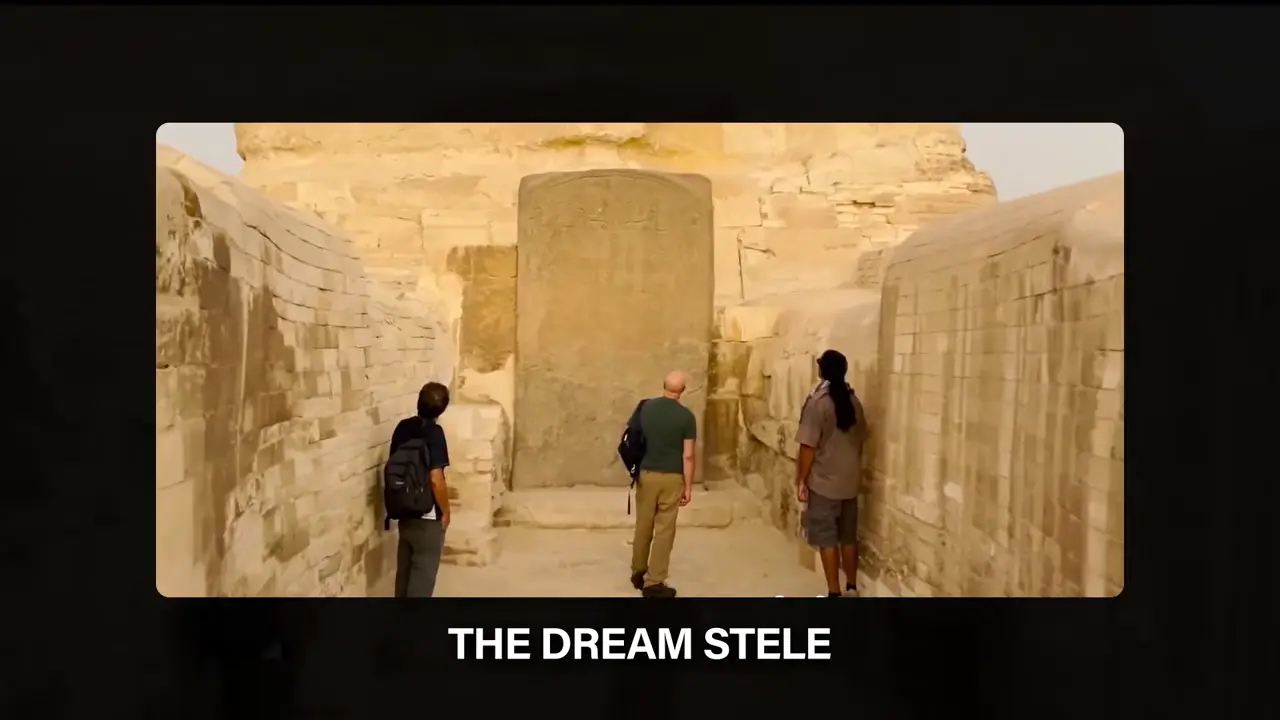
The Dream Stele sits between the Great Sphinx's paws, placed by Thutmose IV around the 1400s BCE. Two sphinx images appear at its top—some link this to Aker's twin guardian theology. Mainstream Egyptology sees both as the same deity, Hor-em-akhet, from east/west viewpoints. Thutmose IV himself appears twice on the stele too—Egyptian duplication didn't mean two physical objects existed!
Dream Stele of Thutmose IV shows dual sphinx imagery likely representing single deity
 EgyptArtifact
Key facts
- The Dream Stele is a large granite slab placed directly between the paws of the Great Sphinx by Thutmose IV during the New Kingdom, around 1400s BCE
- Two sphinx images appear at the top of the stele, which some interpret literally as matching Aker's twin guardian theology
- The text on the stele does not state that two physical sphinxes existed at Giza
- The mainstream Egyptological view holds that both images represent the same deity, Hor-em-akhet (Horus on the horizon), shown from east and west perspectives
- Thutmose IV himself appears twice on the same stele, demonstrating that multiple depictions in Egyptian art did not necessarily mean multiple physical objects
Sources
Dream Stela | Harvard Museum of the Ancient ...hmane.harvard.edu
Dream Steleen.wikipedia.org
Dream Stele (Sphinx Stela)ancientegyptonline.co.uk
Dream Stele of Thutmose IV — Lepsius (1849 - 1856)thegreatsphinxofgiza.com
Was this story useful?
Keep exploring
Every site on this page sits on the globe, and the people who research them are on the Discord.
3D Globe · Sites by country · Story Archive · Research Library · Weekly Journal · Search
AI-generated text · images from the original sources · always verify with the sources.