

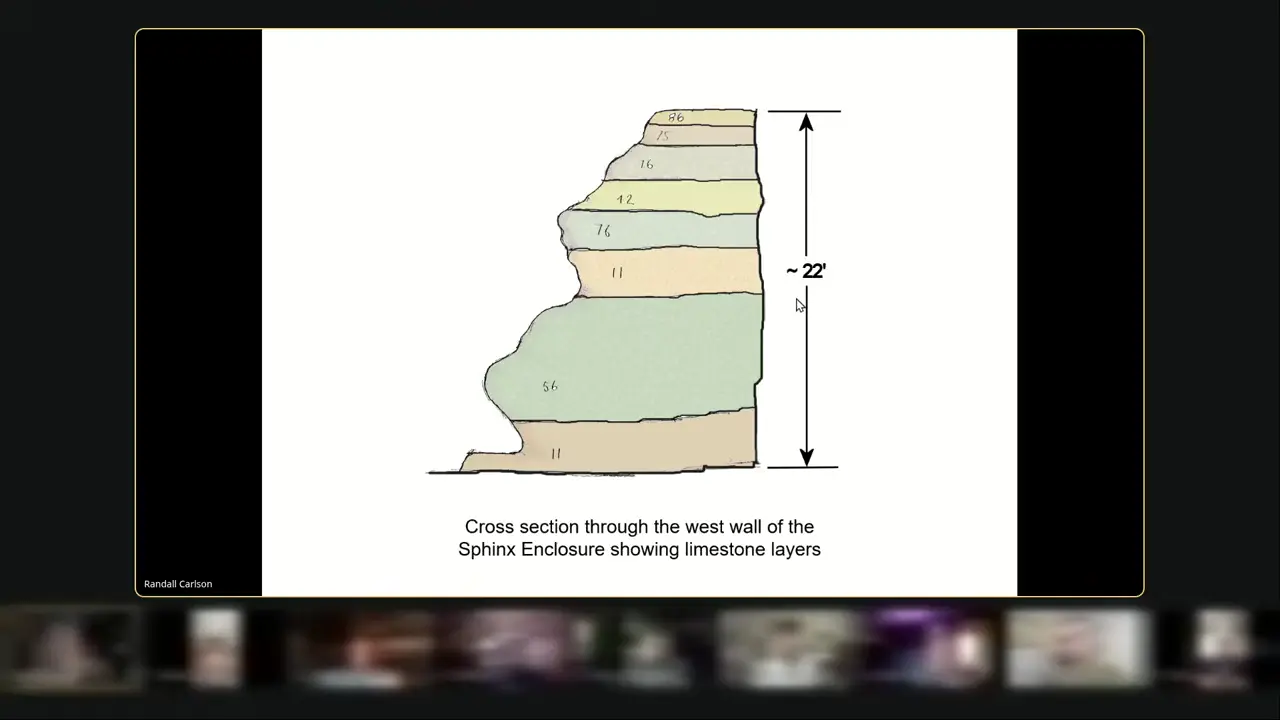
The west wall of the Sphinx enclosure rises about 22 feet above the enclosure floor. A published cross-section, with a quarry profile superimposed, is captioned as revealing extreme erosion; the video argues that the walls’ vertical fissures and rounded surfaces fit joint-guided dissolution. Limestone layers of varying hardness make uneven weathering expected, while cited geomorphology notes that acidic water dissolves limestone and concentrates flow along joints and fissures. Because the ground rises toward the west, runoff crossing the west wall would drain east toward the Nile. The presenter says archaeologists have generally ignored this issue in published work. ⛰️
Video argues Sphinx west wall erosion was guided by limestone joints
 EgyptTheory
Key facts
- The west wall of the Sphinx enclosure stands about 22 feet above the enclosure floor.
- A published cross-section of the west wall, with a quarry profile superimposed, is captioned as revealing extreme erosion.
- The wall includes limestone layers of differing hardness, so uneven weathering is expected.
- Cited geomorphological literature states that limestone dissolves readily in acidic water and that dissolution concentrates along joints and fissures, accelerating face recession.
- The video argues that the enclosure walls’ vertical fissures and rounded surfaces match a joint-guided dissolution pattern.
- Because the local topography rises toward the west, runoff crossing the enclosure’s west wall would drain eastward toward the Nile.
- The presenter says he has not seen archaeologists address this issue in published work and that it is generally ignored.
Sources
Robert M. Schoch: Research Highlights The Great Sphinxrobertschoch.com
The southern wall of the Sphinx Enclosure showing water (via rainfall) erosion. the current western end of the Sphinx Enclosure is at a much higher elevation ...
Scientists unearth protective walls around Sphinxnbcnews.com
Both walls stand just under 3 feet (1 meter). One runs north-south and is 282 feet (86 meters) long, while the other runs east-west and is 151 ...
Great Sphinx of Giza | Photos, Nose, Facts, Age ...britannica.com
The internal walls as well as those few outer-casing stones that still remain in place show finer joints than any other masonry constructed in ...
Sphinx water erosion hypothesisen.wikipedia.org
The Sphinx water erosion hypothesis is a fringe claim, contending that the Great Sphinx of Giza and its enclosing walls show erosion consistent with ...
The Great Sphinx of Egypt: Nature's Shabby-Chic Trick?geoexpro.com
the southern enclosure wall, when carved, was perfectly aligned along the straight west-north-west to east-south-east running Causeway
Was this story useful?
Keep exploring
Every site on this page sits on the globe, and the people who research them are on the Discord.
3D Globe · Sites by country · Story Archive · Research Library · Weekly Journal · Search
AI-generated text · images from the original sources · always verify with the sources.