

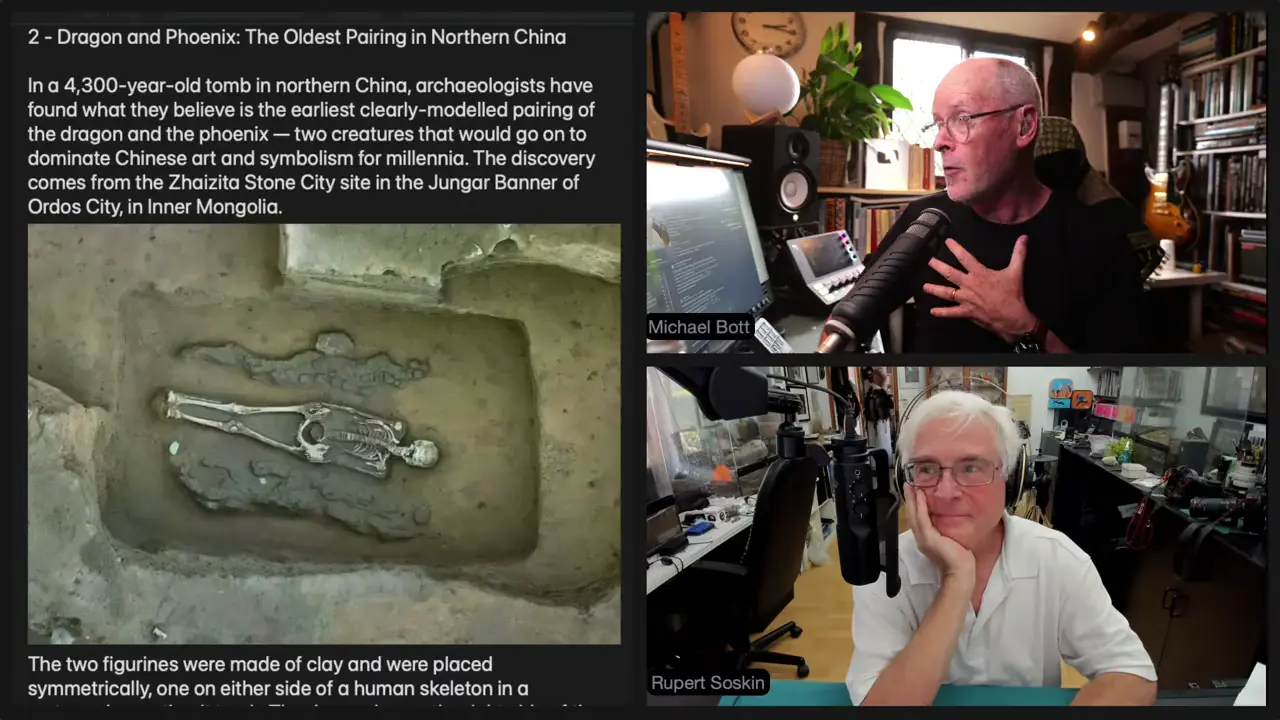
A 4,500-year-old Laushan culture tomb at the Jaisa stone city site in Inner Mongolia held two clay figurines placed symmetrically beside a human skeleton — a dragon on the right, oriented with the body, and a phoenix. Archaeologist Sun Jingong calls these the earliest clear dragon-phoenix pairing from northern China, rendered as 3D sculptures.
Dragon and phoenix clay figurines found in 4,500-year-old northern Chinese tomb
Key facts
- Tomb discovered at the Jaisa stone city site in Jungore Banner, Inner Mongolia
- Two clay figurines found placed symmetrically on either side of a human skeleton in a rectangular earth-pit tomb
- Dragon placed on right side of the deceased with head oriented the same direction as the body
- Radiocarbon dating places burial in the Laushan culture, around 2,300 BCE
- Lead interpreter: archaeologist Sun Jingong, who describes the figures as the earliest clearly modeled dragon-phoenix combination from northern China
- Creatures rendered as three-dimensional sculptures rather than relief on ceramics, making identification unusually secure
- Dragon and phoenix pairing carried meanings of power/sky and grace/rebirth/empress respectively in Chinese tradition
- Tomb interpreted as belonging to a high-status individual
Site mentioned
📍 Jaisa stone city site
Keep exploring
Every site on this page sits on the globe, and the people who research them are on the Discord.
3D Globe · Sites by country · Story Archive · Research Library · Weekly Journal · Search
AI-generated text · images from the original sources · always verify with the sources.